%20(3).png)
Fractional COO Rates: The Honest Math, Including What You'll Pay After the Retainer
- Daniel Madhan
- Jul 1
- 7 min read

Most business owners look at one number when comparing fractional COO rates the monthly bill. That makes sense. It's the most obvious cost, but it's rarely the full picture.
Here's the thing: when you bring in a Fractional COO, the retainer fee is just your starting point. There are other costs that quietly stack up behind it the ones that don't show up on a single invoice but absolutely affect your bottom line.
This guide breaks all of it down in simple English. No corporate jargon, no sugarcoating. Just a clear, honest look at what hiring a Fractional COO actually costs you from start to finish.
Fractional COO Rates: The Sticker Prices (What Every Guide Stops At)

When you start looking into hiring a fractional COO, these are the numbers you'll usually see:
Hourly rate: $175–$500/hour
Monthly retainer: $5,000–$25,000/month
Day rate (projects or off-sites): $1,200–$2,500/day
Project-based (90-day turnarounds): $25,000–$60,000
Model | Typical Investment |
Hourly | $175–$500/hour |
Monthly Retainer | $5K–$25K/month |
Day Rate | $1,200–$2,500/day |
Project-Based | $25K–$60K per 90 days |
What Your Fractional COO Retainer Actually Buys

Paying $10,000 a month feels like a big commitment and naturally, you'd expect serious, dedicated support in return. But here's what's really happening behind the scenes.
That retainer typically buys you a fixed block of hours. And here's the catch those hours are often split between three or four other businesses just like yours. In practice, you're getting a couple of check-in calls each week and the ability to send messages via email or Slack.
But the bigger surprise comes when you dig into what that fee doesn't cover.
Most fractional COO pricing packages leave out what are called "hard costs." These are the real, tangible expenses that come with actually doing the job. Things like software tools, travel to attend your quarterly planning meetings, and any admin support the COO needs to operate effectively. All of that gets added to your bill separately.
Hence, when you do the math, you're not just paying for someone's expertise and time. You're also quietly funding the entire setup they need just to show up and do the work.
The Hidden Costs Behind Fractional COO Rates

Most consultants don't just show up and get to work. They come with a shopping list and that's exactly where your real costs start creeping up.
The Tech Stack: Almost every fractional COO will push you to buy new software tools for managing projects, tracking data, or handling HR tasks. These sound helpful, but the subscriptions add up fast. You could easily spend between $3,000 and $15,000 every single year just keeping these tools running.
Support Staff: Many fractional leaders will tell you they can't do their job alone. They'll ask for a project manager or analyst to assist them. That's a fair request but it costs you an extra $2,000 to $5,000 every month on top of what you're already paying.
Recruitment Fees: When a fractional COO spots a gap in your team, their go-to solution is usually hiring someone new. You'll likely pay a recruiter to find that person, and recruiters typically charge 20% of the new hire's first-year salary. That's anywhere from $15,000 to $40,000 per hire.
Add all of this together, and your total bill can quietly double.
The Real Fractional COO Cost AFTER the Retainer Ends (what nobody writes about)

Here's something most people don't talk about. What happens when the contract is over?
The second your fractional leader walks out the door, you're in trouble. Think of them like the glue that holds everything together. They knew your systems, processes, and quirks. When they leave, all of that knowledge leaves with them.
You're now stuck running a machine that only one person knew how to operate and that person is gone.
So what do most companies do? They panic-hire a full-time director just to keep things from falling apart. We're talking a salary somewhere between $80,000 and $150,000 a year.
People look at the retainer fee and think that's the total bill it's not. The true cost is the retainer plus the salary of the replacement you were forced to hire after the retainer is gone.
The true cost is the retainer plus the salary of the replacement you were forced to hire after the retainer is gone.
The fractional model can work, but if there's no proper handoff or knowledge transfer built in, you're not saving money. You're just delaying a bigger expense.
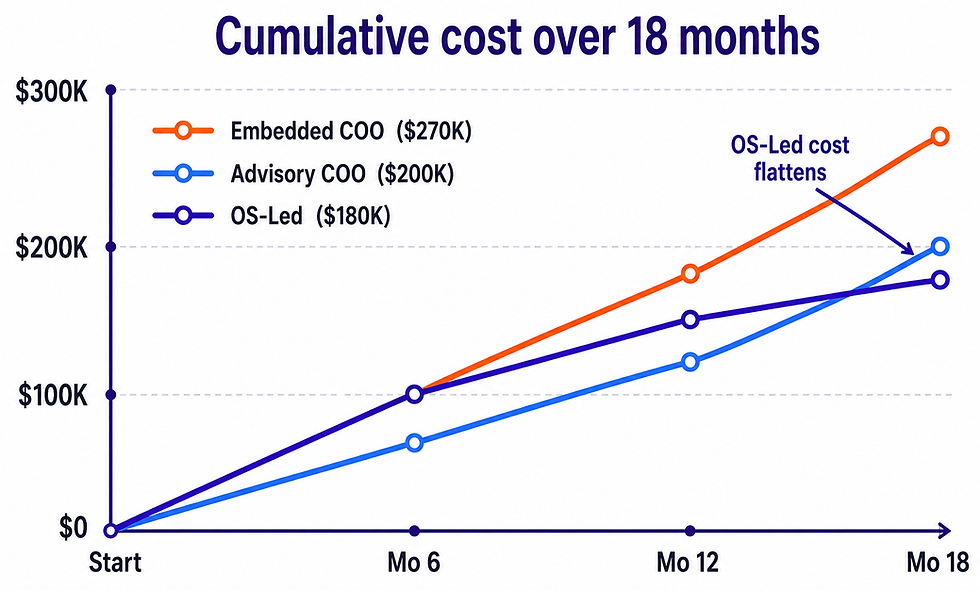
Three Fractional COO Cost Scenarios Over 18 Months (the math nobody shows you)
Let's talk real money. Most companies won't show you these numbers because the truth is uncomfortable. Only one model the "Operating-system-led" approach actually stops your costs from growing forever.
Scenario | Setup Cost | Mo 1–6 | Mo 7–12 | Mo 13–18 | Total |
Advisory COO | $0 | $60K | $60K | $80K* | $200K |
Embedded COO | $30K | $90K | $90K | $90K | $270K |
OS-Led | $30K | $90K | $60K | $30K | $180K |
Advisory: You pay a consultant for advice and ideas. But here's the problem nothing gets built. No tools, no processes, no systems. Eventually, you have to hire a full-time employee just to do the work the consultant described. Now you're paying twice.
Embedded: The consultant moves in and never leaves. Month after month, the big invoices keep coming. You grow dependent on them. Your team never learns to run things independently. You're stuck.
OS-Led: You pay once to build something a real system with software and clear processes. Once it's running, it runs itself. You stop needing expensive outside help because the system does the heavy lifting daily.
Why an Operating-System-Led Model Is Structurally Cheaper
An operating system, like a specialized EOS-aligned platform, typically costs between $200 and $400 per month. That price stays the same no matter how busy things get inside your business.
Here's why that matters: when the rules and processes are built directly into the software, your team always knows what to do. The system itself keeps everyone on track. You don't need to hire an expensive consultant to show up every week and remind people of their responsibilities. The software does that job automatically.
Think of it this way with a traditional consultant, you're paying for their time. The moment they stop showing up, the guidance stops too. But with an operating system, you're paying for something that keeps working in the background all the time, whether anyone is on a call or not.

There's another big advantage here. When a consultant leaves, they take all their knowledge with them. With a software-based system, everything is stored inside the platform. The processes, the accountability, the structure it all stays with your business permanently. That's a much smarter long-term investment.
How to Ask About Fractional COO Tail Costs Before Signing

Most people interview agencies by asking about their process. That's the wrong question. What you really need to ask is how they plan to leave.
Here are three questions that will tell you everything:
"When our contract is over, what tools or systems will still be running so I can manage things on my own without having to hire someone expensive to DD replace you?"
"Are there any extra tools or people I'll need to pay for just to keep your way of doing things going?"
"If I cancel in 12 months, what happens to everything you built inside my business?"
Pay close attention to how they answer. If they say something like, "We'll cross that bridge when we come to it" that's a red flag. It usually means they haven't thought about it, or worse, they don't want you to think about it.
A trustworthy agency should be able to clearly explain what happens after they leave. They should be building things that make you more independent over time not more dependent on them. If they can't show you a path to where you won’t need them, you're probably walking into a contract that never ends.
A Note on Geography and Remote Fractional COO Rates

Where your fractional COO lives can have a big impact on what you pay them. It's one of the most overlooked factors when budgeting for this kind of hire.
Consultants based in the US typically charge 20–30% more than others. Why? It’s because they're dealing with higher living costs, office expenses, and a market that simply expects those rates. It doesn't always mean they're better it just means the price tag is higher.
On the flip side, fully remote consultants even the really talented ones are starting to charge less. You can find top-tier remote professionals working in the $200–$350 per hour range, which is much more manageable for growing businesses.
There's also a newer model worth knowing about. Some firms are set up so that a US-based founder handles the strategy, while a skilled team in India or Latin America takes care of the day-to-day operational work. These teams are highly trained and experienced they just happen to be based somewhere with a lower cost of living. By doing this, you could cut your total costs by 30–50% without seeing any drop in the quality of work delivered.
FAQs
What's a fair Fractional COO hourly rate in 2026?
For a high-level, US-based strategist, $250–$350 is standard. If you are paying $500/hour, you are paying for a "celebrity" consultant who is likely not doing the actual execution.
Why are Fractional COO rates so variable?
Rates vary because they are not selling time, but are selling leverage. A COO who manages $50M in revenue will charge more than one managing a $2M startup because the cost of a mistake in the larger company is exponential.
Is a monthly retainer cheaper than hourly?
Usually, yes, if you have consistent needs. Hourly rates are often punitive to encourage you to sign a long-term agreement. However, ensure the retainer comes with a clear "off-ramp" strategy.
What's the total cost of a Fractional COO over 18 months?
As shown above, expect to budget at least $180K–$270K when you include the "tail costs" of software, support, and necessary permanent hires.
Most Fractional COOs leave when the retainer ends. ShiftFocus stays because the software stays. [Book a 30-min diagnostic]


Comments