%20(3).png)
OKR Software That Keeps Goals Moving After They Are Set

Updated: Sep 29
You've probably experienced this: your team walks out of a quarterly planning session feeling energized, goals clearly defined, then two months later, nothing has moved. That gap between setting goals and actually following through is where most strategies quietly fail.
OKR software exists to close that gap. Instead of treating your goals like a document you revisit once a quarter, it keeps them visible every single week. You can see what's progressing, what's stalling, and where your team needs to redirect effort before it's too late to course correct.

What should OKR software actually do?

Think of OKR software not just as a place to store your goals, but as the main engine that drives your daily strategy. A good OKR platform is all about setting big Objectives, defining clear Key Results, and making sure everyone on your team stays responsible not just the leaders.
The right tool does more than just hold your goals. It actually makes sure you and your team follow through. Here’s what it should do for you:
Set and link goals: It connects your company’s top-level goals to everyday tasks. This way, every team member can easily see how their own work fits into the bigger picture.
Run weekly execution: It encourages regular check-ins throughout the week, rather than waiting for quarterly reviews. That way, progress never stalls in silence.
Identify risk: It alerts you when goals are falling behind, so you can catch issues early before they turn into bigger problems.
Trigger management action: If a goal is in trouble, it helps you respond clearly and with real data not just a simple warning.
Preserve learning: It lets you record why a goal was missed, so you can apply those lessons to the next planning cycle instead of forgetting what happened.
Why do most OKR dashboards become goal repositories?

Most teams start each quarter with a lot of excitement. Everyone logs in to the OKR platform and writes down their goals, and for the first couple of weeks, people are actively looking at progress and discussing priorities. Then, somewhere around the fourth week, that excitement starts to disappear.
The reason is simple. The OKR dashboard is no longer a tool that assists people in managing their daily work, but simply a repository for goals. Someone updates a progress bar once a month, not because they carefully measured the results, but because the number is close enough. No one objects to the update. No budget changes, no additional meetings, no shifting of people or resources based on the dashboard.
Once the team realizes that updating the system has no real impact on decisions or daily work, they slowly stop paying attention to it. The final result is that the dashboard becomes a management tool. It turns into a tidy list of objectives that all parties agreed to at the start of the quarter, but no one owns them now.
▍ REPOSITORY VS ENGINE
Behaviour | Static goal dashboard | ShiftFocus execution OS |
Weekly updates | A slider nudged once a month | Evidence + a confidence score, required |
Risk | Surfaces at quarter-end | Drift flagged in week three |
Blockers | Noted, then forgotten | Escalated automatically as they age |
Decisions | No budget or people move | Triggers a corrective action with a deadline |
Ownership | Agreed, then orphaned | One accountable owner per Key Result |
Set and align company, team, and individual OKRs
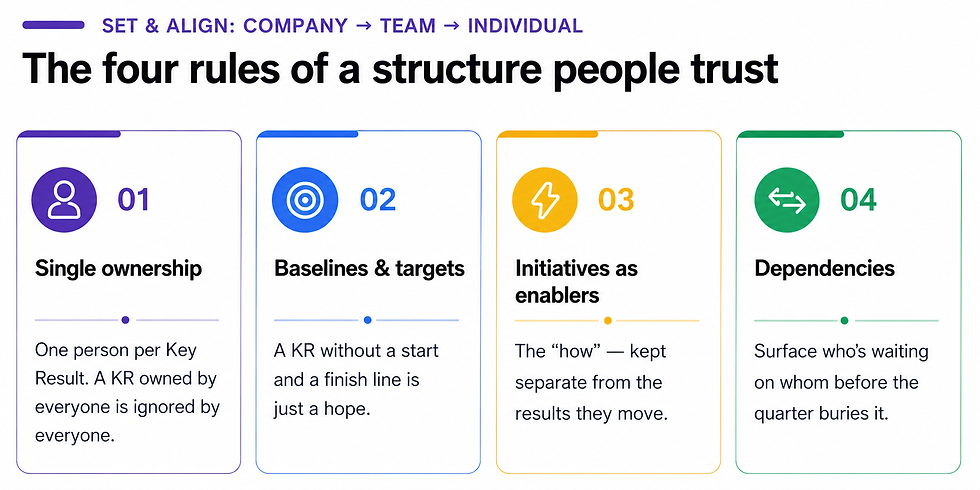
A truly helpful OKR app makes things clear from the very beginning. You need a clear goal structure where the reason behind every task is obvious, not hidden or guessed at.
When you're putting this system together, a few things are must-haves:
Single Ownership: Never give one goal to a group. If a Key Result is assigned to everyone, it usually ends up being ignored by everyone. Each KR must have one specific person who is responsible for keeping it up to date.
Baselines and Targets: A Key Result without a starting point or a clear finish line is really just a hope. Set your baseline right at the start, not in the middle of the quarter.
Initiatives as Enablers: Initiatives are your "how" the actual work and projects you're doing to move the numbers. Keep these separate from the results themselves, or you'll lose sight of what's actually affecting what.
Dependencies: Use the tool to point out when Sales is depending on something from Marketing. Bringing that link out into the open early on stops cross-team problems that would otherwise stay hidden until the quarter is nearly finished.

Run weekly OKR execution without chasing status

If you're still sending out "any updates on this?" emails manually, then the software isn't doing its job. It ought to replace those manual check-ins with something automated.
Good OKR software relies on updates backed by real evidence. Instead of just moving a slider to 50%, the owner should have to include a confidence score and something concrete to support it a link, a number, anything real.
If a project hits a stumbling block, they should be able to flag that immediately, right in the same place. That changes the whole conversation from "are you finished yet?" to something much more helpful: "what do you actually need from me to remove this block?"
Detect drift before the quarter-end surprise
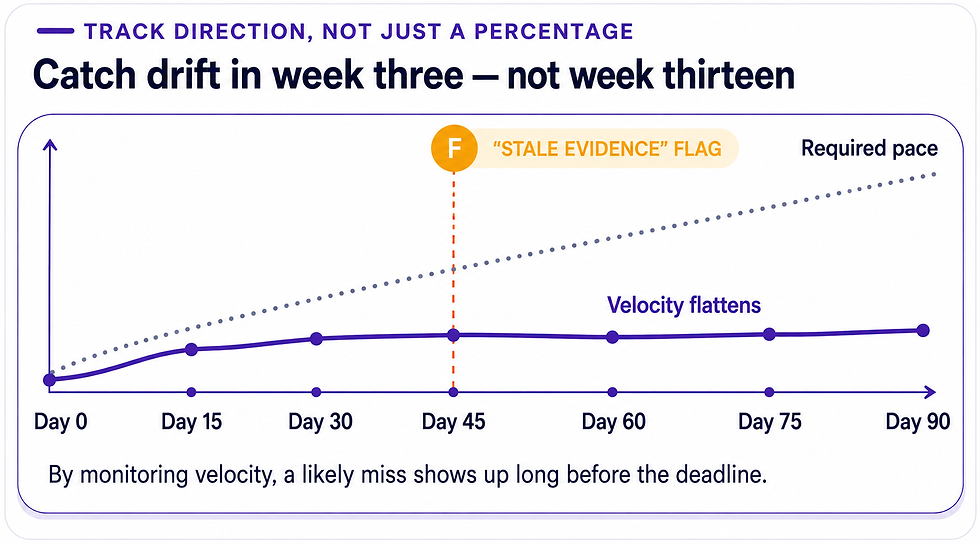
Nothing is more dangerous in any organization than a quiet miss, one that no one is expecting because nobody was paying close enough attention. The idea is to identify drift in week three, not in week thirteen. Find software that tracks progress direction, not just a percentage.
If a team is 90 days into a goal and still has not made real movement by day 45, the system should raise a "stale evidence" flag. That is not about watching people too closely it is simply the numbers. By monitoring velocity, you can get a good idea of which goals are likely to be missed well before the deadline. So if it continues to drop as the deadline nears, then that's typically the first sign you'll receive.
Intervene, escalate, and track recovery

What good is it if you see a problem brewing and you do nothing about it? The platform should seek a real recovery plan, not another alert, after a goal is marked as at risk.
A simple warning is not good enough. A good OKR platform will assign an owner to the issue and will mandate a corrective action with a clear deadline. When a Lead Generation KR starts to slip, the system should require a commitment from the owner to make a change, like increasing ad budget or adding a new team member, and also documenting these efforts.
Over time, that builds a recovery record, which is very useful when coaching people through course corrections while there's still time to make a difference.
Executive Reporting That Leads To Decisions

You shouldn't have to dig through complicated menus just to see if your company is doing well. Your dashboard should give you a big-picture view of your portfolio's health one clear screen that quickly shows you which strategic goals are on track and which ones need your attention right now.
A good executive report should show you:
The "Required Action" list: This isn't just a progress update. It's a short, focused list of goals that require a real decision from you this week not just data to skim over and forget about.
Dependency Maps: These visuals show you when one team is blocked by another. When work slows down, it's often because of a holdup between teams, not an issue inside a single team. This map helps you see the problem right away.
Historical Trends: This shows you how often a particular team has missed its goals in the past and gives you clues about why. Over time, you begin to notice patterns, so you can address the root cause instead of reacting to every miss as a one-time event.
Integrations, security, and implementation

Your OKR software needs to work smoothly with the tools your team already uses every day. If it doesn't connect with Slack, Microsoft Teams, or your project management system like Jira, Asana, or others people will stop using it within a month, and they won't tell you why.
A 90-day rollout usually works best: use the first 30 days to test with a small group, the next 30 days for training and connecting your existing tools, and the final 30 days to roll it out across the whole company and make sure everyone is using it.
Also, double-check that your provider can really deliver on SSO and data-residency promises. If your goal data isn't properly protected, your IT team will likely block the whole transparency effort before it even has a chance to get started.

Who ShiftFocus is best for
This level of structure is appropriate for organizations that have matured beyond the "figure it out as we go" mentality and require something that can scale. It's for companies that are already on a quarterly cadence and are seeing that their process is generating more reports than results.
The more departmentally dependent the goals are (meaning multiple departments need to move in tandem to achieve the number), the more the structure a real OKR platform provides you becomes important.
Who should choose a simpler tool?
If you're a five-person team that solves most problems by walking across the room and talking, don't weigh yourself down with enterprise-grade OKR software tools. What you need is speed, not a maze of permissions and dependency mapping.
And if your team isn't ready for the discipline of weekly check-ins yet, a lighter tool (or even a well-kept spreadsheet) will get you by until the culture is ready for something heavier.
▍ WHO SHIFTFOCUS IS BUILT FOR
Choose a structured OKR platform when… | A simpler tool is enough when… |
You're already on a quarterly cadence | A five-person team that talks across the room |
Goals span multiple departments | Speed matters more than dependency mapping |
You're producing more reports than results | You're not ready for weekly check-in discipline |
Numbers need several teams moving in tandem | A well-kept spreadsheet still gets you by |
FAQs
What is OKR software?
OKR software is a solution designed to help you create, monitor, and track your Objectives and Key Results. Think of it as more than just a to-do list. A regular task manager will help you cross off tasks, but OKR software is about strategic alignment.
It translates your executives' high-level objectives into the work you and your team perform on a daily basis. So each job you do is directly tied to a measurable result that is important to the business. It gives you clarity on what you're working toward and why it's important.
What is an OKR management system?
An OKR management system is the process and the tool together: how you set objectives and key results, who owns each one, how often you check in, and what happens when a goal slips. OKR software is the tool part. The system only works when the tool enforces the rhythm, with weekly check-ins, one owner per key result, and alerts when progress stalls.
Is an OKR tracker the same as OKR software?
Not quite. An OKR tracker, often a spreadsheet or a simple app, records goals and progress. Full OKR software also runs the weekly check-in, flags risk early, escalates stalled key results, and keeps a record of what was fixed. If you only need a list, a tracker is enough. If goals keep slipping mid-quarter, you need OKR software.
What features should OKR software have?
When selecting OKR software, consider these essential features for a smoother experience.
The first is automated weekly check-ins, which save you time and help you stay on track.
Secondly, visual alignment maps that help you see exactly how your goals relate to the overall team and company goals.
Third, every Key Result must have one owner and only one, which means that responsibility is clear and that there is no confusion about who is responsible.
Fourth, risk-flagging analytics that alert you when a goal is slipping.
Lastly, seamless integration with your daily tools, such as Slack or Microsoft Teams, so you don't need to switch back and forth between apps all day long.
Is OKR software better than a spreadsheet?
In most cases, yes. Spreadsheets are ideal for a simple list, but spreadsheets don't have "state awareness". That is, they will not warn you when progress slows, they will not show you how the goals of various teams are related to each other, and they will not remember what you did when things went off track.
OKR software provides automatic notifications, goal connections visibility, and a complete history of adjustments. This will help you to be proactive and not reactive and this is important for you to be able to meet your targets.
▍ SPREADSHEET VS OKR SOFTWARE
Capability | Spreadsheet | OKR software |
State awareness | None | Warns you when progress slows |
Cross-team visibility | Manual, if at all | Shows how team goals connect |
Memory of changes | Lost across versions | A full history of adjustments |
Posture | Reactive | Proactive |
How much does OKR software cost?
The price of OKR software usually depends on the number of users. For basic tools, you might pay just a few dollars per user each month. Other features, like detailed analytics and dedicated support add to the cost, especially for enterprise-sized contracts. It is advisable to start with a plan that fits your current team size and budget, and then add more as your needs increase.
How long does implementation take?
The typical OKR software implementation process takes about 90 days. This allows you to run a pilot program with a small group, get the tool into your existing workflow, and train your managers on how to conduct effective check-ins and recovery talks. The aim is to gradually introduce the new system to ensure everyone is at ease and confident in using it.
Can OKR software integrate with Slack or Microsoft Teams?
Yes, there are native integrations with Slack and Microsoft Teams on most reliable OKR platforms. This allows you to get reminders about progress, update your Key Results, and mark any blockers directly in the chat app you already use. No need to open a new browser window or tab. You will be able to work without any interruptions.
ShiftFocus OS the execution layer for OKRs
Predict failures 2–3 weeks early. Escalate automatically. Recover on time.


Comments