%20(3).png)
The Fractional COO Buyer's Guide Nobody Will Give You (Because They're Selling)
- Daniel Madhan
- Jul 2
- 7 min read

Here's something most people don't realize: nearly every guide about hiring a fractional COO is written by someone who profits from selling you one. That's a massive conflict of interest. Companies like Toptal, ScaleUpExec, and GCE all want your business. So naturally, they'll paint their service as the ultimate solution to your problems.
This guide is different. ShiftFocus builds software. We don't sell fractional COOs. We don't earn referral fees, and we have nothing to gain from your decision either way. That means this is one of the few times you're getting genuinely unbiased advice.
The Conflict of Interest in Every Fractional COO Guide You've Read
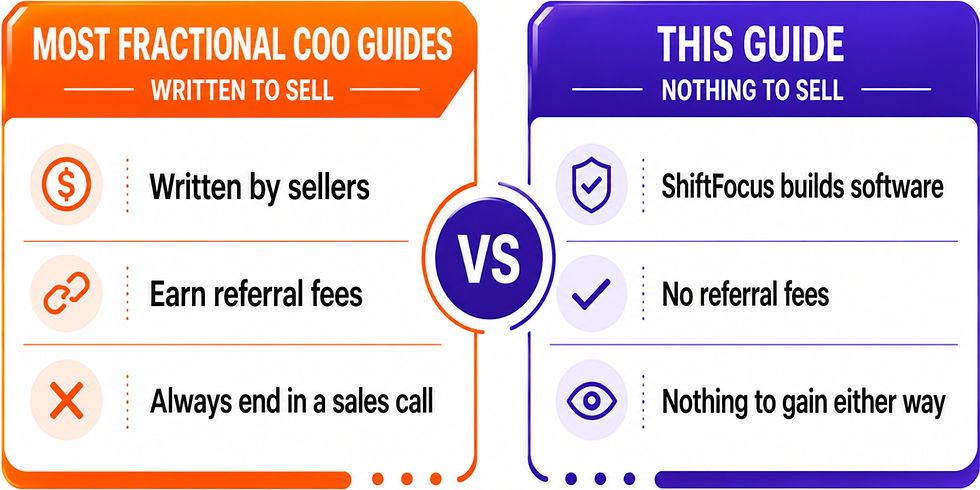
Go ahead and Google "fractional COO guide" right now. Every single result at the top comes from a company actively selling fractional COO services. Their articles are packed with glowing benefits, cherry-picked success stories, and helpful-sounding advice that somehow always end with booking a call.
Nobody is deliberately deceiving you. It's just how money shapes the message. When your income depends on COO retainers, you're never going to write an honest article telling people they might not need one.
Five Signs You Actually Need a Fractional COO
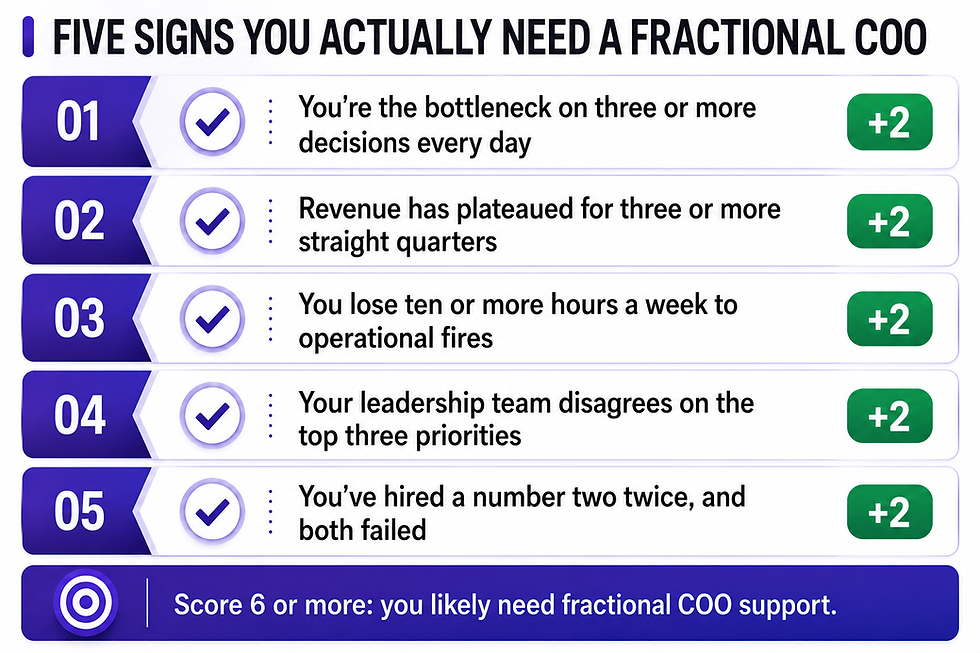
Here are the five signs that you actually need a fractional COO:
You're the bottleneck on three or more decisions every single day
These aren't big strategic calls. They're little things like approving a small discount, answering a vendor question, or handling an HR issue that should never reach your desk. When your team can't move without checking with you first, your entire business structure has a problem. Simply deciding to "delegate more" won't solve it.
Revenue has plateaued for three or more consecutive quarters
Sales aren't the issue. The real problem is that your operations can't physically handle more customers without everything starting to break.
You're losing ten or more hours weekly to operational fires instead of growth
Track your time for one week. Most founders are genuinely shocked at the results.
Your leadership team disagrees on the company's top three priorities
Ask each person separately. Different answers mean you have a communication and clarity crisis, which is fundamentally an operations problem.
You've hired a "number two" twice, and both failed
This rarely means you hired badly. It almost always means there's no clear structure for anyone to actually step into.
Signal Indicator | Impact Score |
Bottleneck on 3+ decisions/day | 2 |
Revenue stalled 3+ quarters | 2 |
10+ hrs/week lost to ops | 2 |
Team can't name top 3 priorities | 2 |
Two failed hires | 2 |
Score 6+: You likely need fractional COO support. Score under 4: Keep reading.
Five Signs You Don't Even If It Feels Like You Do
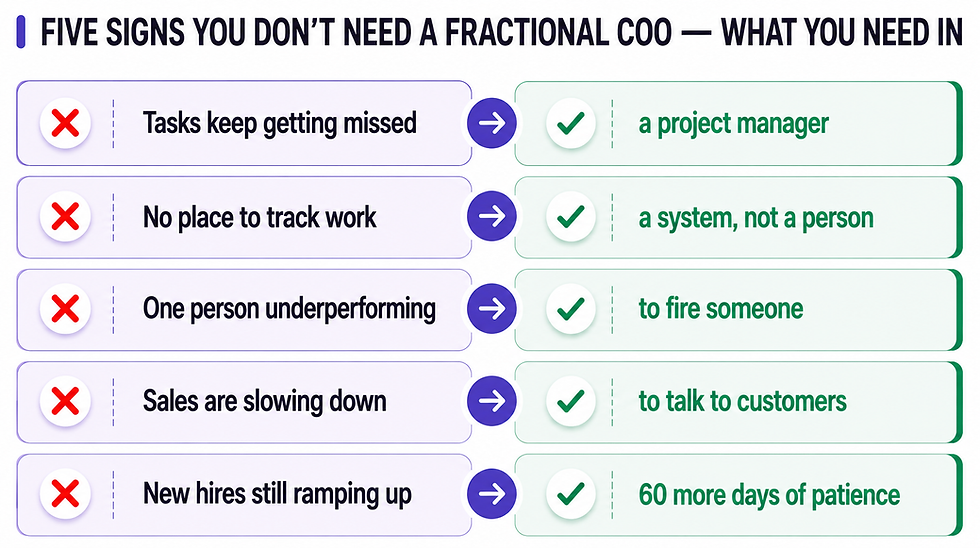
You need a project manager, not a COO
If tasks keep getting missed or forgotten, that's a project management issue. It's a waste of money to hire a fractional COO at $10K per month to follow up on to-do lists.
You need a system, not a person
Sometimes your team already knows their jobs they just have no clear place to track work or share updates. If you add another person without fixing that structure, it will only cause more confusion.
You need to fire someone
This is uncomfortable, but it's true. A lot of operational chaos actually comes down to one person not doing their job well. You likely already know who it is.
You need to talk to your customers more
If sales are slowing down and you haven't spoken to customers in months, no operations hire will fix that. The actual issue may be that your product is not what people are actually looking for.
You need 60 more days of patience
Sometimes, businesses simply have a rough patch new employees getting up to speed, new products getting off the ground. Adding another person to that chaos, without a clear plan, can make things worse, not better.
What a Fractional COO Actually Costs in 2026
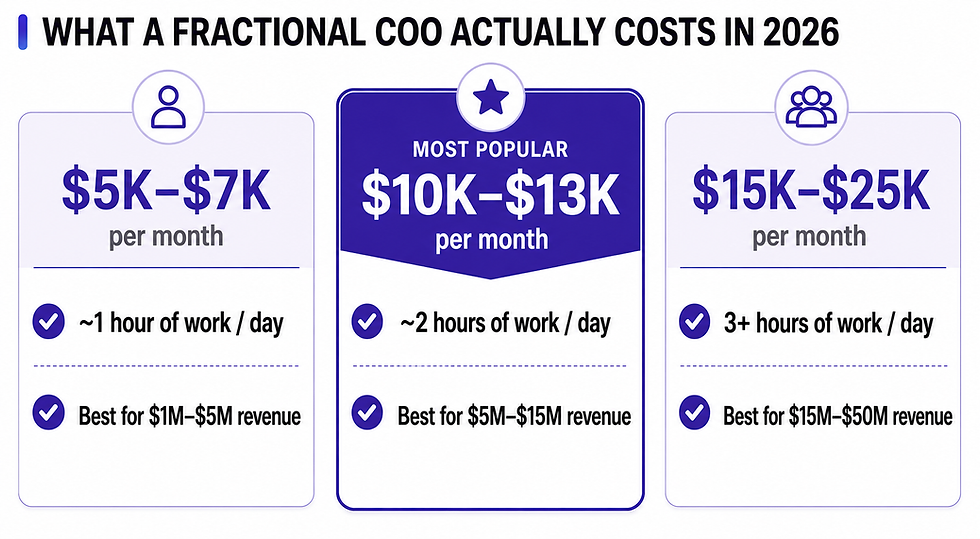
These numbers are directly from published rate cards at ScaleUpExec, GCE, and Trinity One.
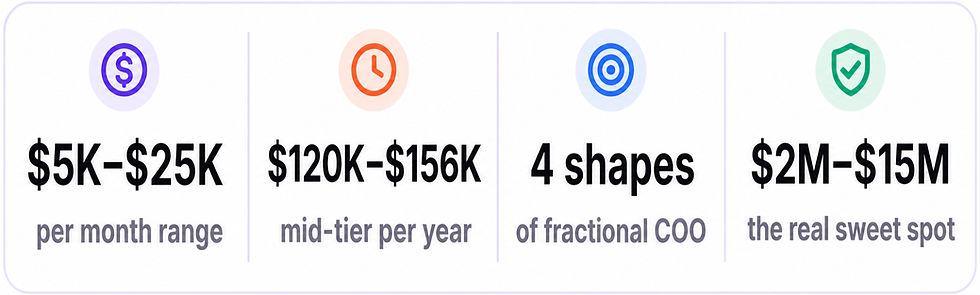
$5K–$7K/month: Approximately 1 hour of work per day. Ideal for small businesses with annual revenues of $1M to $5M that require someone to keep things running smoothly and organized.
$10K–$13K/month: Approximately 2 hours per day. The most popular option for $5M–$15M companies that already have a team in place but need stronger leadership support.
$15K–$25K/month: Three or more hours every day. Built for larger $15M–$50M businesses with complicated operations or those getting ready to sell.
Hourly rates: $175–$500/hour, depending on their experience and specialty.
Mid-tier engagement adds up to $120K–$156K per year. Be suz`re you are paying for a specific, measurable outcome and not for "better operations".
The Four Shapes of Fractional COO (Most Guides Skip This)
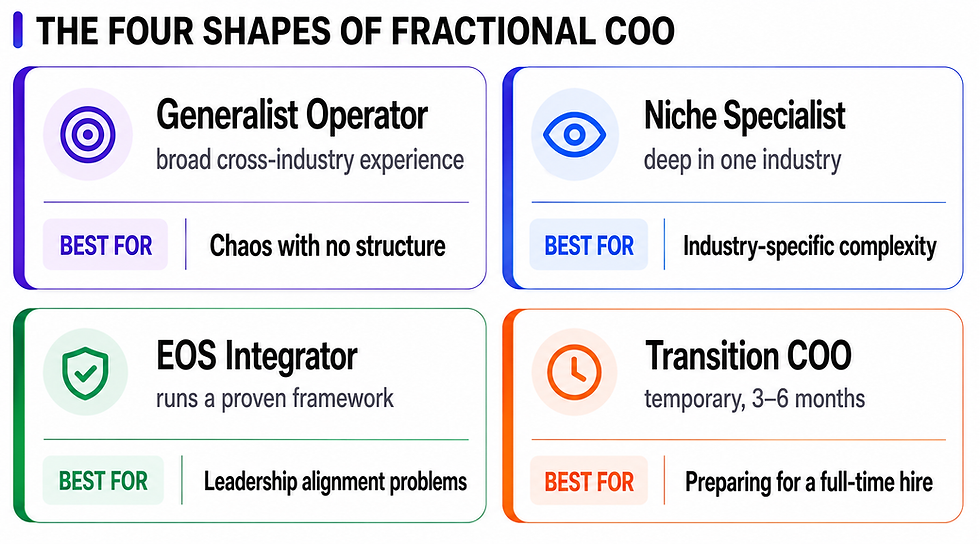
Not all fractional COOs are created equal. Many business owners make a costly mistake without realizing it when they choose the wrong type.
The Generalist Operator has experience across many different industries. They're great at quickly spotting problems and bringing order to a messy business. The downside is they might miss details that are unique to your specific industry.
The Niche Specialist is dedicated to your niche. For example, a construction COO understands project budgets and managing subcontractors. A SaaS COO is intimately familiar with customer renewals and revenue growth. If you have industry-specific issues, this is your best option.
The EOS Integrator is trained to run structured business frameworks like EOS or Scaling Up. They don't just run operations, they lead your entire leadership team through a proven system. If your team is already using EOS, hiring this type gets results faster.
The Transition COO fills in until you find a permanent candidate. The position is temporary and typically lasts for three to six months. This is a choice that most companies don't consider, but it can be the most sensible and straightforward one for companies that are aware they will require a full-time COO in the future.
Which Fractional COO Shape Fits Your Situation?
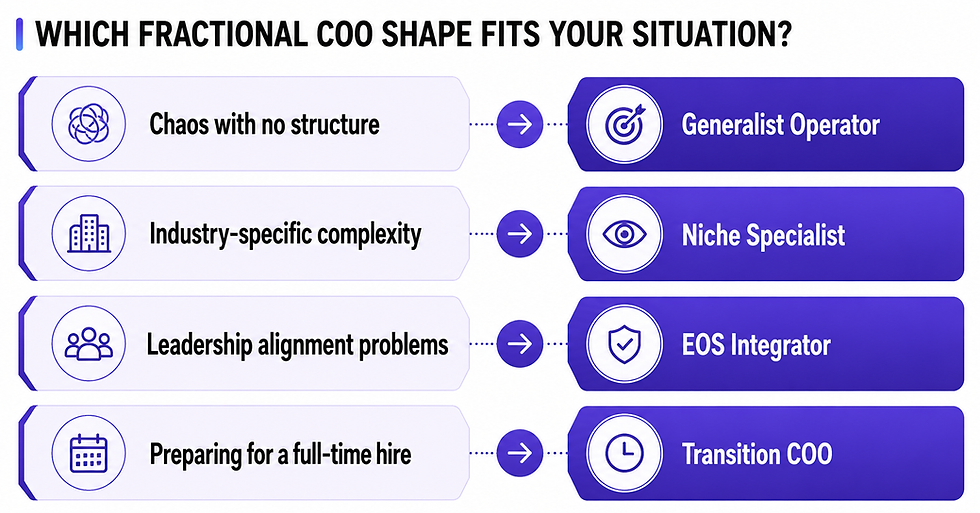
Chaos with no structure → Generalist Operator
Industry-specific complexity → Niche Specialist
Leadership alignment problems → EOS Integrator
Preparing for a full-time hire → Transition COO
The Questions to Ask Before Hiring a Fractional COO
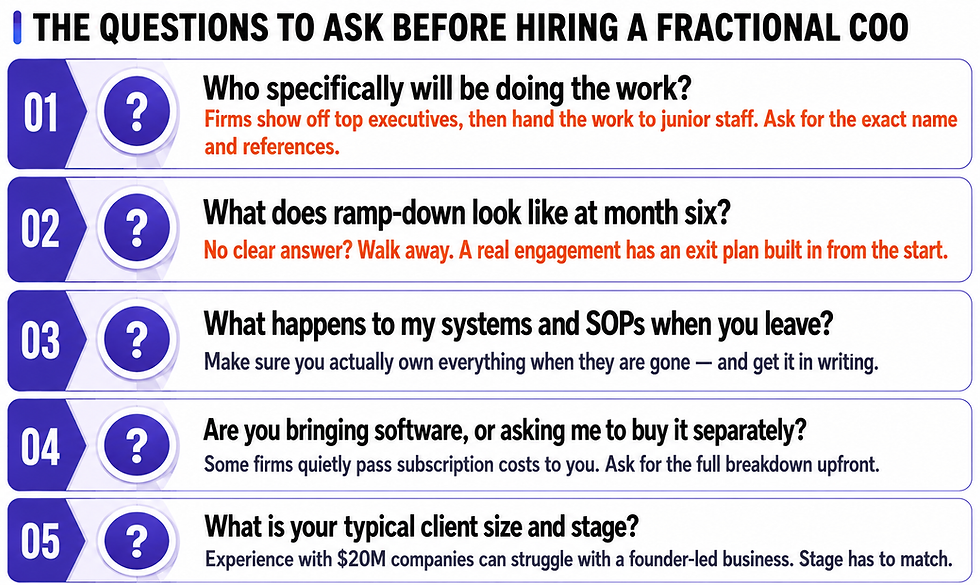
"Who specifically will be doing the work?" Companies love showing off their top executives during sales calls, but the actual work often gets handed to newer, less experienced staff. Ask for the exact person's name, look them up on LinkedIn, and request references from their past clients not just general company references.
"What does ramp-down look like at month six?" If they can't give you a clear answer, walk away. A trustworthy engagement always has an exit plan built in from the start including proper documentation and a smooth handoff.
"What happens to my systems and SOPs when you leave?" Most buyers forget this one. Make sure you actually own everything when they're gone and get it in writing.
"Are you bringing software, or asking me to buy it separately?" Some firms use tools like Asana or Monday and quietly pass the subscription costs onto you. Always ask for the full price breakdown upfront.
"What's your typical client size and stage?" Someone experienced with large $20M companies may struggle with a small founder-led business. Experience level and business stage need to match.
The Hidden Multiplier Most Fractional COO Firms Don't Talk About
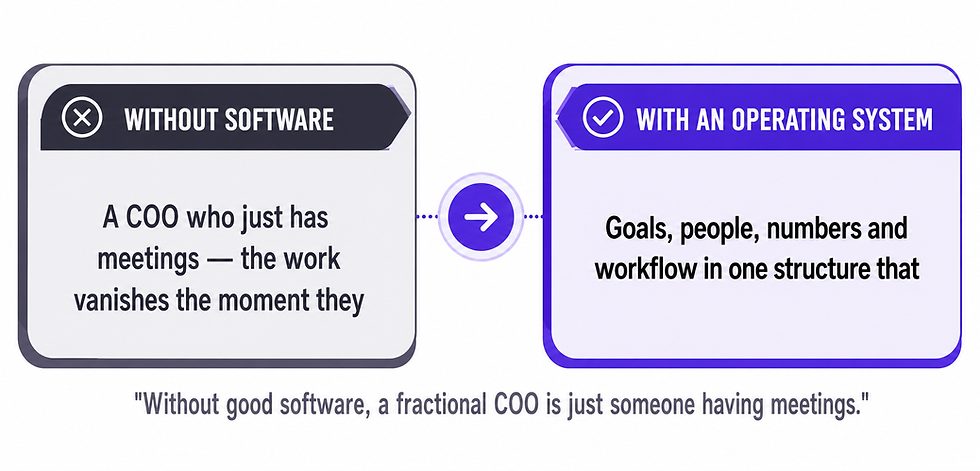
Without good software a fractional COO is just someone having meetings. They come in, see the problems, give advice and move things along. But without a central place to put that work (a place where your team can track progress, stay accountable, and build real habits), everything they built vanishes the moment they leave.
Most businesses just use whatever tools they already have lying around. That's easy, but it's lazy thinking. Tools like Asana or Monday handle specific jobs. An operating system does something bigger it connects your goals, your people, your numbers, and your workflows into one living structure that keeps running on its own. The businesses that get the most value from a fractional COO are the ones where the system they built keeps working long after that they are gone.
The Fractional COO Setup We'd Recommend for Most $2M–$15M Companies

If your business makes between $2M and $15M, here's the setup that gives you the best results:
A clear operating system first, like EOS or Scaling Up. Basically a simple set of rules that helps your whole team work better together.
Weekly hands-on support, not just a monthly phone call where nothing really changes.
Software that tracks your goals, numbers, and weekly meetings and keeps working even after we stop working together.
That's exactly what ShiftFocus does. We're not just a consultant you ring once a month. We're the daily system that makes everything actually stick and work effectively.
FAQs
Do I need a fractional COO or just better systems?
For most businesses making between $2M and $8M a year, the honest answer is to fix your systems first. Hiring a fractional COO without proper business tools in place is like bringing on a financial expert but giving them no accounting software to work with. The person can only do so much without the right foundation.
If your business doesn't yet have the basics like weekly check-ins, clear priorities, or written-down processes, start building those. Once you do, you might find you don't even need a COO or at the very least, you'll be in a much stronger position if you do hire one.
How long do most fractional COO engagements last?
Most engagements run somewhere between six and twelve months. Shorter ones, around three to four months, usually focus on a specific transition or change. Longer ones, stretching to eighteen months, can mean the company is going through deep changes but sometimes it means the business has become too dependent on that person instead of learning to run on its own. Always ask any firm upfront what their average timeline looks like and what a successful ending actually means to them.
Can a fractional COO work fully remote?
Absolutely. Since 2020, remote work for executives has become completely normal. What matters far more than where they're located is how consistently they show up to your meetings, how easy they are to reach between sessions, and whether they keep clear documentation of everything.
What's the difference between a fractional COO and a consultant?
A consultant tells you what's wrong. A fractional COO actually fixes it. Consultants hand you a report and move on. A fractional COO joins your leadership meetings, takes responsibility for results, and is measured by the same goals your team is. If you need answers, hire a consultant. If you need someone rolling up their sleeves every single week, that's a fractional COO. Mixing the two up is a costly mistake many businesses make.
A consultant tells you what's wrong. A fractional COO actually fixes it.


Comments