%20(3).png)
Why Most Fractional COO Engagements End at Month 7 (And How to Be in the 40%)
- Daniel Madhan
- Jun 30
- 7 min read

Updated: Jul 1
Most fractional COO engagements fail not because of poor performance, but because they were never built to last. Business owners see early results, then, around month six or seven, things quietly fall apart. Nobody discusses this openly.
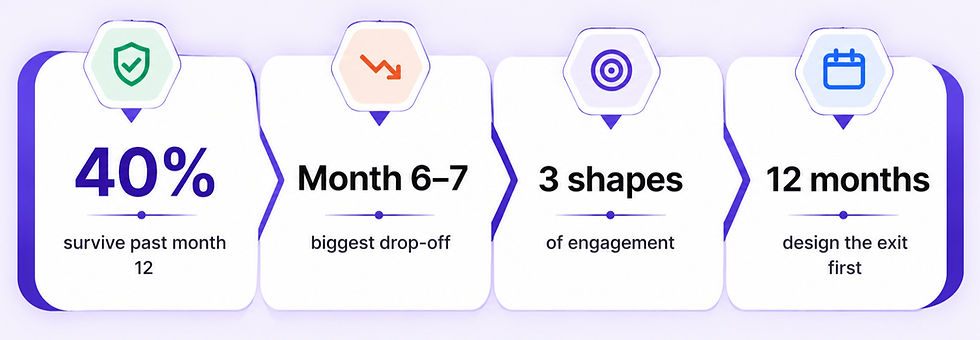
Most engagements end before month 12, with the biggest drop happening around months six and seven.
Here's the pattern: months one through three feel exciting. By month five, the easy wins are gone. By month seven, the retainer feels expensive and the engagement dies.

The real question isn't cost. It's whether the engagement was designed to survive past the honeymoon phase.
The Four Reasons Most Fractional COO Engagements Die

Reason 1: The honeymoon ends, and no real systems were built
Everything begins on a positive note. The COO improves your hiring process, organizes your meetings, and creates a project tracker. It seems like things are getting better, but these are just temporary solutions. Once the simple tasks are completed, the real challenge starts: creating something that will continue to function well even after they leave. Many projects fail at this point because no one clearly stated that goal from the beginning.
Reason 2: The COO leaves, and the knowledge leaves with them
This is how things usually go wrong. Over time, your COO understands everything, like your suppliers, team, and any hidden issues. However, this information stays in their mind and isn't shared with the business. When they leave, you end up with some papers that no one really looks at. If only one person knows something, that knowledge isn't helpful for the business.
Reason 3: The CEO never let go of the bottleneck
When you bring on a COO but still approve every vendor, every hire, and every dollar spent, you haven't handed over real authority you've just added a title. Your COO ends up stuck in meetings without the power to act. That's not an operator. That's an expensive bystander.
That's not an operator. That's an expensive bystander.
Reason 4: The wins were tactical, not structural
There's a real difference between fixing a problem and preventing it from coming back. If things only run smoothly because someone is actively managing them, that's not progress it's a patch. You need systems that hold up on their own, long after attention moves elsewhere.
What the Surviving 40% of Fractional COO Engagements Do Differently

They install a system, not a personality
The COOs who stick around aren't succeeding because they're likable or quick to respond. They succeed because they build a clear structure that the company can use on its own. Whether it's EOS, OKRs, or something custom-built it's written down in software, not stored in someone's head.
They document everything the COO touches.
In long-lasting engagements, documentation isn't an extra task it's a core part of the job. Every process, every decision, every workflow gets written down and stored. So when the COO works fewer hours, nothing falls apart.
They give the COO real decision rights, not just suggestions
The best engagements give COOs actual power to hire, restructure, and act without needing constant approval. When a COO has to check with the CEO on everything, they stop being a leader and start being an expensive helper.
They measure system health, not COO effort
Bad engagements track what the COO does meetings attended, projects managed. Good engagements track how the business is performing revenue, delivery speed, hiring efficiency. If your measurements are focused on the COO's activity, you're missing the bigger picture.
The One Question to Ask Before You Hire a Fractional COO
Before signing a fractional COO contract, ask just one question:
"When you leave, what stays behind?"
If they say, "Your team will remember the SOPs and keep things running" leave. SOPs buried in Google Drive folders that no one opens aren't systems. They're just digital paperwork collecting dust.
But if they say, "The operating system runs on its own, and here's the software that holds everything together" that's someone worth hiring.
This question cuts through all the fancy sales talk. It forces them to show you something real and tangible not just their skills or methods. Something your company actually owns after they're gone.
Three Fractional COO Engagement Shapes and Their Survival Rates
Not all fractional COO engagements are the same. The structure of the engagement is one of the strongest predictors of whether it survives or not.
Engagement Type | What It Looks Like | Typical Outcome |
Advisory-Only | Monthly calls, strategic input, no execution authority | Ends when budget tightens usually month 4 to 7 |
Embedded Operator | In the weeds, running teams, owns projects | Ends when the COO leaves knowledge walks out the door |
Operating-System-Led | Installs a framework, enforces it through software, trains the team | The system outlasts the COO highest survival rate |
The advisory-only model feels low-risk because it's the cheapest. It's actually the highest risk because it produces the least durable change. The embedded operator model produces real results, but it's personally dependent the second that the COO takes on a bigger engagement, you feel it. The operating-system-led model is the only one where the ROI compounds after the COO reduces their hours.
What "Operating-System-Led" Fractional COO Engagement Actually Means

An operating-system-led fractional COO engagement has three non-negotiable components:
A framework - This could be EOS, OKRs, or something built specifically for your business. Think of a framework as the rulebook for your company. It explains how decisions get made, how goals are set, and who is responsible for what. Without one, you just have people sharing opinions with no real structure.
Software that holds the framework - Your framework needs to live inside a tool your team uses every single day not buried in a document nobody opens. Think project management tools or reporting dashboards that make following the system the easy, natural choice.
A cadence the system runs, not a person - Weekly check-ins, monthly reviews, quarterly planning these should happen automatically, regardless of who is in the room.
The fractional COO's real goal is simple: build something so strong that it no longer needs them.
The Case for Software-First Fractional COO Engagements

Software never calls in sick. It doesn't forget a meeting, miss a deadline, or walk away for a better opportunity.
When your business runs on software you own, your COO stops being the glue holding everything together. Instead, they teach your team how to use the system well. That's a huge difference one keeps you dependent, the other makes you stronger.
The businesses that truly benefit from a fractional COO treat software like a foundation, not a bonus feature. The COO builds the system. The software stores it. You own both.
Questions to Ask a Fractional COO Firm Before Signing

Most people walk into these conversations asking the wrong questions. They want to hear success stories, industry experience, and résumé highlights.
Below are the right questions to ask:
What operating system do you install? If they can't name a specific framework and just say "we tailor everything to you," be careful. A firm without real structure is essentially guessing and you're paying for that guess.
Is software included or separate? Tools you pay extra for are tools nobody actually uses. When leadership shifts, optional systems are the first thing to go.
What happens at month 12? You need a real answer here a handoff checklist, a wind-down plan, something concrete. Hesitation means they haven't thought past the sale. Unplanned exits leave your operations exposed.
Can I cancel month-to-month? Firms confident in their work won't flinch at this. If they push back hard, that reaction is your answer.
What's your typical engagement length, honestly? Don't accept the polished version. If they say 6 to 18 months but clients routinely leave at seven, you're seeing a pattern. A firm that tells you the truth about this actually understands what makes partnerships work and that matters.
FAQs
How long should a Fractional COO engagement last?
The right answer depends on what you're building. A purely tactical engagement, including fixing broken processes and stabilizing a team, can wrap in four to six months. An operating-system build typically needs nine to twelve months to fully take root. If your goal is to install a durable framework that survives leadership changes and growth phases, plan for twelve months minimum and design the exit before you sign the contract.
Why do Fractional COO engagements fail?
The most common cause isn't poor execution its poor design. Engagements that fail were designed around the COO's presence rather than a system that outlasts them. Other key failure points: CEOs who won't delegate real authority, engagements with no documentation requirement, and firms that measure success by activity rather than business outcomes. The structure of the engagement predicts the outcome more than the COO's skill level.
Can a Fractional COO transition out without losing momentum?
Yes if the transition was designed into the engagement from day one. The mistake is treating the exit as a future problem. Companies that transition smoothly have three things in place before the COO reduces hours. These include documented SOPs the team actually uses, software that enforces the operating cadence, and at least one internal operator who owns the system. Without these three, every transition loses momentum.
Should I extend or end my Fractional COO engagement?
Extend if the system is still being built, the framework is taking root but isn't self-running yet, and your team can articulate what the operating model is. End if the COO is doing things your team should be doing, you can't describe what's been installed, or the value feels personal rather than structural.
The test is simple if, for example, your COO took a two-week vacation tomorrow, would your company run smoothly or stall? If it stalls, the engagement isn't finished yet. If it runs, you may be ready to step down to a coaching-only model.
Most fractional COO services sell momentum. The rare ones sell permanence. The difference is whether they leave behind a system your company owns or a void your company scrambles to fill. Most Fractional COOs leave when the retainer ends. ShiftFocus stays because the software stays. [Book a 30-min diagnostic]


Comments