%20(3).png)
EOS Quarterly Conversations: How to Run the 5-5-5 Meeting Right

By Madhan | Founder, ShiftFocus OS
A quarterly conversation need not feel like a smaller version of an annual performance review. Rather, it is a systematic point of contact between a manager and a direct report.
The goal is clear: to review what is going well, to address what is not going well, to provide helpful feedback and to come up with a plan going forward.
The EOS quarterly conversation provides managers with a repeatable framework. However, this framework is only effective provided that managers collect relevant information, manage conflicts effectively, and fulfill their promises.

PART A: WHAT EVERYONE COVERS
What Is an EOS Quarterly Conversation?
An EOS quarterly conversation is a structured dialogue between a manager and his/her subordinate during which such topics as performance, behaviors, roles, and obligations for the stated quarter are covered.
A shorter feedback loop is created. Problems are resolved at the time rather than waiting for an annual review.
What 5-5-5 Means: Core Values, Roles, Rocks
The 5-5-5 approach examines these three areas:
Area | Scope of the review |
|---|---|
Consistency in demonstrating expected behavior by an employee. | |
Understanding, competence, and desire of the employee to perform the role. | |
Results concerning critical quarterly goals. |
Ratings of Core Values can be +, +/−, or −. These ratings have to be supported with concrete examples.
Core Value rating scale at a glance
Rating | What it means | What the manager does next |
|---|---|---|
+ | The value shows up consistently. | Name the example. Keep on. |
+/− | The value shows up inconsistently. | Name the behavior behind the rating. Set a follow-up. |
− | Below the bar. | Clarify the gap, state the standard, set a correction plan and a follow-up date. |
Quarterly Conversation vs. Annual Performance Review
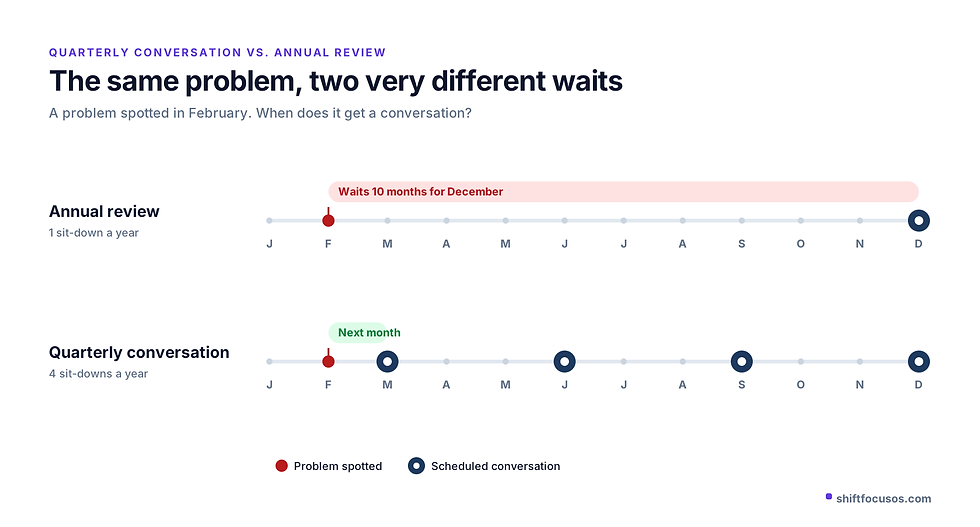
An annual review refers to the ability to review a long period of time, whereas a quarterly discussion helps maintain four opportunities within a year to discuss performance and issues related to growth.
This enables feedback to be faster. The problem detected at the beginning of the year will not have to wait for December to be fixed.
Annual review vs. quarterly conversation vs. quarterly + ShiftFocus
Annual review | Quarterly conversation | Quarterly + ShiftFocus | |
|---|---|---|---|
Formal sit-downs a year | 1 | 4 | 4 |
Longest wait before a problem is discussed | Up to 12 months | Up to 3 months | Flagged the week a commitment goes overdue |
Focus | The past year | The last 90 days and the next 90 | The next due date |
Who speaks first | Manager | Employee, then manager | Employee, then manager |
Where promises live | The review form | Meeting notes | Tracked to-dos with an owner and a deadline |
The Agenda, Step by Step
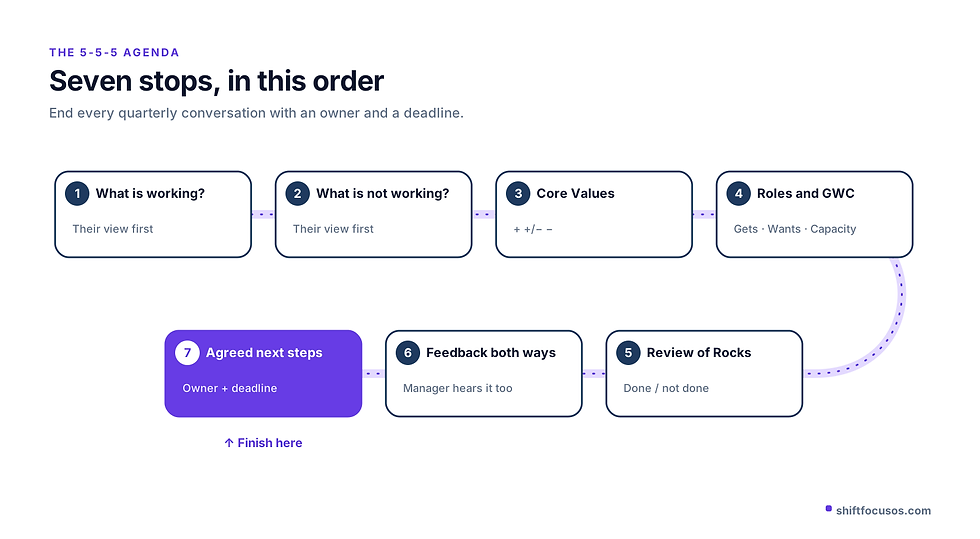
The effective agenda should include:
What is working?
What is not working?
Assessment of the core values.
Specifics of Roles and GWC.
Agreed next steps
The meeting should end with clear owners and deadlines.
What to ask at each step, and what you leave with
Step | Ask | Output |
|---|---|---|
1. What is working? | “What has gone well?” | Wins to keep |
2. What is not working? | “What do you need to work on?” | Issues named by the employee first |
3. Core Values | +, +/− or −, with examples | A rating backed by evidence |
4. Roles and GWC | Gets it? Wants it? Capacity to do it? | Yes or no on each |
5. Rocks | Done or not done? | Completion count |
6. Feedback both ways | Keep, adjust, missing | The manager’s own to-dos |
7. Agreed next steps | What, when, and how we check | Owner + deadline |
The Three Strikes Rule
You shouldn’t just terminate the employment of an employee because they’re not meeting up to expectations. Use the 3-Strike Rule instead.
Strike One: Meet with the employee and explain what needs to be done differently, Document your conversations and establish a 30-day check-in period to check the progress of your employee.
Strike Two: Meet again with the employee to check his or her progress. Provide written feedback if there are no improvements. Agree on new target for another 30 days.
Strike Three: If the employee still didn’t meet the target after 30 days, it means he or she is not the right person for the job, or not in the right seat, or both. You can now fire the employee or take him or her to another seat where they’re a better fit.

The three strikes at a glance
Strike | When | What happens | What goes in the record |
|---|---|---|---|
One | Day 0 | Explain what needs to change | The conversation and a 30-day check-in date |
Two | Day 30 | Check progress; written feedback if nothing improved | Written feedback and a new 30-day target |
Three | Day 60 | Target still missed | The decision: a better seat or an exit |
PART B: ADDING VALUE
What to Say: Scripts for the Hard Moments
The difficult part of a 5-5-5 meeting is usually not the agenda; the most difficult part arises when the individuals find it hard to hear the comments they did not want to hear.
Opening the Conversation
Instead of starting with an evaluation, find a place for the employee to express his/her views on the situation:
“Now let us look for some successful practices demonstrated by the employee, the fields that need improvement, and the things that can be improved in our conversation.”
Then ask:
“What has gone well, and what do you need to work on?”
This will basically identify the concerns before the supervisor presents them.
Giving a “−” on a Core Value
Avoid saying:
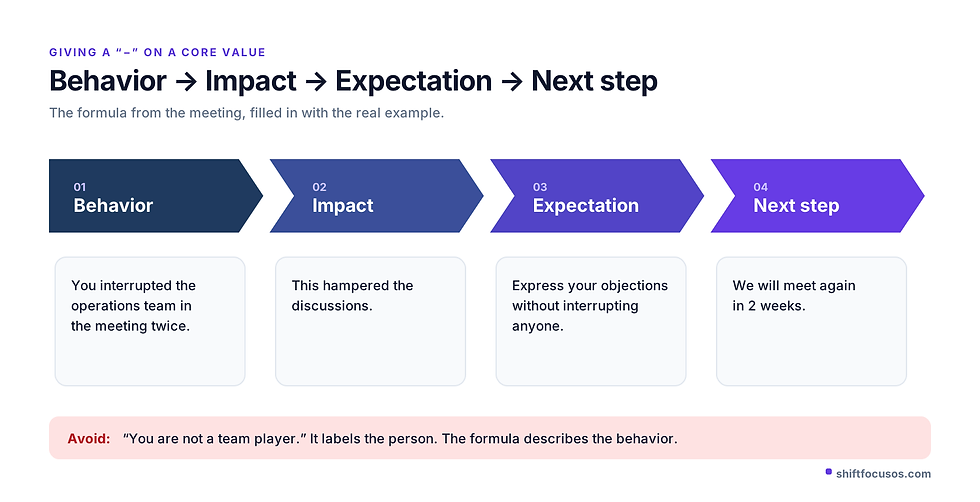
“You are not a team player,”
We would say, “The rating was ‘−’ for this value because of two particular instances. In both situations, the action was not in accordance with the required level of behavior.”
Then we should explain the required behavior and what adjustments need to be made. To ensure consistency, we can use the formula:
Behavior → Impact → Expectation → Next step
For example,
“You interrupted the operations team in the meeting twice. This hampered the discussions. I want you to express your objections without interrupting anyone. We will meet again in 2 weeks.”
When the Employee Pushes Back
You must always try to disagree tactfully. You should say:
“I see your point. How do you think I have missed this?”
This is an opportunity to learn new facts. If the rating stays intact, provide your justification:
“I see your view. I still hold my opinion on the appropriateness of the rating, as it was awarded because of a repetition of the same behavior in different circumstances.”
Disagreement does not imply that the rating is invalid. However, the management will have to reconsider it once they receive reliable new information.
Closing With Agreed Next Steps
When concluding your conversation, try to avoid the expression:
“We will observe the situation.”
Instead, say:
“Let us clarify everything. What should you do, when should you do it, and how can we check if it has been done?”
Write the answer down.
Quarterly conversation scripts: avoid vs. say instead
Moment | Avoid | Say instead |
|---|---|---|
Opening | Starting with an evaluation | “What has gone well, and what do you need to work on?” |
Giving a “−” | “You are not a team player.” | Two specific instances, then Behavior → Impact → Expectation → Next step |
Pushback | Defending the rating right away | “I see your point. How do you think I have missed this?” |
Closing | “We will observe the situation.” | “What should you do, when should you do it, and how can we check if it has been done?” |
A Filled-In Example: One Sales Manager's 5-5-5
Let’s take an example of Daniel, a sales manager.
Area | Result | Evidence | Follow-up |
|---|---|---|---|
Core values | + | Good customer satisfaction. | Keep on. |
Core values | +/− | Two communication issues. | Weekly follow-up. |
Roles/GWC | Yes. | Handles core responsibilities. | No changes. |
Rock 1 | Complete | Launched new sales process. | Keep it under observation. |
Rock 2 | 70%. | Delayed CRM cleanup. | Complete by April 12. |
The +/− indicator, however, is not the whole story.
Daniel confirms that the order issues actually stemmed from an operations failure. Daniel’s boss admits that Daniel did have an issue, but he mentioned that Daniel has been sending e-mails with increasing levels of irritation.
They come to the conclusion that Daniel should not e-mail the problems recurrently, but should attend the weekly cross-functional meeting instead, where all raised issues get discussed. Now the record contains the issue, evidence, expected behavior, owner, and deadline.
The Three Hardest People to Rate
The Top Performer That Breaches Core Values: Separate outcomes from behavior. It is possible for a salesperson to exceed expectations and still earn a “−” in the Core Value category given evidence of a pattern of behavior that goes against the company’s standards. A helpful phrase would be “Your performance scores well. The point of concern is the manner in which the performance was attained.”
The Loyal Long-Timer Who Has Outgrown the Seat: Don’t let seniority take over the assessment of the job requirements at present. Ask the following question: “If we were hiring for this position now, would you qualify?” If the employee does not, make sure to explain what exactly he is failing at.
The Person Promoted Into a Seat They Can't Do: Examine the qualifications for the role. Next, determine whether the issue is a deficiency of skills — thus requiring coaching — or more profound incompetence in executing basic duties. This discovery will call for a conversation of appropriate nature.
The three hardest ratings: the trap and the line to use
Person | The trap | What to say or ask |
|---|---|---|
Top performer who breaches Core Values | Letting results excuse behavior | “Your performance scores well. The point of concern is the manner in which the performance was attained.” |
Loyal long-timer who outgrew the seat | Letting seniority decide | “If we were hiring for this position now, would you qualify?” |
Person promoted into a seat they can't do | Treating every gap the same | Skill gap → coaching. Can't do basic duties → a seat conversation. |
How the Direct Report Should Rate the Manager
Employees are entitled to present their review too.
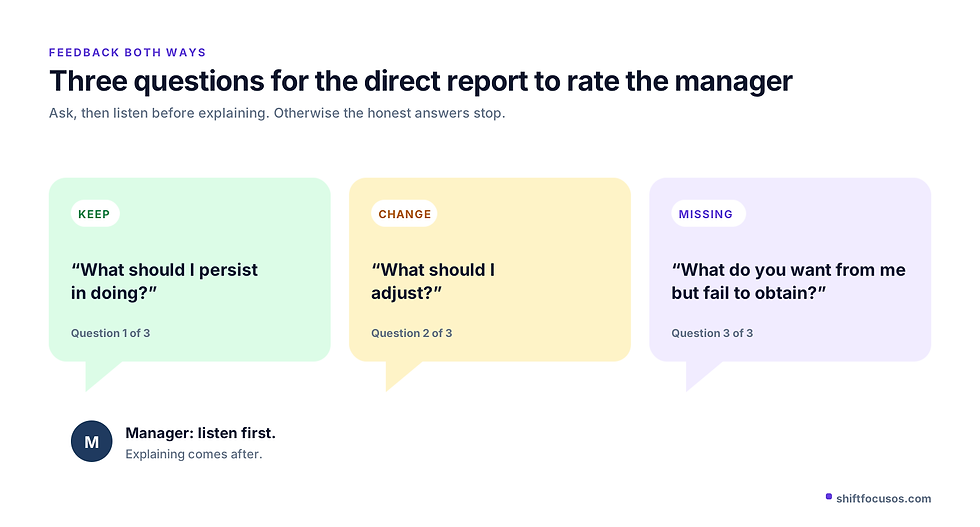
Ask the following to an employee:
“What should I persist in doing?”
Then go ahead and ask:
“What should I adjust?”
And:
“What do you want from me but fail to obtain?”
Before offering an explanation, the manager needs to listen. Otherwise, employees will refrain from providing truthful answers.
Calibration: Why Two Managers Rate the Same Value Differently
It is possible for two managers to assess the same behavior differently. One manager can put down their ratings immediately as +/− based on the event witnessed. Another one may prefer to wait until several cases are spotted.
A simple exercise in calibration will help with that. Present managers with three case studies and ask them to rate the cases individually. Then discuss the ratings.
Reading a Year of Ratings: Four-Quarter Trend
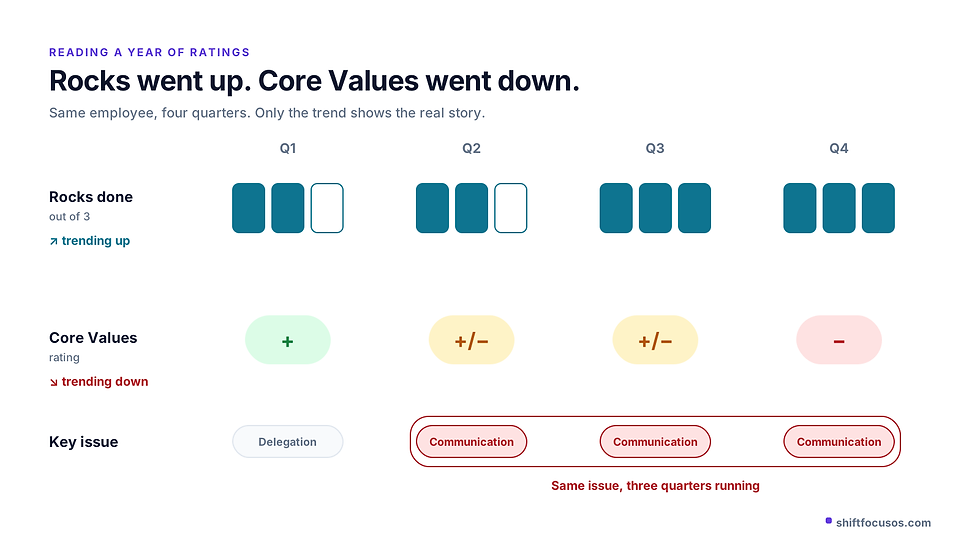
A single quarter can give misleading results, while four quarters can establish trends.
Quarter | Core Values | Rocks | Key Issue |
|---|---|---|---|
Q1 | + | 2/3 | Delegation. |
Q2 | +/− | 2/3 | Communication. |
Q3 | +/− | 3/3 | Communication. |
Q4 | − | 3/3 | Communication. |
Although the employee is hitting the Rocks, the same behavioral issue has existed across three quarters. This is better than just using the Q4 score in isolation.
The Time Math: 8 Reports × 4 Quarters
Eight direct reports means:
8 x 4 equals 32 conversations yearly.
At 45 minutes each:
32 x 45 equals 1,440 minutes, i.e., 24 hours.
If another 30 minutes of preparation is factored:
32 x 30 equals 960 minutes, i.e., 16 hours.
In all, about 40 hours will be spent yearly.
Doing two conversations a week around quarter-end would make scheduling easier, though the key lies in enough preparation.

The same math for smaller and bigger teams
4 reports | 8 reports | 12 reports | |
|---|---|---|---|
Conversations a year | 16 | 32 | 48 |
Meetings (45 min) | 12 h | 24 h | 36 h |
Prep (30 min) | 8 h | 16 h | 24 h |
Total | 20 h | 40 h | 60 h |
Quarterly Conversations and Pay Raises
Quarterly discussions can provide valuable information for decisions about salary, but be careful not to turn the ratings into a strict formula like “three-plus ratings equals a 10% salary increase.” It might lead to people managing their results instead of managing their performance. The salary can be based on the quarterly performance and other factors, such as job description, market data, company’s performance, and level of internal fairness.
Using the Record When You Have to Let Someone Go
It is not enough to prepare records only when it is necessary to fire someone. A good record indicates what has been said, what expectation has been set, what has been offered as support, and whether the problem has improved. If employment action is taken, those records might be crucial.
Tracking Every Promise Until the Next Conversation
Being able to track a commitment allows one to turn it into an actionable task.
Commitment: Performing CRM clean-up.
Owner: Daniel.
Deadline: April 12.
Success: All accounts that have been assigned have been reviewed.
The manager no longer has to depend on his/her memory to keep track of commitments.
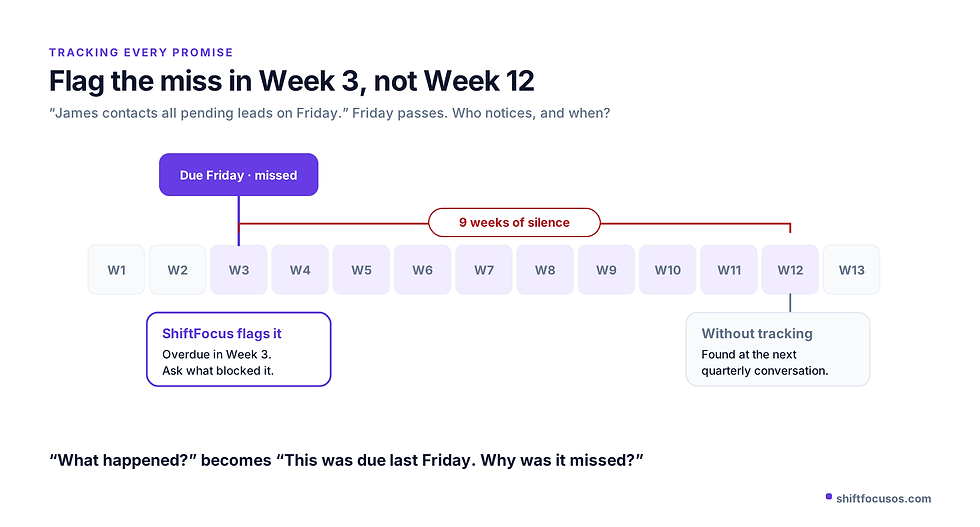
ShiftFocus comes in here. There is no need to wait for the next quarterly meeting to find out about a missed commitment; the system will notify the manager when a commitment is overdue.
This shifts the conversation from the question "What happened?" to the question "This was due last Friday. Why was it missed?" This gives one employee a chance to remedy the situation before it turns into a quarterly shock.
Agreements Become To-Dos With Owners
All agreements should transform into actual assignments with a responsible person and due date. According to EOS, clarity is gained with clear expectations about who is doing an action and when.
For instance, instead of a vague task “Improve client follow-up,” it should be replaced by the specific action “James contacts all pending leads on Friday.” The assignment becomes quantifiable and gives the supervisor an opportunity to assess results.
Vague agreement vs. trackable to-do
Field | Vague | Trackable |
|---|---|---|
Task | “Improve client follow-up” | “James contacts all pending leads” |
Owner | The team | James |
Deadline | Soon | Friday |
How we check | “We will observe the situation.” | All pending leads contacted |
Where ShiftFocus Flags a Missed Commitment in Week 3, Not Week 12
The purpose of tracking an assignment is an opportunity to resolve an issue before it is too late. According to research-proven performance management recommendations, regular feedback should be utilized when the process is monitored rather than waiting for the end of a performance evaluation period.
Thus, if James misses the Friday deadline, ShiftFocus is able to identify the task that is overdue in week 3. The supervisor can inquire what obstacles there were, restate the expectations, or set a new deadline instead of waiting for the next quarterly conversation.
Where a missed commitment gets caught
Memory and notes | Shared spreadsheet | ShiftFocus | |
|---|---|---|---|
When the miss is noticed | At the next quarterly conversation | When someone opens the sheet | The week it goes overdue |
Who chases it | The manager | The manager | Automatic escalation in Slack or Teams |
The conversation | “What happened?” | “What happened?” | “This was due last Friday. Why was it missed?” |
FAQs
What is a 5-5-5 meeting in EOS?
The 5-5-5 meeting is a structured quarterly meeting that deals with the following three areas: Core Values, Roles/GWC, and Rocks. Its purpose is to set up a regular feedback and accountability loop.
How long should a quarterly conversation take?
A quarterly meeting lasts approximately somewhere between 45 and 60 minutes at most. Complicated problems related to effective performance may take longer to solve.
Who runs it?
The direct supervisor is the one who conducts the meeting, but the employee should also have enough time to express his/her understanding and opinion.
Is it the same as a performance review?
Not exactly. Quarterly meetings are held more often than performance evaluations and concern future performance rather than past problems.
Can it replace annual reviews?
They can, to a certain extent, but the companies might still require annual evaluations for compensation or employment documentation purposes; therefore, the answer depends on the HR policies of the organization.
What questions should a manager ask?
Inquire as to what is functioning correctly, what is not, where assistance is needed by the employee, and what changes need to be made by the manager. After that, provide concrete instances as well as accepted actions.
What does +/- mean on a Core Value?
It indicates the employee is displaying the value very inconsistently; thus, the manager must be clear about the behavior linked to such a rating.
What happens if someone scores below the bar?
Clarify the scope of the gap, outline the standard that must be met, and set a correction action plan. Choose a follow-up date to verify the changes.
What do I say when an employee disagrees with the rating?
Find out missing information that might have influenced the opinion. If the proof is still there, provide it and try to justify your actions without starting an argument.
How do I rate a top performer who breaks Core Values?
Distinguish between results and behavior. High performance does not eliminate the existing Core Value issues.
Should the employee rate the manager too?
Providing employees with an organized way to give feedback can yield more meaningful discussions. A manager should listen, instead of trying to defend every single decision.
How do I keep ratings fair across managers?
Use comparable examples of behavior exhibited by the managers and regular calibration so that they compare the reasoning for their ratings and see the points where they differ.
Should quarterly conversations affect pay?
While these ratings can shape compensation decisions, it is not reasonable to say that they should become the only criteria for pay raises. The amount of compensation usually depends upon many different factors.
Can the record be used for a PIP or termination?
This document may serve as a basis for the communication regarding expectations, feedback, and follow-up steps to be taken. However, any formal disciplinary actions need to go through the policies established by the company and the law.
Do quarterly conversations work for frontline or part-time staff?
Yes. The format can be shortened and adapted to the employee's actual responsibilities while making sure that expectations are clear.
Can they be done over Zoom?
Absolutely. Online conversations can occur using the same structure that is followed in face-to-face meetings, and the manager must provide a private setting for these meetings and encourage employees to share their feedback.
Do leadership team members have them too?
Yes, they can. Leaders have the same advantages of feedback, responsibility, and conversation regarding their commitments.
How do I follow up between quarters?
Translate the commitments into action items that have assigned ‘owners’ and deadlines. During your regular meetings, go over the action items and monitor their progress until the next quarterly meeting.


Comments