%20(3).png)
The Week 3 Pattern: When Every OKR Initiative Quietly Dies

Updated: Mar 11
When we finished the ShiftFocus MVP, the first thing I did was give it to our own team. My marketing agency has 15 people, 10+ clients. Every client has its own objectives.
Every objective has main outcomes. Every team member is assigned to multiple clients. If any team was going to stress-test an OKR enforcement tool, it was mine.
And everyone was excited. The senior team leads set up their objectives for the year.
Junior marketing executives got their primary outcomes assigned. People were logging in, exploring, and setting things up.
Week 1 felt like confirmation that my own team was using the product I built.
Week 2, the first real check-ins happened. Senior team members updated their progress.
They checked in on their main results, marked what was done, and flagged what was blocked. I was genuinely happy. This is working, I thought.
But then I observed something.
Maybe 50% of the junior marketing executives weren't checking in at all.
Skipping it completely.
The seniors were doing it, but when I looked closer, some of them were doing it just because I was watching.
Not because the software was helping them. They were checking in for the sake of checking in, to avoid a conversation with me. The moment I stopped hovering, they would have stopped too.
That hit me hard. This is my own product. My own team. If I can't get 15 people who sit in the same office as me to use it consistently, how am I going to sell this to a company with 500 people?
So I started studying. I used ChatGPT to research why people buy software and then stop using it.
I read about product-led growth, habit-forming products, OKR adoption curves, and why enterprise tools get ghosted after the first month.
I studied everything I could about the psychology of software abandonment.
Not because I was curious, but because my own product was being abandoned by my own team.
That research changed how I think about ShiftFocus entirely. It's why we moved from building a tracking tool to building an enforcement platform.
And that's why I'm writing this article: the pattern I saw in my own company is the same one that kills every OKR initiative at every company I've ever worked with.
Not just my team. My clients. My investors. Friends running SaaS companies.
I started asking around, "How long did your team actually use your OKR tool?" The answer was always the same.
Three weeks. Maybe four.
Then it turned into a ghost town that nobody wanted to admit they were still paying for.
Here's how it dies. Week by week.
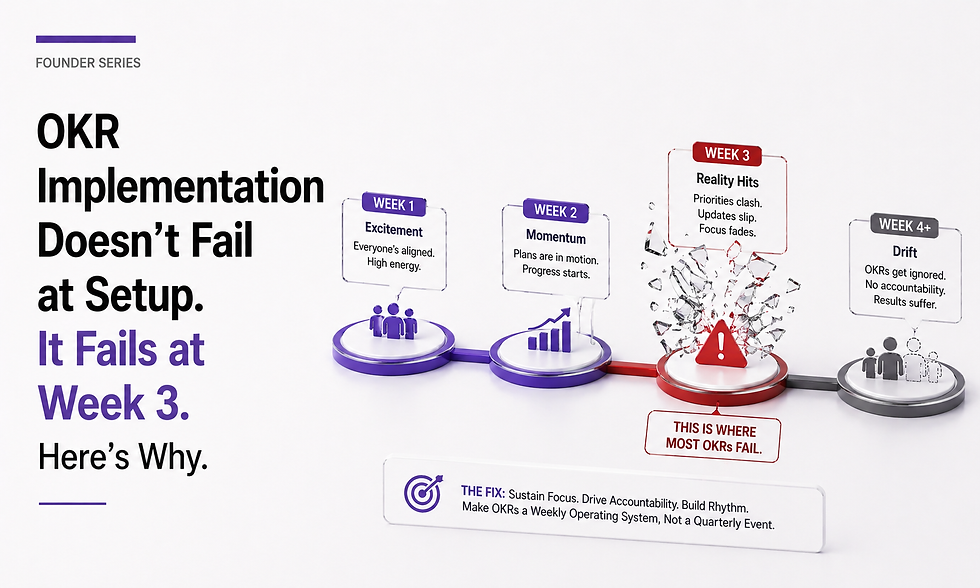
Week 1: The Honeymoon
Everyone's excited. The COO sends a company-wide email: "We're implementing a new goal-tracking system. Please set up your account by Friday."
People create accounts. Set up usernames, passwords, and profile pictures. Managers start building team structures and assigning objectives.
There's a kickoff meeting where someone from the software company does a demo.
Everyone nods along.
But here's what's actually happening in week 1: nobody is doing any real work inside the software. They're just setting up.
The objectives they enter?
They already knew those goals. They were going to work toward them with or without this tool. The software didn't create the goals. It just gave them a place to type them in.
And already in week 1, managers hit the first invisible wall: cross-dependencies. They're managing multiple teams. Some team members wear multiple hats.
One person reports to two managers for two different critical outcomes. The software doesn't know how to handle this. So managers just ignore it and move on.
Week 1 feels productive. It isn't. It's a setup theatre.
Week 2: The First Real Check-In (and the First Lies)
This is where the decay starts, and nobody notices.
The first actual check-in happens. Maybe 60% of the team remembers they have software to update. The other 40% forgot entirely until their manager pinged them on Slack.
They scramble to update something, anything, before the check-in meeting.
And here's what happens with the data: people lie. Not maliciously. Just optimistically.
Say a content marketing team has a main goal to publish 10 cornerstone articles this month. By week 2, they've assigned 4 articles to freelance writers.
The articles haven't been written yet. Nobody has seen a single draft. But the team lead updates the OKR dashboard: "40% complete."
Why? Because they assigned 4 out of 10. In their mind, assigning equals progress. The dashboard shows green. The manager sees green. Everyone moves on.
But 40% of the work isn't done. 0% of the work is done. Four emails were sent to writers. That's it. The dashboard is now lying, and it's only week 2.
Nobody monitors what data is actually being fed into the system. Nobody checks if "40% complete" means 40% of articles are published, or 40% of articles are assigned. The software doesn't know the difference. It just shows a progress bar.
And here's the deeper problem: the team is already questioning why they need this tool. They're already using ClickUp, Asana or Jira for daily tasks.
Now they have to spend another 30 minutes updating a second software for a weekly check-in that doesn't help them do their actual work. The OKR tool feels like overhead, not a tool.
The momentum decay is starting, and nobody notices because the dashboard still shows green.
This is exactly what I saw at my own agency. The senior team leads checked in because they understood the big picture they could see how their client's objectives connected to the agency's revenue.
But the junior marketing executives? They were already drowning in daily tasks across multiple clients.
Adding a weekly OKR update felt like homework on top of homework. They didn't see what was in it for them. Honestly, nothing was in it for them. The software didn't reward them for updating. It didn't penalise them for skipping. So they skipped.
Week 3: The Ghost Town
Research from University College London found that forming a new habit takes an average of 66 days, not 21 days as people commonly believe.
The range is 18 to 254 days, depending on complexity. An OKR check-in isn't a simple habit like drinking water.
It requires logging in to a separate platform, recalling your main results, honestly assessing your progress, and entering meaningful data. That's a complex behaviour.
OKR tools lose people at day 21. Week 3. Exactly when habit formation needs the most reinforcement, the software offers the least.
By week 3, this is what happens:
The manager is off this Friday. Check-in meeting gets postponed to Monday. Monday is packed with other meetings. Check-in gets pushed to "next week." It never happens.
Even the people who were diligently updating in weeks 1 and 2 stopped. Not because they decided to stop. They just forgot. The software sent an alert email.
It went to the same graveyard as every newsletter they've been meaning to unsubscribe from. The reminder email has never changed anyone's behaviour in the history of business.
The OKR tool is now a ghost town. Stale data from week 2 sits on the dashboard. Nobody logs in. The quarterly goals haven't changed; people are still working.
They're just not updating the software. Because the software gave them no reason to stay.
And the people who DO want to use it are your top performers, the organised team leads, who look around and see that nobody else is participating.
Their peers aren't updating. The check-in meetings keep getting cancelled. So even the motivated people give up. Why bother updating your core outcomes when you're the only one doing it?
Week 4 and Beyond: The Zombie Phase
Some companies have a brief revival. A manager realises nobody has updated.
There's a guilt-driven push: "Team, please update your OKRs before Friday." Half the team updates.
The other half doesn't. Nothing happens to those who didn't.
No consequence.
No escalation.
No accountability.
That's the message the entire company just received: updating is optional.
I've watched this at companies spending $36,000 a year on their OKR tool. Three months after launch, fewer than 20% of employees were actively logging in.
The executives who championed the tool were too embarrassed to admit it wasn't working. So they kept paying the subscription.
The tool sat there, accumulating stale data from week 2, while actual goal tracking happened in Slack threads and Friday meetings, exactly how it happened before they bought the software.
And then the worst part: the company blames the tool. "Betterworks didn't work for us. Let's try Lattice." Or "Lattice wasn't right. Let's try Profit.co."
They switch tools every 12-18 months, thinking the problem is the software. It's not. The problem is that none of these tools enforces usage.
They all assume people will voluntarily log in, voluntarily check in, and voluntarily tell the truth. That assumption is wrong at every company.
The Software Shows You Nothing You Actually Need
Compare two dashboards.
Google Analytics shows you traffic, conversions, signups, sales, drop-off points, user behaviour, everything that matters, all on one screen. When you open GA, you immediately see data that helps you make a decision.
Now open your OKR software. What do you see? A list of objectives. Some progress bars. Maybe green, yellow, or red. That's it.
Does it show you the workload?
No.
Cross-dependencies?
No.
Momentum decay?
No.
Which team members are engaged and which have gone silent?
No.
Is the goal actually achievable based on the current pace?
No.
And if someone on your team has been crushing it for four straight weeks, checking in, hitting targets, consistently winning, does the software highlight that?
Does it tell anyone?
No.
The top performer gets the same blank dashboard as the person who hasn't logged in since week 1.
Zero incentive to keep using it if you're winning. Zero consequence for abandoning it if you're losing.
The Unpleasant Truth
Every company spends thousands of dollars on these tools. Some spend tens of thousands. Enterprise clients spend hundreds of thousands. And what did they buy?
A form builder with a progress bar.
You know what else has forms and progress bars? Excel. Google Sheets. A Notion template. Or a no-code tool like Lovable, where someone can build the same thing in a weekend for $100.
If your OKR software doesn't do anything that Excel can't do, you don't have an execution platform. You have a very expensive spreadsheet.
What Week 3 Should Look Like Instead
Week 3 is exactly when the software should work the hardest, not the user.
If a team member hasn't checked in by Friday, the system shouldn't send a notification email. It should escalate. Flag the manager.
If the manager doesn't act by Monday, flag the department head.
If nobody responds, flag the executive. Not as punishment. As visibility.
Week 3 is when the software should tell the COO: "Your content team's velocity dropped 40% this week.
Two team members haven't updated in 10 days. The dependency on the creative team is blocking 3 critical outcomes." That's useful. That changes behaviour.
Week 3 is when high performers should be recognized automatically. Week 3 is when the software should say: "Based on current pace, this primary outcome has a 20% chance of being achieved.
Recommend re-evaluating scope." No, the OKR tool says that. They just let you drive toward a cliff with the dashboard showing green.
That's what I rebuilt ShiftFocus to do after watching my own team ghost my own product. It doesn't wait for you to log in.
It doesn't send reminder emails into nowhere. It enforces check-ins, escalates silence, flags momentum decay, and tells you the truth about your goals before the quarter ends.
Because every initiative dies the same way. Week 3. Every time. Unless something forces it to stay alive.
The question isn't whether your next OKR tool will be better. The question is whether it will enforce what the last one couldn't.


Comments