%20(3).png)
Align vs Ninety.io vs ShiftFocus for EOS Execution

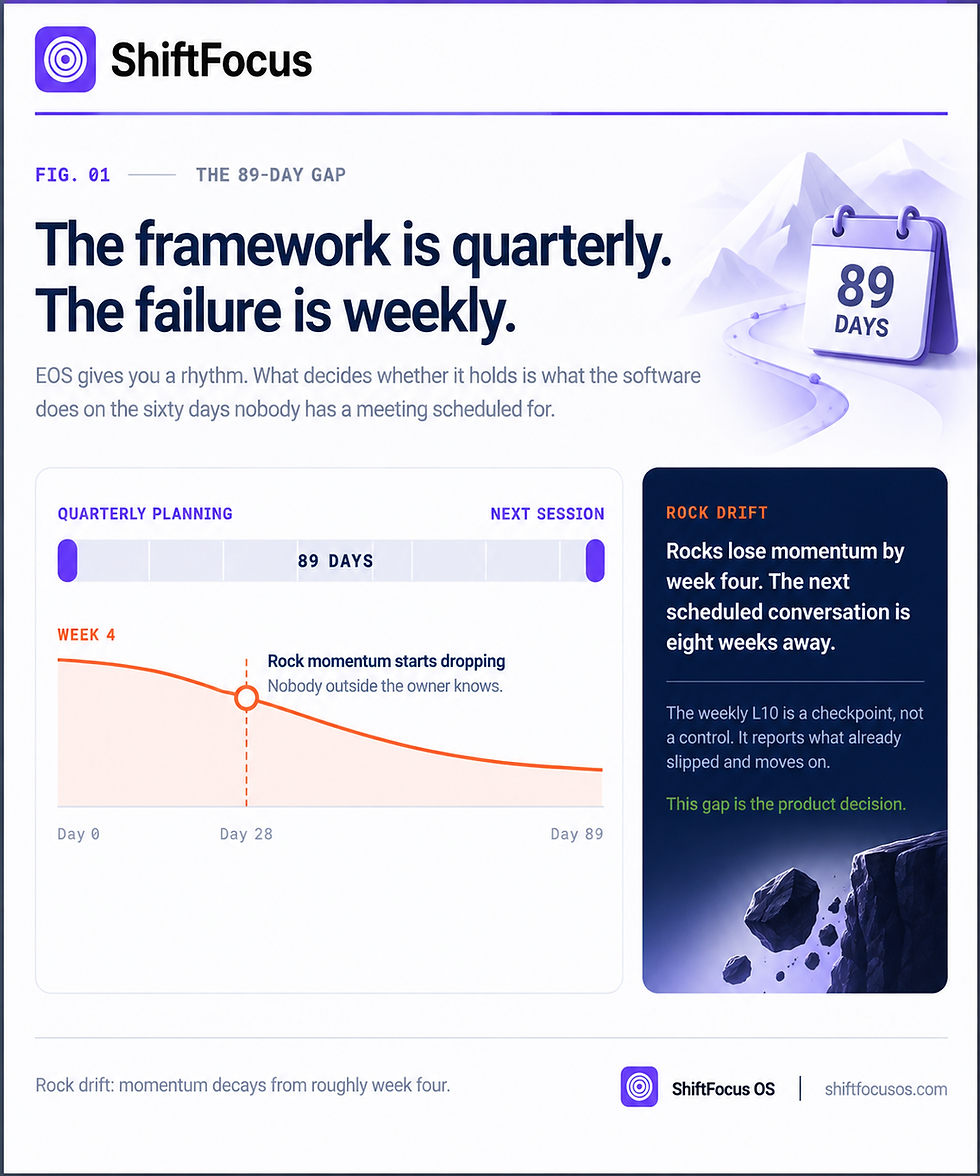
The Entrepreneurial Operating System (EOS) provides you with a framework, but it is the software you choose to operate it that determines whether you end up with a well-running system or more administrative headaches. Most leadership teams spend months (and a lot of money) trying out different platforms since they look good on a demo, only for them to fail somewhere during the 89 days between quarterly planning meetings.
If you choose the wrong tool, it's not just a minor inconvenience, but generally the actual cause of why your Rocks lose their momentum by the fourth week and your L10s end up being another boring status meeting. When you're making this choice, you're not simply picking software; you're deciding whether your business rhythm is going to be strengthened or fall apart.
The Three-Way Shortlist: Who Each Platform Was Actually Built For
You need to understand the "design DNA" of each platform to make the right decision.
TABLE 01 · DESIGN DNA
What each platform was actually built to do
Align | Ninety.io | ShiftFocus | |
Built for | Flexible goal tracking (OKRs, Rockefeller Habits) | EOS-specific L10 facilitation | Execution enforcement |
Core job | Connect goals to long-range plans | Run a clean weekly meeting | Prevent the miss between meetings |
Assumes | You will bring your own structure | You will act on what you see | Nothing the loop runs anyway |
Strongest moment | Annual planning | The 90 minutes of the L10 | The 89 days between sessions |
Align was built as a flexible goal-tracking tool for methodologies like OKRs and the Rockefeller Habits. It centralizes data and connects goals visually, but it was not designed with the rigid structure of an EOS Level 10 meeting in mind. It works best for companies that want flexibility across different methodologies.
Ninety.io is the most popular EOS-specific platform. It was designed to look clean and make setting up an L10 easy. It emphasizes the efficient running of the weekly meeting. But it frequently fails to function after the meeting is over, since it has no enforcement mechanism.
ShiftFocus was built to solve the specific problem of passive software. It is about enforcement, not tracking. It foresees when goals are languishing and proactively escalates issues, which is perfect for teams that lack follow-through.
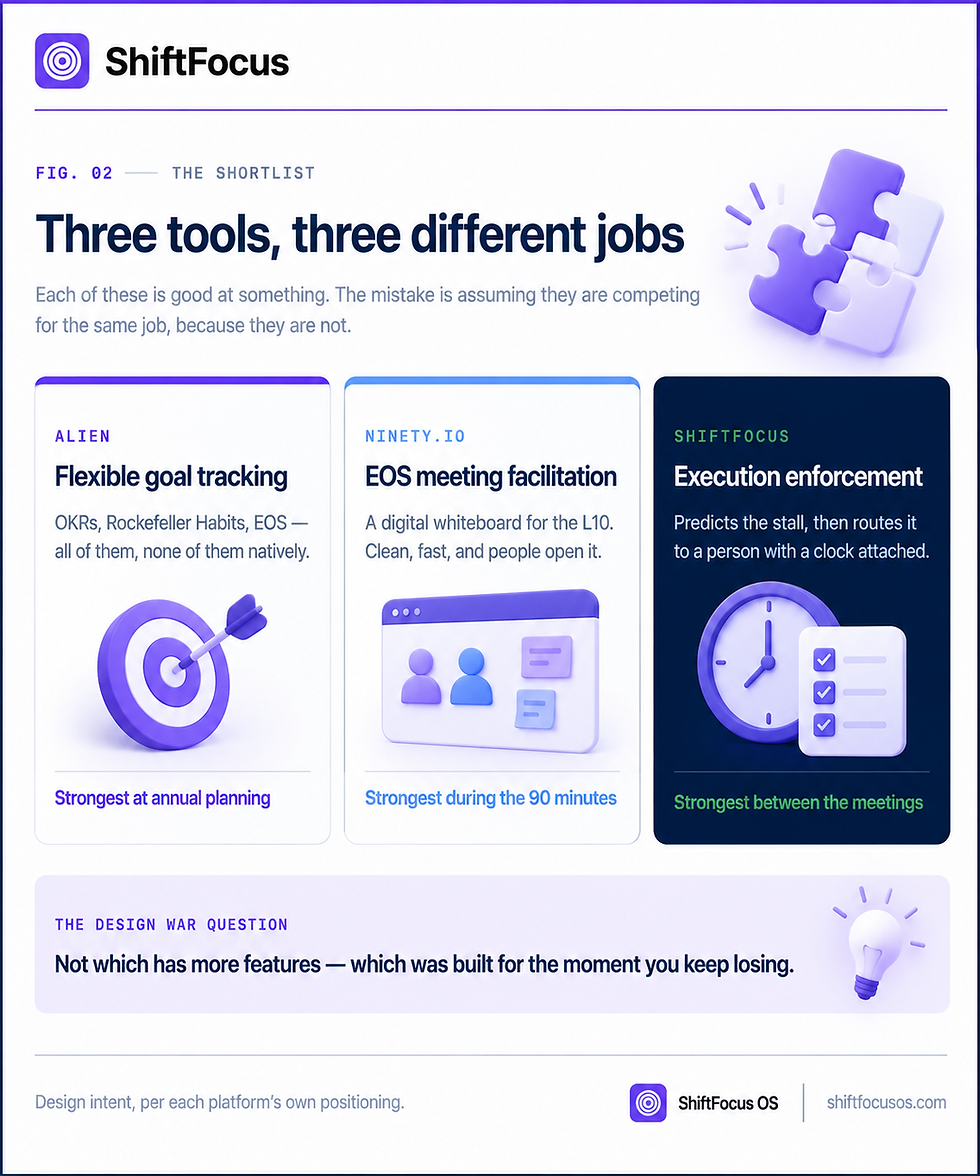
TABLE 02 · CATEGORY
Tracking, facilitating, enforcing
Align | ShiftFocus | ||
Tells you where you are | Yes | Yes | Yes |
Structures the meeting | No build it yourself | Yes, purpose-built | Yes, AI-generated brief |
Acts when something stalls | No | No | Yes, automatically |
Predicts the stall in advance | No | No | 2–3 weeks early |
Needs a person to chase | Yes | Yes | No |
Align: The OKR Tool EOS Teams Adopted Anyway and Where the Seams Show
Align allows you to pair annual initiatives alongside your goals so that key results and long-term plans live in the same view. This is great for high-level visualization. It helps you answer "Are we moving in the right direction?"
The Seam: The EOS framework relies on a specific rhythm, specifically the Level 10 meeting. Align does not have a built-in L10 meeting structure with the standard "Segments" (Good News, Scorecard, Rocks, Issues, To-Dos). You would have to manually build this structure in Align or run the meeting outside the software. By trying to be everything to everyone, Align lacks the specific "muscle memory" that EOS teams need to run an efficient meeting. It is a high-level strategic planning tool, not an EOS execution engine.
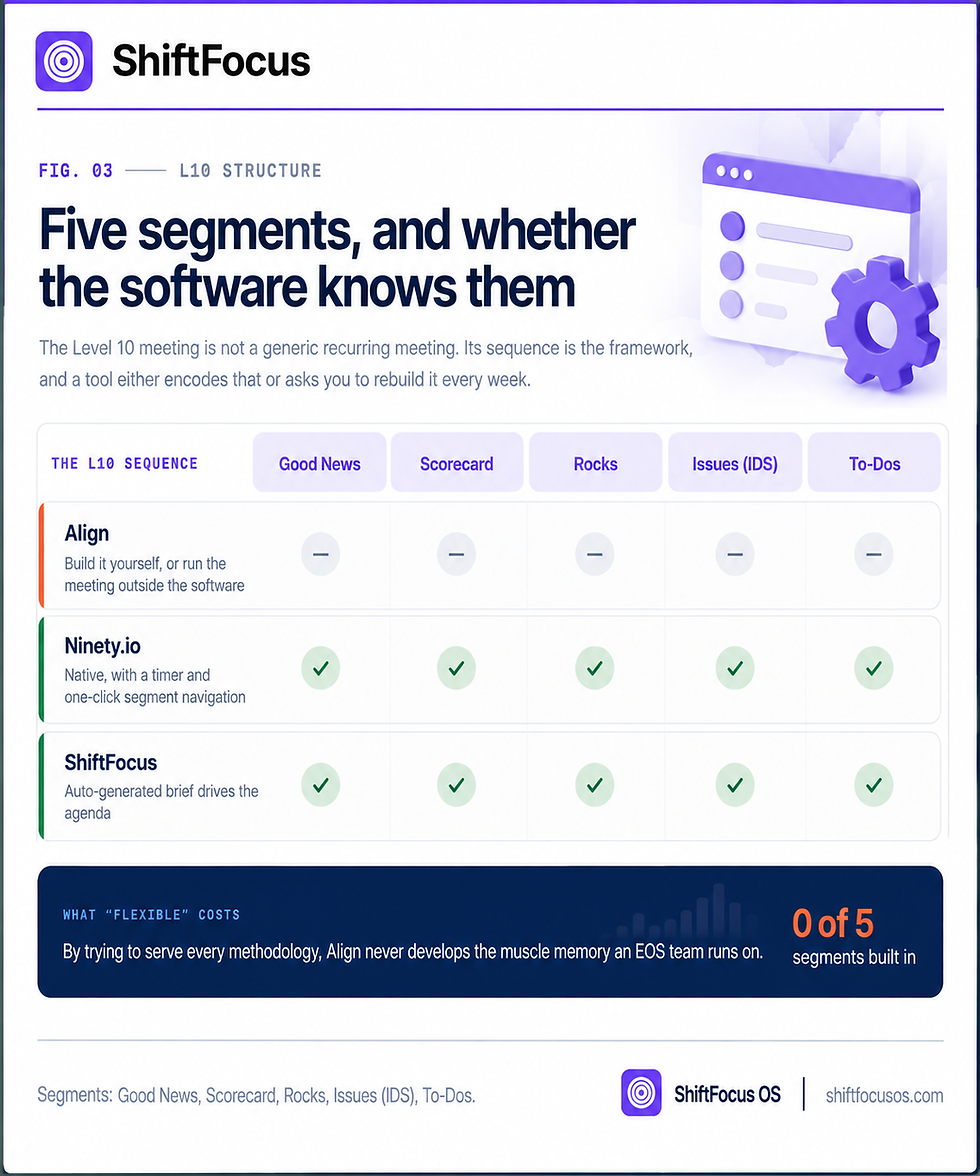
TABLE 03 · EOS STRUCTURES
Whether the framework is native or improvised
Align | Ninety.io | ShiftFocus | |
L10 segments (Good News → Scorecard → Rocks → Issues → To-Dos) | Not built in | Native | Native brief, auto-generated |
Meeting timer | No | Yes | Not the mechanism |
IDS issue processing | No | Yes | Issues routed to owners |
Rocks as a distinct object | Priorities among other goals | Yes, on the dashboard | Yes, with risk scoring |
Scorecard vs Rock distinction | Not modelled | Yes | Yes |
TABLE 04 · THE ALIGN SEAM
Where a flexible tool meets a rigid framework
Align | Ninety.io | ShiftFocus | |
Methodology fit | Any OKRs, Rockefeller, EOS | EOS only | EOS, OKRs, hybrid |
Goal-to-plan visualisation | Strong 3–5 year plans in one view | V/TO document | Live dependency graph |
EOS muscle memory | Absent must be simulated | Built in | Built in, plus enforcement |
Where the L10 actually runs | Outside the software | Inside the software | Inside, with prep automated |
Ninety.io: Strongest at Meetings, Weakest After the Meeting Ends
Ninety.io is a digital whiteboard for your L10. It is extremely user-friendly, allowing anyone to create tasks, host meetings, and view progress as it takes place. A study shows that 70% of digital transformation efforts fail simply because people refuse to use the tools; Ninety gets ahead of this by being a platform people actually want to open. You can get your first Level 10 meeting up and running within minutes.
The Ceiling: Once the meeting ends, active management ends. If your Scorecard goes red or your Rock is off-track, Ninety displays it in the software; it doesn't do anything about it. You have to wait until next week's L10 to discuss the failure. Furthermore, real user reviews state that entering scorecard data is not efficient, requiring "lots of pointing and clicking instead of tabbing/entering". Reporting is limited. Once you want deeper data or custom charts, "the walls start closing in pretty fast". It is clean, but passive. Example: Real user feedback notes that "Scorecards are very difficult to administer" and that you "cannot manage measures for users easily".
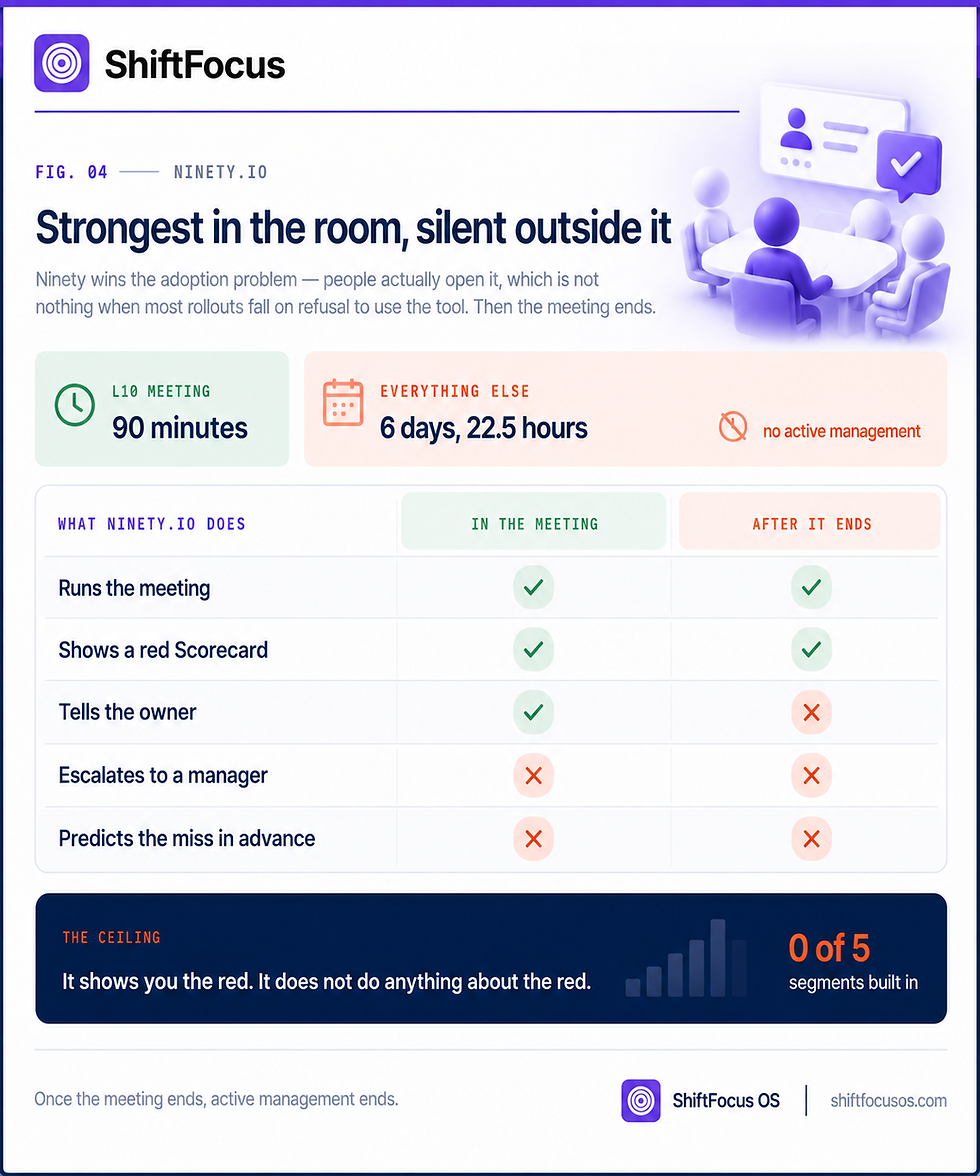
TABLE 05 · AFTER THE MEETING ENDS
The 89 days nobody watches
Align | ShiftFocus | ||
Rock goes off-track on day 8 | Visible if you look | Displayed in the software | Flagged and escalated |
Who is told | Nobody | Nobody | Owner, then their manager |
When it gets discussed | Next planning session | Next week's L10 | Within the escalation window |
Consequence of silence | None | None | Status decays automatically |
Follow-through depends on | Leader discipline | Leader discipline | The system |
TABLE 06 · REPORTED FRICTION
What real users say slows them down
Align | ShiftFocus | ||
Scorecard data entry | Custom dashboards | “Lots of pointing and clicking instead of tabbing” | 30-second check-ins |
Administering measures | Flexible but manual | “Very difficult to administer” | Owner and cadence inherited from the goal |
Custom reporting | Configurable | “The walls start closing in pretty fast” | Auto-generated exec brief |
Issues list ordering | N/A | Does not always show the same item on top for everyone | Auto-generated exec brief |
ShiftFocus: Built Around Enforcement, Not Tracking
ShiftFocus takes a different approach when it comes to execution. Ninety indicates when a task is red, but ShiftFocus predicts that you will fail before you actually reach that point. It employs predictive goal health scoring and risk detection to identify priorities that may stall 2-3 weeks in advance. It incorporates zero-meeting check-ins that take about 30 seconds, which helps keep your Rocks in focus without having to wait for the weekly meeting. Additionally, it automatically escalates when goals begin to stall, utilizing Slack or Teams triggers to ensure accountability.
The Pain Point is that ShiftFocus operates under the assumption that your team requires a "nudge" to carry out tasks. It is not merely a system for record-keeping; it acts as an active operator that addresses issues directly. This feature addresses the problem of the 89-day gap that exists between quarterly sessions, during which "Rock drift" can occur and hinder progress.
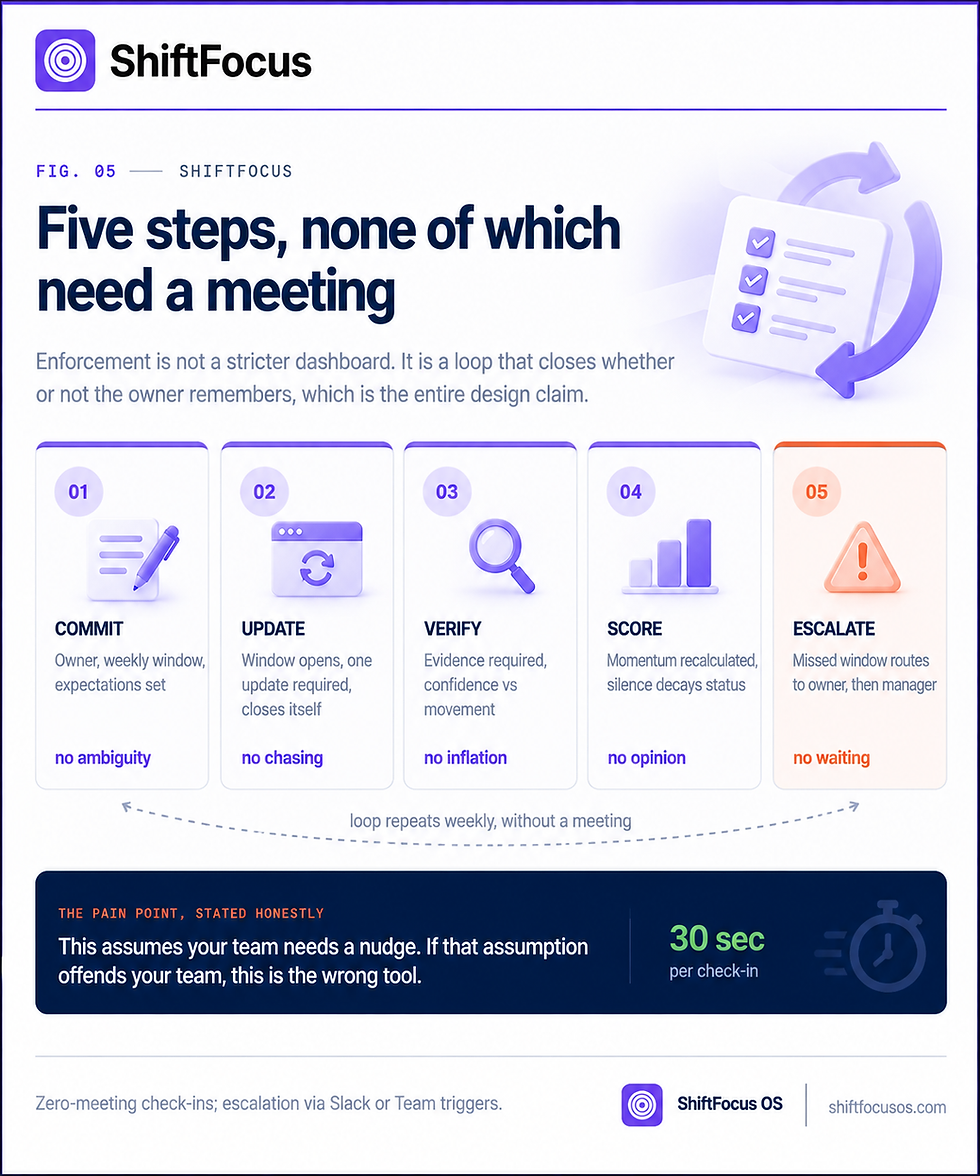
TABLE 07 · ENFORCEMENT MECHANICS
What actually happens when a Rock stalls
Align | Ninety.io | ShiftFocus | |
Detection | Manual review | Owner marks it red | Momentum score falls automatically |
Explanation | None | None | Missed check-ins, velocity decay, dependency age |
Routing | None | None | To the owner, then the manager |
Channel | In-app | In-app | Slack or Teams trigger |
If ignored | Waits for planning | Waits for the L10 | Escalates on a clock |
Side-by-Side: L10 Facilitation, Rocks, Scorecard, V/TO, Accountability Chart
L10 Facilitation:
Ninety.io: Layout is less busy on the eyes, making it smoother to work through issues. It functions as a strict meeting manager.
ShiftFocus: Uses strict AI-generated insights and narratives to keep the meeting efficient.
Align: This is not a standard feature. You have to customize dashboards to simulate a meeting.
TABLE 08 · L10 FACILITATION
Running the meeting itself
Align | Ninety.io | ShiftFocus | |
Meeting structure | Customise dashboards to simulate one | Strict meeting manager, clean layout | AI-generated insights and narrative |
Segment navigation | Manual | One-click next segment | Brief drives the agenda |
What the team spends time on | Assembling the view | Working through issues | Solving, not reviewing data |
Prep time before the meeting | Manual | Manual | Auto-generated |
Rocks:
Ninety: Show up right on your main dashboard for visibility.
ShiftFocus: Predicts risk of Rocks stalling 2–3 weeks early and escalates.
Align: Treats Rocks as high-level priorities that live among other goals, which can dilute focus.
TABLE 09 · ROCKS
Quarterly priorities, three ways
Align | Ninety.io | ShiftFocus | |
Where they live | Among other goals | On the main dashboard | In the risk queue |
Visibility | Diluted by other goal types | High | Exception-only for leaders |
Drift detection | None | None | 2–3 weeks before the deadline |
On drift | — | Displayed | Escalated with a recommended action |
Scorecard:
Ninety: Keeps things "straightforward" but users report difficulty in administering measures and entering data efficiently.
ShiftFocus: Offers outcome probability forecasting to tell you if your numbers will be met, not just if they were met last week.
TABLE 10 · SCORECARD
Weekly measurables and what happens to them
Align | Ninety.io | ShiftFocus | |
Setup | Custom KPI dashboards | Straightforward, but hard to administer | Inherits cadence from the goal |
Data entry | Manual | Point-and-click, users report friction | 30 seconds per item |
What it reports | Last week's number | Last week's number | Outcome probability for the target |
When a measurable goes red | Nothing | Displayed until the next L10 | Alerts owner and manager immediately |
V/TO:
Ninety: Looks like a "living document" that reflects the current business reality.
ShiftFocus: Uses a live dependency network graph to show how goals are linked.
Align: Provides a custom setup that visually connects goals and 3-5-year plans.
TABLE 11 · V/TO AND ACCOUNTABILITY
The strategic layer
Align | Ninety.io | ShiftFocus | |
V/TO | Custom setup linking goals to 3–5 year plans | Living document reflecting current reality | Live dependency network graph |
Accountability chart | Role clarity via goal ownership | Native EOS chart | Owner per line, with reliability scoring |
Who delivers consistently | Not tracked | Not tracked | Accountability heatmap over weeks |
Cross-team dependency | Visual goal links | Not modelled | Cascade failures spotted early |
Pricing Compared Per-Seat, Minimums, and What the "Free" Tier Actually Excludes
Ninety.io typically charges a base fee as well as a per-seat fee, which is usually around $16 per user per month for a standard plan – full access will require a paid subscription.
ShiftFocus is priced around $19 per user per month, including the "enforcement layer" without the need for an additional Integrator or consultant.
Align doesn't disclose their prices. They typically require a custom quote, meaning that you have to call them to get a price, and they don't usually have a free tier for full features.
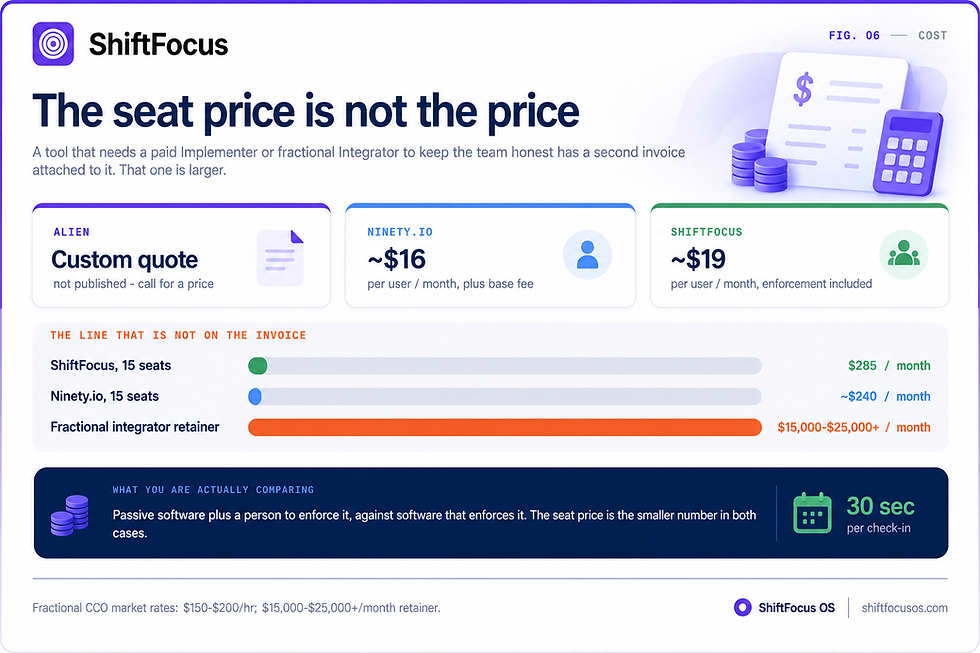
TABLE 12 · PRICING
Published, per seat, and what you actually pay
Align | Ninety.io | ShiftFocus | |
List price | Not disclosed custom quote | Around $16 per user per month | Around $19 per user per month |
Base fee on top of seats | Negotiated | Typically yes | No |
Free tier with full features | No | No | 90-day parallel pilot instead |
Price discovery | You have to call them | Published | Published |
Enforcement layer included | N/A | N/A | Yes |
TABLE 13 · THE COST THE LICENCE HIDES
What a team pays to keep itself honest
Align | Ninety.io | ShiftFocus | |
Software per user, per month | Custom quote | About $16 | About $19 |
Fractional Integrator retainer | Often required | Often required | The layer it replaces |
Typical fractional COO hourly rate | $150–$500 | $150–$500 | — |
Typical monthly retainer | $15,000–$25,000+ | $15,000–$25,000+ | — |
Who enforces accountability | A person you hire | A person you hire | The software |
Weekly Meeting Management: Which One Survives a 90-Minute L10 with 8 People
Ninety.io is built specifically for this environment. The meeting timer, the ability to click "Next Segment," and the visual priority of the Issues List work well. However, there are reports of glitches. When putting things in order in the Issues tab, "it doesn't always show the same issue at the top for everyone". If your meeting is fast-paced, this is frustrating. ShiftFocus, with its AI-generated insights, can streamline the conversation by highlighting the data that needs to be discussed, allowing the team to spend more time solving issues than reviewing data.
TABLE 14 · THE 90-MINUTE L10
Eight people, one meeting, no patience
Align | Ninety.io | ShiftFocus | |
Meeting timer and segments | Not native | Purpose-built, works well | Brief replaces the review portion |
Issues list priority | Manual | Reported to differ per user | One ranked queue |
Data review time | High assembling views | Moderate | Minimal pre-summarised |
Time left for solving | Low | Moderate | High |
KPI Accountability: Who Owns a Measurable and What Happens When It Goes Red
Ninety.io relies on the discipline of the leader to look at the red score and act. There is no consequence built into the software. ShiftFocus enforces action. If a measurable goes red, the system triggers alerts and escalations automatically to the owner and their manager, ensuring the issue isn't buried until the next L10.
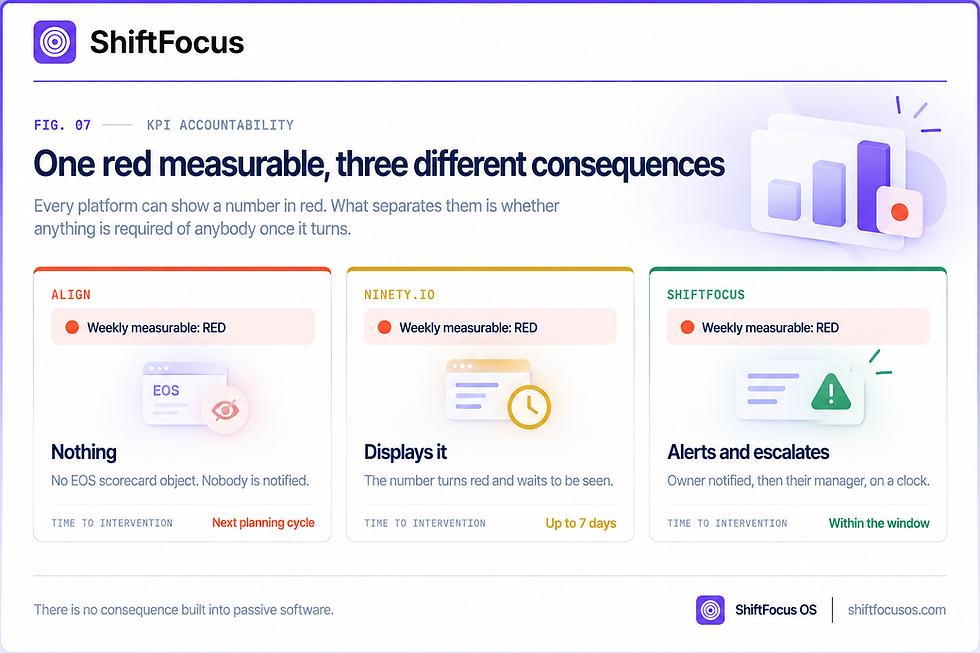
TABLE 15 · WHEN A MEASURABLE GOES RED
Ownership and consequence
Align | Ninety.io | ShiftFocus | |
Who owns it | The goal owner | The measurable owner | One named owner |
What the software does | Displays | Displays | Alerts and escalates |
Who else finds out | Nobody | The room, next week | The owner's manager |
Built-in consequence | None | None | Automatic escalation |
Time to intervention | Next planning cycle | Up to seven days | Within the window |
Ease of Use for SMB Leadership Teams (The Actual Switching Cost)
Ninety.io wins on initial ease. The interface is extremely well-laid-out. However, the "switching cost" is not just learning the buttons. For SMBs, the cost of a tool that requires a paid EOS Implementer to keep the team honest creates high friction. ShiftFocus argues that it lowers the switching cost by eliminating the need for a separate Fractional Integrator, automating enforcement for $19/user. Align, on the other hand, is flexible but lacks the rigid structure that SMBs need to stay on track.
TABLE 16 · SWITCHING COST
What it actually costs to run each one
Align | Ninety.io | ShiftFocus | |
Learning the interface | Moderate configurable | Low well laid out | Low check-ins in Slack or Teams |
Structure required to succeed | You supply it | You supply the discipline | The system supplies it |
Paid EOS Implementer needed | Often | Often, to keep the team honest | Not required for enforcement |
Ongoing admin | Dashboard maintenance | Scorecard administration | Auto-generated reporting |
Which One to Pick: Three Decision Paths by Team Size and EOS Maturity
Path 1 - The Experienced EOS Team (5-10 people): You are familiar with the system and need a clean digital record. Pick Ninety.io. It helps you to keep your V/TO and your meeting notes organized.
Path 2 - The Growing Team (10-25 people): You have a hard time holding people accountable between meetings. Pick ShiftFocus. You must have the enforcement layer to prevent "Rock drift" if you don't want to increase the number of managers.
Path 3 - The "Methodology Flexible" Team: If you are using OKRs or Rockefeller Habits with EOS. Pick Align. It allows you to plan initiatives visually (but you will have to do the L10 manually).
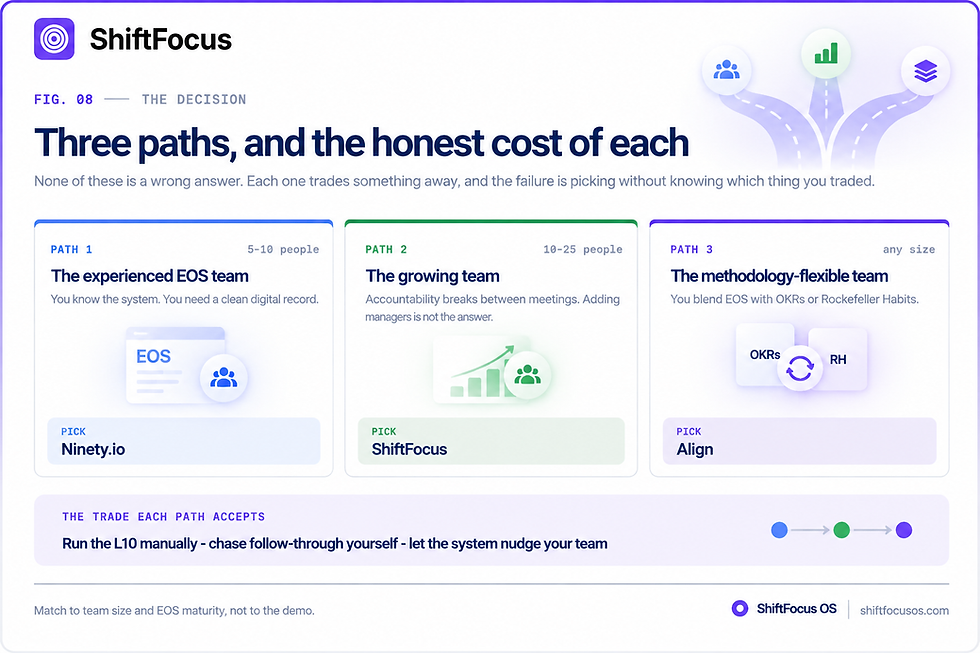
TABLE 17 · THREE DECISION PATHS
Match the tool to the team, not the demo
Align | Ninety.io | ShiftFocus | |
Experienced EOS team, 5–10 people | — | Pick this clean digital record | More than you need |
Growing team, 10–25 people | — | Accountability gaps between meetings | Pick this the enforcement layer |
Methodology-flexible team | Pick this OKRs plus EOS | EOS only | EOS, OKRs or hybrid |
The trade you accept | Run the L10 manually | Chase follow-through yourself | The system nudges your team |
FAQs
Is Ninety.io easier to use than Align?
Yes, for EOS specifically. Ninety.io provides a pre-built L10 framework so it can be up and running in minutes. Align needs to be tailored for EOS-specific meetings and structures.
Can Align run a Level 10 meeting properly?
No. Align does not come with any built-in L10 facilitation tools (Segments, IDS, and the specific meeting timer). You would have to maintain a manual record of the meeting or otherwise keep track of it without the software.
Which is better for KPI accountability on an SMB leadership team?
ShiftFocus. It allows predictive risk detection and auto-escalation, which will actively enforce accountability when a KPI enters the "Red Zone,". Ninety just presents the data and waits for the next meeting.
What does Align cost vs Ninety.io per user?
Ninety.io is usually priced around $16 per user per month and may include a base charge. The prices of Align are not published, and you will likely need to get a custom quote from them, which is typically at a higher level.
Do I need EOS-specific software or will an OKR tool work?
When using EOS strictly, EOS-specific software is required. There's no structural accountability in OKR tools like Align, and no distinction between Scorecard and Rock, as EOS does in a Level 10 meeting.
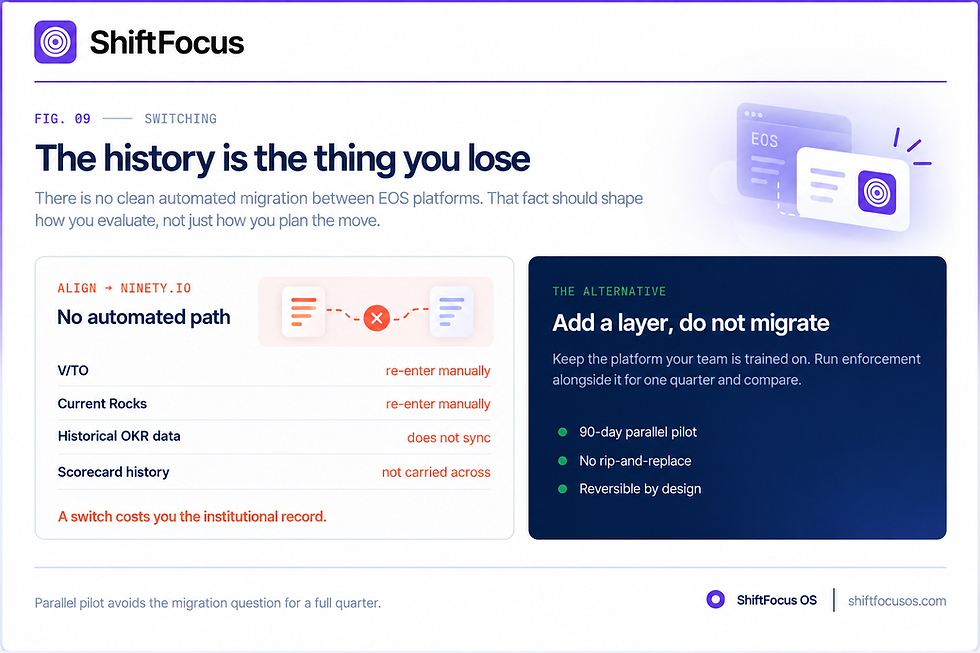
Can I migrate from Align to Ninety.io without losing history?
There is no simple automated migration for history or historical data. You will have to re-enter your V/TO and current Rocks manually. Historical OKR data from your Align account is not synced to Ninety.io.
Which platform do EOS Implementers usually recommend?
Ninety.io is a popular choice for EOS Implementers due to its intuitive interface and its EOS architecture. Professionals, however, say that it works best as a documentation tool, not a performance driver.
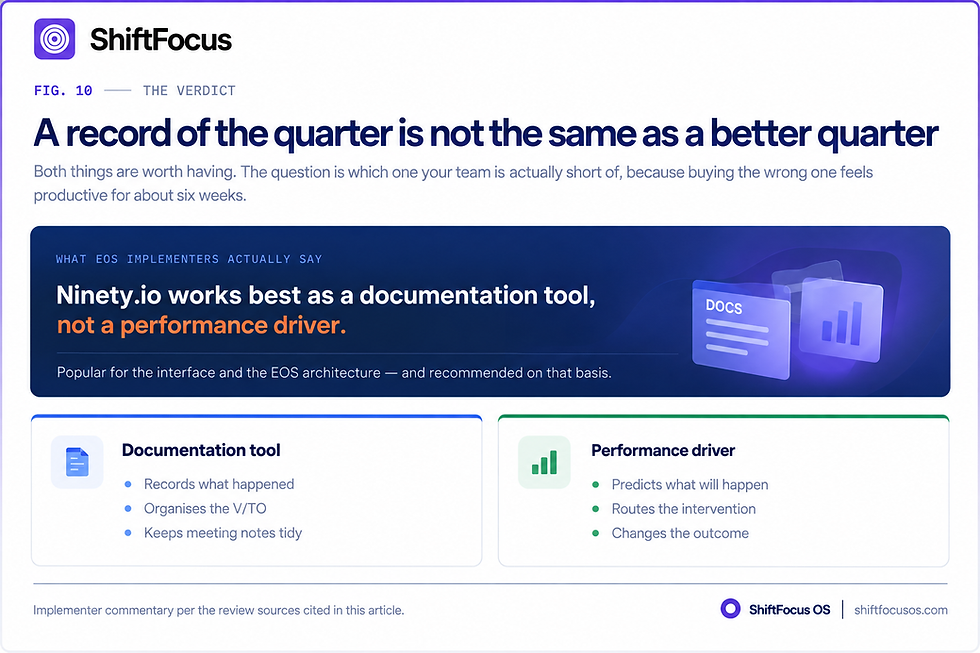
TABLE 18 · MIGRATION AND HISTORY
What survives a platform change
Align | Ninety.io | ShiftFocus | |
Automated history migration | No | No | OKR import supported |
V/TO and current Rocks | Re-enter manually | Re-enter manually | Imported |
Historical scorecard data | Not synced across | Not synced across | Trend reporting continues |
Recommended approach | — | — | 90-day parallel pilot, no rip-and-replace |


Comments