%20(3).png)
EOS Implementer vs Fractional Integrator: Why the Model Is Changing
- Daniel Madhan
- Jun 27
- 6 min read

Most small and mid-sized businesses fail not because of a bad idea, but because they cannot connect their big-picture goals to everyday operations.
Founders are usually visionaries. They dream big. But turning that dream into daily action is a completely different skill set, and most founders simply don't have it.
This is exactly where understanding the difference between an EOS Implementer™ and a Fractional Integrator becomes critical. Choosing the right role for your company could mean the difference between your business growing steadily or staying permanently stuck.

The Two Roles, Defined
EOS Implementer™
Think of an EOS Implementer™ like a coach who shows up, runs a workshop, and hands you the playbook. They're trained to teach your leadership team how the EOS system™ works. They come in for a full day, walk everyone through the tools and processes, and then head out. After that, it's on your team to actually put what they learnt from the EOS Implementer™ into practice.
Fractional Integrator
A Fractional Integrator is completely different. This person joins your company part-time but works like a real executive. They show up to your weekly meetings, help sort out people's problems, and make sure things actually get done every single day. They're not just explaining the plan they're actually working with the team.

How They Work (side-by-side table)
Dimension | EOS Implementer™ | Fractional Integrator |
Cadence | 5–8 sessions/year | Weekly + monthly + quarterly |
Pricing | $4,500–$6,600/day | $5K–$13K/month |
Role | Coach, facilitator | Operator, executor |
Year 1 cost | $36K–$53K | $60K–$156K |
Ownership | Teaches the framework | Owns the outcome |
Between sessions | Unavailable | Embedded |
When an EOS Implementer™ is Right
So, when does hiring an EOS Implementer™ actually make sense? It comes down to where your business currently stands.
If your company is completely new to EOS™, then bringing in a professional Implementer is a smart move. Think of them as a guide who walks you through the entire setup from scratch, step by step, so nothing gets missed or done incorrectly.
Another situation where an Implementer shines is when your leadership team already has a strong, capable person in the Integrator role. The Integrator is basically the person who keeps everything running smoothly day to day. If that person is already in place and doing well, you don't need someone to run things for you. You just need someone to teach you the EOS™ tools and then step back.
The Implementer model also works really well if your team is mature and disciplined enough to stay consistent. EOS™ runs on 90-day cycles called "Rocks," which are your most important priorities each quarter. If your team can hold itself accountable to hitting those goals every single quarter without falling off track, an Implementer gives you the structure and shared language to actually move forward together.
When a Fractional Integrator is right
When do you actually need a Fractional Integrator? It is when your business is running on EOS™, but things are starting to break down. Maybe your team keeps missing deadlines, or your previous full-time Integrator just left, and hiring a new one at $200,000 a year isn't realistic at the moment.
Here's a good way to know if you need one: look at your "Rocks." Rocks are your big quarterly goals. If your team is completing less than 70% of them regularly, that's a red flag. It means nobody is truly holding people accountable day to day.

The biggest mistake I see all the time is the CEO trying to do everything. They're supposed to be the big-picture thinkers (the visionary) but instead, they get pulled into managing daily operations. This quietly destroys growth because your attention is split in two directions at once.
A Fractional Integrator steps in and fixes this. They take over the day-to-day management of your business, keep the team focused, and make sure goals are achieved.
When You Need Both (and most don't realize it)
Here’s something most founders learn too late: building a system and maintaining a system are two very different roles.
Building a system and maintaining a system are two very different roles.
When you first hire an Implementer, their job is to build everything from scratch. They make sure the system is set up correctly and that everyone on your team knows how to use it.
Once the system is up and running, most businesses think the hard work is done. So, they carry on. And that's exactly where things start to go wrong. By year two, momentum slows, old habits creep in, and all of a sudden, EOS™ feels like it “stopped working”.
That’s where the role of a Fractional Integrator becomes vital. They jump in during or after the final stages of your EOS™ rollout and ensure the system really takes hold in the long run. They catch things early, they hold the team accountable, and they make sure daily decisions are in line with the bigger picture.
Why The Model Is Shifting Toward Fractional
The way businesses use EOS Implementers™ versus Fractional Integrators has changed a lot since 2016. The "session-only" approach was long thought to be the best option. This would involve a business hiring an Implementer for one day, paying them, and then waiting for the next time they were scheduled to come back.
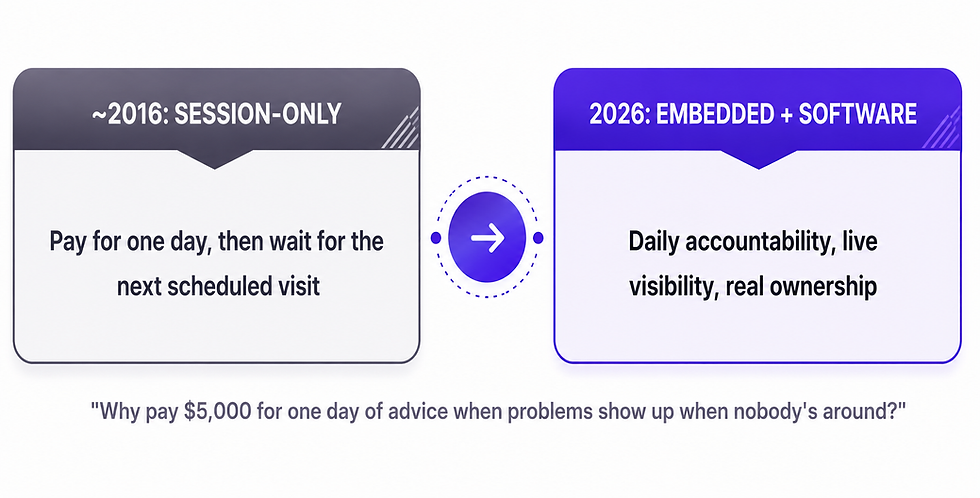
But companies started growing more complicated. They had more data to deal with, more moving parts, and larger teams. Leaders started asking a very fair question: "Why am I paying $5,000 for one day of advice when my real problems turn up when nobody is around to help?"
The reality is that leadership teams do not need to be coached just once a month. They need someone in the field with them. Someone who can read the profit and loss statement can intervene when two department heads are fighting, and ensure that the weekly L10 meeting takes place and is on track.
That's the main reason why businesses are moving towards the Fractional Integrator model. It's not about theories or frameworks taught in a one-day session. It's about true accountability, showing up consistently, and addressing problems as they occur.
The Role Of Software In This Shift
The Fractional model wouldn't even exist without the right software backing it up.
Tools like ShiftFocus, Ninety, and Bloom changed everything. Before these platforms came along, teams were juggling Rocks, To-Dos, and Issues through endless email chains and messy spreadsheets. Nothing got tracked properly. Things slipped through the cracks constantly. It was chaotic at best.
These platforms take all the invisible, behind-the-scenes work of running a business and put it in one clean, organized place. Your Fractional Integrator can log in from anywhere, check every department's numbers, and instantly spot where things are moving slowly or not moving at all.
That's a big deal.
It means your business gets real leadership and real accountability without needing someone sitting in your office five days a week. The software keeps everything visible, consistent, and on track day after day, not just during a quarterly check-in that everyone forgets about two weeks later.
How to Choose For Your Company

Not sure which is right for your company? Start by honestly answering these three questions:
Is your team completing their "Rocks" more than 80% of the time? If the answer is no, you don't need another training session. You need someone in your company holding people accountable an Integrator.
Is your CEO still drowning in daily HR drama and running every meeting? If yes, that's a problem. The CEO should be leading the company, not managing it. An Integrator takes that weight off immediately.
Does your team already know the EOS™ tools but simply isn't using them? That's not a knowledge gap that's a culture gap. A Fractional Integrator shows up every day and makes sure those tools actually get used.
If you're exhausted from watching great plans fall apart in execution, it's time to stop spinning your wheels. At ShiftFocus, our Fractional Integrator engagement bridges the gap between what you know and what actually happens. We bring the consistency, pressure, and steady leadership your team has been quietly waiting for.
Frequently Asked Questions
Can a Fractional Integrator replace an EOS Implementer™?
No. They serve different purposes. An Implementer is an expert at installing the framework. A Fractional Integrator is an expert at running the business using that framework. While some Integrators have deep EOS™ knowledge, the Implementer provides the objective, neutral third-party view required to settle high-stakes leadership conflicts.
Do Fractional Integrators need to be EOS™-certified?
Not necessarily, though it helps. What matters more is their experience as a former COO™ or CEO. A great Fractional Integrator understands how to drive results; their familiarity with EOS™ is the tool they use to do it.
What's the cost difference over 2 years?
An Implementer will cost you roughly $40k–$50k in the first year and less in year two. A Fractional Integrator is a higher recurring investment ($60k–$150k annually), but they pay for themselves by fixing execution errors, increasing revenue per employee, and freeing up the CEO to focus on high-leverage growth.
Can the same person be Implementer and Integrator?
It is rarely recommended. The Implementer role requires an outsider’s perspective to remain objective during "Issues Solving Tracks." If they become your Integrator, they lose their neutrality, and the "coach" becomes a "player," which changes the dynamic of your leadership meetings.


Comments