%20(3).png)
Why Your EOS Implementer Can't Fix Your Execution Problem Alone

Hiring an EOS Implementer™ doesn't automatically mean your team will get things done. Plenty of companies running EOS™ still fail to complete their Rocks™ every quarter and it's rarely the Implementer's fault.
EOS Was Never Built for Between-Session Accountability
EOS was never built to keep people accountable between sessions. You leave your first big planning day feeling motivated. You've got your Vision/Traction Organizer™ filled out and a fresh list of 90-day priorities. Everyone's excited.
The Familiar Story: Meetings Pushed, Rocks Buried, Quarter Behind
Then, meetings get pushed. Nobody revisits the Rocks. Important updates get buried in Slack channels that everyone ignores. Before you know it, your next Quarterly is approaching, and half your Rocks are behind.
What an EOS Implementer Actually Does (And Doesn't Do)
The Role: A Coach for the 6 Building Blocks
An EOS Implementer is a trained coach who walks your leadership team through the six building blocks of the Entrepreneurial Operating System™: Vision, People, Data, Issues, Process, and Traction™. Think of them as a guide their job is to teach your team the tools, lead the important planning sessions, and make sure everyone stays on track with the EOS approach. They are not there to run your business for you.
What Implementers Do: Yearly Planning, V/TO, Quarterly Rocks
What they do is genuinely valuable. They lead your yearly and quarterly planning meetings. They help you create your Vision/Traction Organiser (a document that maps out where your company is going), set goals for the next three years, identify what your company stands for, and lock in your short-term priorities called "Rocks." A great EOS Implementer can help a confused, misaligned leadership team get on the same page faster than you'd expect.
What Implementers DON'T Do: Day-to-Day Anything
What they don't do is stick around for the day-to-day activities. They won't show up to your regular weekly meetings. They won't chase down your marketing manager when she hasn't updated her goals in weeks. They won't flag it when your numbers look bad two weeks in a row with no one addressing the problem.
What Implementers Do vs Don't Do
What Implementers DO | What Implementers DON'T Do |
Lead annual and quarterly planning meetings | Show up to your regular weekly meetings |
Build your V/TO with you (3-year goals, core values, Rocks) | Chase down a marketing manager who hasn't updated goals in weeks |
Get a confused leadership team aligned fast | Flag bad numbers two weeks in a row when no one is addressing it |
Session Days vs the Other 87 Days: Where the Implementer Isn't Present
The Real Math: 5 Days Out of 365
During a typical EOS implementation year, your Implementer shows up for around 4 to 5 days in total. These include the Annual Planning day, three Quarterly sessions, and maybe one mid-year check-in. Five days out of 365 means your EOS Implementer is only in the room for about 1.4% of your entire year.

The presence gap
Five days out of 365 means your EOS Implementer is only in the room for about 1.4% of your entire year.
What Happens the Other 87 Working Days
So, what happens during the other 87 working days between sessions? That falls completely on your team. Your weekly L10™ meetings, your Rock updates, your Scorecard™ check-ins, your IDS™ conversations all of that happens without any outside guidance.
Where Most Companies Quietly Fall Apart
And here's where most companies quietly fall apart. According to data from EOS Worldwide™, businesses that struggle with Rocks don't usually fail because they set bad goals. They fail because they stop paying close attention to those goals week after week. The follow-through breaks down, and nobody notices until the Quarterly rolls around and it's too late.
The 70% vs 45% Completion Gap

Teams that review Rock progress every single week finish their Rocks at a much higher rate. One study within an Implementer network found that companies doing structured mid-cycle Rock reviews completed more than 70% of their Rocks. Companies that only checked in Quarterly completed only 45% of their rocks. Your EOS Implementer can run a brilliant Quarterly, but they can't build the habit of weekly accountability for your team.
Weekly Reviews vs Quarterly-Only at a Glance
Weekly mid-cycle Rock reviews | Quarterly-only check-ins |
Structured progress check every week | 90 days between status checks |
70%+ of Rocks completed | 45% of Rocks completed |
Catches problems while they're still small | Discovers problems on the last day of the quarter |
Why the Best Implementers Still Watch Their Clients Miss Rocks
Even 200-Client Implementers Admit This Problem
Even the most seasoned EOS Implementers who have worked with 50, 100, or even 200 companies openly admit to a problem that never seems to go away. You can have a flawless Quarterly session. Clear Rocks can be left with the right person with simple milestones. However, after three months, the team shrugs and says, "We were too busy.
The Pattern: Week 1-2 Energy, Week 5-6 Silence, Week 10 Behind
The pattern repeats itself each time. The team is energized in the first two weeks after a Quarterly. Rocks get updated. The weekly L10 meeting runs smoothly. Then, around week five or six, someone quietly stops checking in on their Rock. No one points it out. No one asks why. Two or three Rocks are already behind by week ten, and the team is now trying to catch up with 12 weeks of work in the final weeks before the next Quarterly.
Why Urgent Always Beats Important Without Outside Pressure
When there's no regular outside nudge keeping goals front and centre, everyday urgent tasks take over. Long-term goals are silent. The need to act is almost always the deciding factor.
Why EOS Is Designed Around Weekly Rhythms
That's why EOS is designed around weekly rhythms goals must be constantly tended to survive real life. The problem is that the weekly rhythm only works when people are held to it. The Implementer can see this pattern a mile away. They can name it, explain it, and coach around it. But they can only do so much. They're not in the building every week and that gap is where Rocks gets forgotten.
Goals must be constantly tended to survive real life.
The Implementer's Frustration: Teaching the System vs Enforcing the System
The Difference Business Owners Never Think About
There's something most business owners never think about when they bring in an EOS Implementer. There's a huge difference between teaching a system and enforcing one.
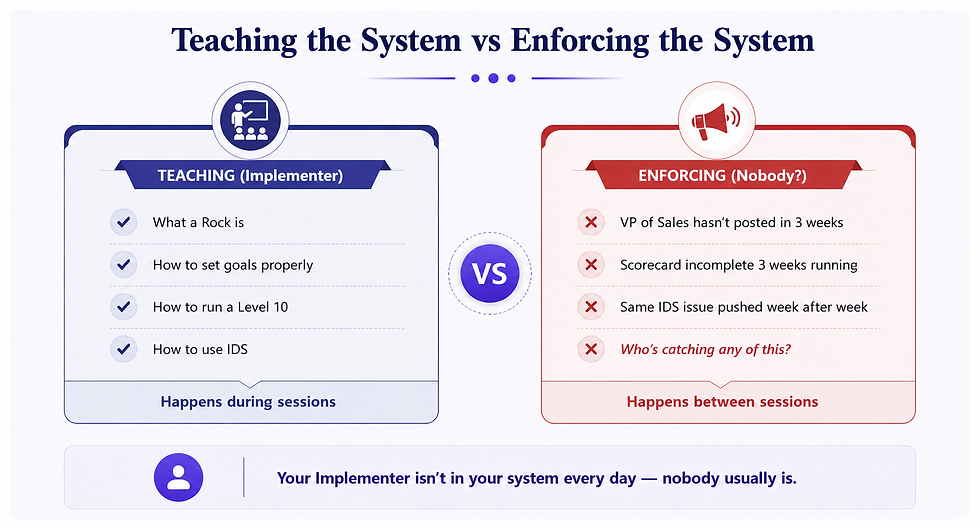
Teaching Happens During Sessions
Teaching happens during your sessions. You learn what a Rock is, how to set goals properly, how to run a Level 10 meeting, and how to work through problems using the IDS process. Implementers are genuinely great at this part.
Enforcement Happens Between Sessions (Where No One Is Watching)
Enforcement is a completely different story and it happens between sessions. Think about it: who's actually checking in on your VP of Sales when his Rock deadline is two weeks away and he hasn't posted a single update in nearly three weeks? Who's noticing that your Scorecard has been left incomplete for three weeks straight? Who's catching the same IDS problems that keep getting pushed to next week's meeting, and the week after that, with no real solution?
Your Implementer Isn't Inside Your System Every Day
Your Implementer isn't doing any of that. They're not inside your system every day. They're not reading your meeting notes. And honestly, most businesses can't afford to pay an Implementer for that kind of daily attention. Their whole business model is built around powerful, focused sessions that happen a few times a year. In between, the expectation is that your internal EOS Champion picks up the slack.

The Hidden Problem: Your EOS Champion Has a Day Job
Here's the problem: your EOS Champion is also managing a whole department. They're dealing with daily fires, urgent tasks, and constant distractions, just like everyone else on your leadership team. So who's really keeping the system alive between sessions? That's the gap nobody talks about.
Teaching vs Enforcing Side By Side
Teaching (Implementer) | Enforcing (Nobody, usually) |
What a Rock is, how to set goals | Checking your VP of Sales hasn't posted in 3 weeks |
How to run a Level 10 meeting | Noticing the Scorecard is incomplete 3 weeks straight |
How to work through IDS | Catching the same IDS problem being pushed week after week |
Happens during sessions (~5 days/yr) | Happens between sessions (~360 days/yr) |
What Implementers Wish Existed: Software That Enforces Between Sessions
The Thing Implementers Think But Don't Say Out Loud
This is something that most EOS implementers will not say out loud, but they all think it. They want a tool that keeps teams accountable even when no one's watching. A quiet presence in the background, working every day to ensure that the work is actually completed between visits every three months.
Why Project Management Tools and Spreadsheets Don't Cut It
Most teams resort to basic project management software or to the old-fashioned spreadsheet. However, those tools don't speak EOS. They will not link a missed Scorecard number with an Issue on your Level 10 agenda. They will not mark a Rock that has been sitting quietly for two months. They sit there, doing nothing, and accountability slowly slips away.
What "Designed for EOS" Actually Has to Mean
What implementers really want is software that is designed for EOS. A system that reminds your team every morning, ensures that Scorecards are updated before the weekly meeting, and will not allow anything important to remain hidden. That's a digital enforcer that keeps the entire team to the EOS standard.
What implementers actually want
A digital enforcer that keeps the entire team to the EOS standard not a tool that sits there doing nothing while accountability slips away.
How Enforcement Tools Make Your Implementer More Effective, Not Less
The Wrong Way to Think About EOS Software
Some leadership teams believe that once they have an EOS software platform, they don't need an Implementer. That's completely the wrong way to look at it.
When the Base System Runs Itself, Your Implementer Does Higher-Value Work
When your team actually uses the system regularly not just during scheduled sessions, your Implementer gets to show up and do the real, meaningful work. Rather than spending time on the basics, they can concentrate on the bigger picture how to solve real business problems, how to make their leadership team more effective, and how to create more effective decision-makers throughout the organization. That's where the true value of an Implementer lives.
Willpower Isn't a System
If you don't have that base, you're just hoping that everyone will remember to follow the system because they are motivated to do so. That's not realistic. The whole idea of a structured system is to eliminate the need for constant willpower to make good habits automatic, not difficult.
It's Not Your Implementer's Fault It's Missing Infrastructure
If your team is constantly going back to the same patterns between sessions, it's not your Implementer's fault. It just means that you don't have the proper infrastructure in place to keep things moving in the right direction. Put that piece in place, and everything your Implementer worked hard to build will finally stick.
Implementer + Enforcement Tool: How They Work Together
Implementer alone | Enforcement tool alone | Both together (ShiftFocus) |
In the room 5 days/year. Coaches between sessions remotely at best. | Reminds and escalates daily. Doesn't replace the strategic coaching. | System runs itself daily. Implementer focuses on real business problems. |
Wins on teaching | Wins on enforcing | Wins on both every Rock has both teaching and enforcement |
Put that piece in place, and everything your Implementer worked hard to build will finally stick.
The Bottom Line
It's not your Implementer's fault it just means you don't have the proper infrastructure to keep things moving between sessions.


Comments