%20(3).png)
EOS Annual Planning: How to Run the 2-Day Session

By Madhan | Founder, ShiftFocus OS
The EOS annual planning refers to more than just an annual goal-setting gathering. This is a time when the leadership of a company analyzes the previous year, verifies if the direction of the company is still reasonable, and prepares the plan for the coming year. The real test comes after this, as the company needs to be able to implement that plan regardless of the changing situation in the market and other external factors. Thus, the importance of having a solid EOS annual planning process is obvious.

PART A: WHAT EVERYONE COVERS
What Is EOS Annual Planning? Annual vs Quarterly Planning
EOS annual planning is the annual leadership event that involves the analysis of the past year, renewal of the company vision, and creation of the one-year plan. The quarterly planning happens every three months and indicates the preparation for the next quarter. Annual planning looks further ahead and sets the major direction for the entire year.
Area | Annual planning | Quarterly planning | In ShiftFocus |
|---|---|---|---|
How often | Once a year | Every 90 days | Multi-period planning (Q/H/Y) |
Length | Two days | One day | Plan lives in one place all year |
Horizon | 3-Year Picture and 1-Year Plan | Next quarter's Rocks | Goal cascading and alignment |
Main output | 1-Year Plan and Q1 Rocks | Rocks for the next quarter | Every goal gets an owner and a weekly update window |

Who Attends the EOS Annual Planning Session and Why Offsite
The leadership team are major participants, as these are corporate-level choices. The individuals bearing the responsibility for important choices ought to assist in devising the plan.
An off-site meeting is beneficial as it eliminates usual distractions. It does not have to be costly. The place where the meeting is held should be free of any distractions to allow for thoughtful and comprehensive discussions and decision-making.
Seat | Why they are in the room | What they bring |
|---|---|---|
Owns the long-term direction | The 3-Year Picture view | |
Integrator | Turns the plan into execution | Last year's goals and results |
Sales lead | Owns the revenue number | Pipeline and close rates |
Operations lead | Owns delivery capacity | Hours, staffing, workload |
Finance lead | Owns the budget | Year-end financials |
EOS Annual Planning Day 1 Agenda
Day 1 concentrates on the past prior to planning for the future. The team connects, assesses the previous year’s results, discusses the state of the team, processes the SWOT and Issues List, and updates the Vision and Traction Organizer (V/TO). The goal is not rewriting all of the information, but about ensuring that the leadership agrees on the company’s path.
Day 1 block | Question it answers | Output |
|---|---|---|
Check-in | How is everyone arriving? | Wins and expectations |
Prior-year review | What did we hit and miss? | Results vs last year's plan |
Team health | Do we work well together? | Named people and trust issues |
SWOT + Issues List | What helps or blocks us? | A ranked Issues List |
V/TO review | Is our direction still right? | An updated V/TO |
EOS Annual Planning Day 2 Agenda
Day 2 transforms the direction into reality. The team processes the 3-Year Picture, 1-Year Plan, and Q1 priorities. The issues are addressed, action items are decided, and the team is informed of the order of actions. The basic connection is:
3-Year Picture → 1-Year Plan → Q1 priorities → execution.

Day 2 block | What gets decided | Owner | Tracked in ShiftFocus |
|---|---|---|---|
3-Year Picture | Revenue, profit, what the company looks like | Visionary | Goal hierarchy |
1-Year Plan | 3 to 7 annual goals | Leadership team | Annual goals with owners |
The first 90 days of work | Each Rock owner | Weekly check-ins (30 sec) | |
IDS + next steps | Who does what, by when | Integrator | Auto-escalation when goals stall |
PART B: WHAT WE ADD
The Pre-Mortem: “It’s December 31, and We Failed. What Happened?”
Conduct a pre-mortem in your EOS annual planning session before the targets are established.
Inform your team:
“It’s December 31, and we missed out on the plan for the year. Why?” Give them a few minutes to write their responses.
Possible responses could be:
Hiring happened too late.
The pipeline was not strong enough.
A big customer left.
Delivery was unable to cope with the workload.
There were too many tasks.
The sales team sold work that couldn’t be done by Operations.
Lastly, use responses to identify the risks of your annual plan. This approach works in one simple way. The team highlights the points of failure before the project is approved.

Pre-mortem answer | Early signal to watch | Check it | ShiftFocus flag |
|---|---|---|---|
Hiring happened too late | Open roles past start date | Monthly | Deadline enforcement |
Pipeline not strong enough | Qualified opportunities vs plan | Weekly | Salesforce pipeline tracking |
A big customer left | Top-account health | Monthly | Automated risk alerts |
Too many tasks | Rocks per owner | Quarterly | Live dependency graph |
Sales sold work Ops can't do | Delivery hours booked vs free | Weekly | Risk detection 2-3 weeks early |
Running It Before the Goals Are Locked
Don’t carry out the processes when the leaders have fixed their target. Instead of asking, “How can we make it to ten million dollars?” ask the question: “What should be true for the amount of ten million dollars to be realistic?” This will make your team review their sales capabilities, prices, pipeline, etc.
Pre-mortem after goals lock | Pre-mortem before goals lock | |
|---|---|---|
Question asked | How do we hit $10M? | What must be true for $10M? |
What the team does | Defends the number | Tests the number |
Risks found | Late, at the quarterly | Early, in the session |
Result | A target | A target with a plan |
Annual Planning Revenue Math Check
Back-solve the revenue goal in the annual plan. For example, if the revenue target for the year is $6 million, and if the average size of the deal is $100,000, we can calculate the number of deals required as follows:
$6M ÷ $100K = 60 deals.
Now, if the closing rate is assumed to be 25%, the qualified opportunities required would be:
60 ÷ 0.25 = 240 qualified opportunities.
Now, a concrete test for the leadership team has been formed against which it can be measured. The leadership team can be expected to close 40 deals. If they are asked to close 60, it would mean that a 50% increase is expected, and the underlying cause leading to this improvement must be specified.

Step | Math | Result |
|---|---|---|
Revenue target | Set in the 1-Year Plan | $6,000,000 |
Average deal size | From last year's actuals | $100,000 |
Deals needed | $6M ÷ $100K | 60 deals |
Qualified opportunities | 60 ÷ 25% close rate | 240 |
Gap to today | 60 vs 40 deals | +20 deals (+50%) |
When the Number Does Not Add Up
The number of deals needed is 60, but if the current sales team does not have the capability of closing more than 40 deals, leadership will have to either recruit additional salespeople, which will lead to an increase in costs, or increase the amount of sales generated per person, or find a new marketing channel capable of delivering higher revenue, or set a different revenue goal.
Option | Cost | Must be true | Track it in ShiftFocus |
|---|---|---|---|
Hire salespeople | Salary before revenue | Hired by Q1, ramped by Q2 | Deadline enforcement |
More sales per rep | Training and tools | Close rate rises above 25% | Progress tracking and analytics |
New marketing channel | Marketing budget | Channel adds pipeline by Q2 | HubSpot CRM integration |
Set a different goal | Lower growth | Team agrees on the new number | Goal re-set with owner sign-off |
Capacity Check: Do We Have the People for This Annual Plan?
Revenue leads to business opportunities. Suppose a service establishment needs to complete 600 tasks. For each one, the company requires 20 hours of delivery.
Calculation:
600 x 20=12000 hours.
One worker has roughly 1260 hours of working time per year.
Calculation:
12000/1260 = 9.5.
Thus, a business needs about ten employees to do this amount of work. Given that the company has only six employees, there is a gap in its feasibility plan. The solution may be employing more workers or changing plans and processes.

Hours and Hires Needed per Goal
Conduct the calculations on the efforts necessary to achieve major operational objectives.
Goal | Required Hours | Available hours | Gap |
|---|---|---|---|
600 projects | 12,000 | 7,560 | 4,440 |
New service line | 2,400 | 1,800 | 600 |
Support expansion | 3,000 | 2,200 | 800 |
The detected gaps signal that some decisions concerning staffing or processes must be made.
Goal | Gap hours | Hires at 1,260 hrs | Decision |
|---|---|---|---|
600 projects | 4,440 | 3.5 | Hire or cut scope |
New service line | 600 | 0.5 | Part-time or contractor |
Support expansion | 800 | 0.6 | Process fix first |
Total | 5,840 | 4.6 | Budget for 4 to 5 roles |
Linking the Annual Plan to the Budget
The budget and annual plan should be in agreement. Let’s say that the expenditure for recruiting would be $180,000, for purchasing equipment it is $100,000, and $75,000 is the budget for marketing. So, $355,000 is needed for making the investments.
If there are only $200,000 provided for it, the leaders should not disregard the difference. They should determine the important investments that should be made, when, and with what expected results.

Line | Amount | Share of the ask |
|---|---|---|
Recruiting | $180,000 | 51% |
Equipment | $100,000 | 28% |
Marketing | $75,000 | 21% |
Funded | $200,000 | 56% |
Unfunded gap | $155,000 | 44% |
Setting Quarter Targets for Seasonal Businesses: Why Revenue ÷ 4 Is Wrong
Ideally, annual sales for businesses that are seasonal cannot be obtained just by dividing sales over 4 quarters.
Let’s assume we are expecting to achieve sales of $4 million during the year. However, we should also take into consideration seasonality in the last four quarters: 15% in Q1, 20% in Q2, 25% in Q3, and 40% in Q4.
Quarter | Projection |
|---|---|
Q1 | $600,000 |
Q2 | $800,000 |
Q3 | $1,000,000 |
Q4 | $1,600,000 |
Total | $4,000,000 |
Setting the revenue for the four quarters to be $1 million is not very reasonable.

Quarter | Revenue ÷ 4 | Seasonal target | Difference |
|---|---|---|---|
Q1 | $1,000,000 | $600,000 | −$400,000 |
Q2 | $1,000,000 | $800,000 | −$200,000 |
Q3 | $1,000,000 | $1,000,000 | $0 |
Q4 | $1,000,000 | $1,600,000 | +$600,000 |
Three Scenarios: Base, Downside, Upside
It is good to develop three different scenarios before working out the annual plan.
Scenario | Expected Sales | vs Base | What leaders prepare |
|---|---|---|---|
Downside | $3.2 million | −20% | Which spend to pause |
Base | $4 million | — | The operating plan |
Upside | $4.6 million | +15% | Capacity for extra demand |
Base means the operating plan has been formed. Downside indicates the areas of risk. Upside represents whether there are enough resources to meet improved demand.
A Filled-In Example: A 40-Person Services Firm's 1-Year Plan
Let us examine a 40-person services firm with annual objectives:
Goal | Annual Targets |
|---|---|
Revenue | $8m |
Gross Margin | 42% |
Client Retention | 90% |
Billable capacity | 7200 hours/month |
When we assume the average contract price of $80,000:
$8,000,000 ÷ $80,000= 100 contracts.
By winning 25% of the contracts:
100 ÷ 25%= 400 qualified opportunities.
The team then lays out the expected course of the year:
Quarter | Main Priority |
|---|---|
Q1 | Fill in the pipeline and hire two professionals |
Q2 | Improve utilization and revenue |
Q3 | Maximize the strongest service line |
Q4 | Ensure retention and finish the year |
In that way, Q1 plans will contribute to the achievement of the annual target without turning it into a new list of everything they would like to achieve.
Annual goal | Owner | Weekly measure | In ShiftFocus |
|---|---|---|---|
$8m revenue | Sales lead | Qualified opportunities | Pipeline tracking |
42% gross margin | Finance lead | Margin by project | Executive dashboards |
90% retention | Customer Success | Renewals at risk | Automated risk alerts |
7,200 billable hrs/month | Operations lead | Utilization | Momentum analytics |
The 30 Days After the Annual Planning Session
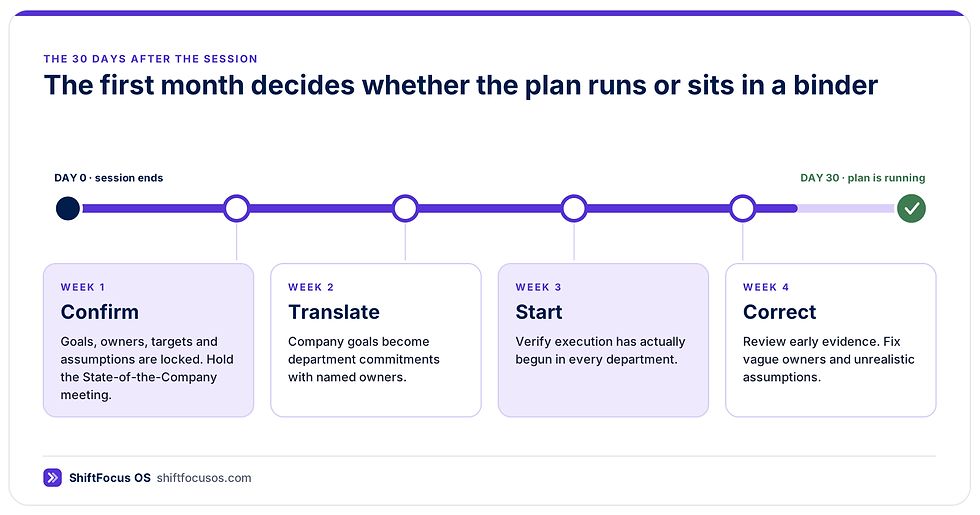
The EOS annual planning session only constitutes a starting point. In 30 days, leadership has to communicate the annual plan, convert main objectives into commitments made at the level of departments, and the level of responsibility. The first month is a period when all theoretical matters get actualized. If departments understand the plan differently, the errors should be fixed as soon as possible.
The State-of-the-Company Meeting
To successfully execute the strategic plan, it is necessary to clarify goals for the organization. This involves communicating the strategic concept to employees and answering three questions: what the organization’s goals are, their importance, and each department’s responsibility.
Question | What employees should hear |
|---|---|
What are the goals? | The 3 to 7 goals in the 1-Year Plan |
Why do they matter? | The reason behind each goal |
What is my department's part? | The department priority tied to each goal |
Rolling It Out to Department Priorities
It has to be taken into account that corporate goals need to be implemented on the departmental level. For example, if the company has set the goal of increasing its retention rates from 85% to 90%, the Customer Success department might be responsible for managing the renewal processes, and the Product department might be in charge of solving recurring issues. Each departmental goal should be related to the corporate plan. It is necessary to develop a timetable for implementing the plan.
Level | Goal | Measure |
|---|---|---|
Company | Raise retention from 85% to 90% | Retention rate |
Customer Success | Manage the renewal process | Renewals closed on time |
Product | Solve recurring issues | Repeat tickets per month |
Week-by-Week Checklist
In the first week, corporate goals, responsible persons, targets, and relevant assumptions should be confirmed. In the second week, corporate goals should be translated into departmental commitments. In the third week, the commencement of execution should be verified. As for the fourth week, early evidence should be reviewed to rectify vague responsibilities and unrealistic assumptions.
Week | Leadership task | Done when | ShiftFocus support |
|---|---|---|---|
1 | Confirm goals, owners, targets | Every goal has one owner | Goal templates and library |
2 | Translate into departments | Each department has commitments | Goal cascading and alignment |
3 | Verify execution has started | First check-ins are in | Structured check-ins |
4 | Review early evidence | Vague owners are fixed | Weekly Exec Brief |
Rules for Changing the Annual Plan Mid-Year
An annual plan shouldn't undergo alterations every time a company does not meet a target. However, it needs pre-planned modifications anytime a key assumption has changed.
One can ask:
What has changed?
Is it significant?
Does the original goal hold water?
What would take its place?
Having lost a customer representing 20% of annual income is not comparable to failing to reach one monthly goal.
Situation | Change the plan? | Why |
|---|---|---|
Lost a customer worth 20% of income | Yes | A key assumption changed |
Missed one monthly goal | No | Normal variance |
Rock behind for three weeks | No | Escalate and recover first |
Market price drops for the year | Review | Revenue math may no longer hold |
Checking Every Month That the Year Is on Pace
The annual objectives need to be checked regularly. Assume the annual goal is $8 million. After two months, the income equals $1.4 million.
Straight-line pace = $8 million/12 months x 2 months= $1.33 million.
So, it means that the company is doing well. However, seasonal businesses should apply their predicted curve, rather than straight-line calculations.

Method | Expected after 2 months | Use it when |
|---|---|---|
Straight-line | $1.33M of $8M | Revenue is flat across the year |
Seasonal curve | Your predicted share | Some quarters carry more revenue |
Actual | $1.40M | Compare to the right method |
Where ShiftFocus Shows Annual Pace Against the Plan
An annual plan can be accurate while not working well due to gradual change. ShiftFocus's technology allows businesses to track goals, ownership of tasks, developments, blockages, and indicators of execution so that management can notice when the plan goes astray. The question to ask is not merely, "Did we achieve all our annual goals?" The correct question to ask is: "Did we follow a reasonable process towards accomplishing them?"
Annual plan question | Spreadsheet or binder | ShiftFocus |
|---|---|---|
Is the year on pace? | Last month's number | Momentum analytics and trend forecasting |
Who owns each goal? | A name in a cell | An owner with a weekly update window |
Is anything stuck? | Found at the quarterly | Risk detection 2-3 weeks early |
Did someone go silent? | Not visible | Silence decays status, auto-escalation |
Quarterly prep | Hours of compiling | Auto-generated Weekly Exec Brief |
EOS Annual Planning FAQs
What is EOS annual planning?
EOS annual planning is a two-day planning seminar devoted to evaluating the past year and developing plans for the next one. It provides a link between the long-term vision of the company and the annual and quarterly priorities.
How long is the EOS annual planning session?
Usually, two days are given to this planning seminar: the first day is targeted mainly on review and defining the direction; the focus of the second day is on making plans.
What’s the difference between annual and quarterly planning?
Annual planning presents the main direction and goals of the year, while quarterly planning is focused more on getting updates and identifying the main priorities for the next three months.
When should we hold EOS annual planning?
Most companies conduct their annual planning meetings either towards the end of the current year or before the start of the next financial year. Therefore, it is best to conduct it at a time when the leaders have good year-end operational and financial information.
Do we need to go offsite?
Not necessarily. However, conducting the meeting offsite will allow for less distraction and better discussions. What matters more than the venue is the fact that there is protected time for the leadership team to meet.
Who should attend?
The leadership team has to take part in the meeting since it will be responsible for major company decisions. The right participants are the people who will make the decisions and implement them.
What pre-work is required?
The required pre-work includes gathering the financial results, goals from the previous year, operating statistics, customer information, staffing data, and current planning documents. All participants should come prepared to discuss the facts instead of using meeting time to gather them.
Pre-work item | Who brings it |
|---|---|
Financial results | Finance lead |
Last year's goals and results | Integrator |
Operating statistics (Scorecard) | Each leader |
Customer information | Sales and Customer Success |
Staffing data | Operations or HR |
Current V/TO and plans | Everyone reads it first |
How many annual goals should we set?
Maintain the quantity at a level that would support the concentration. The EOS suggests implementing three to seven primary targets within the 1-Year Plan.
What is the 3-Year Picture?
It describes what the company should look like three years from now. It connects longer-term direction with the more specific goals in the 1-Year Plan.
How do I check that the revenue goal is realistic?
Start from revenue and work in reverse order by utilizing the average transaction value, required sales, percentage of successful deals, pipeline kind, and distribution capability. If the calculated figure serves as a basis for significant improvement in the general performance, find how this achievement could be accomplished.
How should seasonal businesses split quarterly targets?
It should be done based on historical seasonality and expected demand, not by subdividing annual revenue into four equal parts.
Should the annual plan be tied to the budget?
Yes, the budget should provide for the necessary resources for implementing the plan. Any critical discrepancy should be rectified before the execution begins.
Can we change the annual plan mid-year?
Yes, if there is a major change in circumstances affecting the original assumptions. Avoid changing the goals simply because it is hard to implement the plan.
What if we badly missed last year's goals?
It is necessary to identify the reason why. Distinguish between invalid assumptions and lack of proper execution before considering what needs to be changed in the new plan.
Can we do it without an implementer?
This is possible, but the leadership team should have enough discipline to deal with the assumptions and make difficult decisions.
How much does a facilitated annual planning session cost?
The cost cannot be determined as there is no general pricing structure. EOS Implementers determine their own fees, which means it’s best to get in touch with the facilitator to find out the price.
Can EOS annual planning be done virtually?
Yes, a virtual session can be successfully conducted if the team manages to create a distraction-free environment for the meeting.
How do we share the plan with the whole company?
The explanation should include the main goals and their significance as well as mentioning the responsibilities of each department. Employees need to understand how their jobs fit into the plan for the year.


Comments