%20(3).png)
25 Company OKR Examples That Cascade into Real Team Commitments

Updated: Sep 30
Successful businesses do not accomplish their bold objectives just because all departments work harder, but because all teams aim for the same strategic results. Properly crafted company OKRs provide such agreement by linking the corporate goals with measurable contributions of every department, thus eliminating repetitive objectives.
This is a guide with real company OKR examples demonstrating how company-wide OKRs can be translated into solid commitments for each department, including marketing, sales, product, and customer service departments.
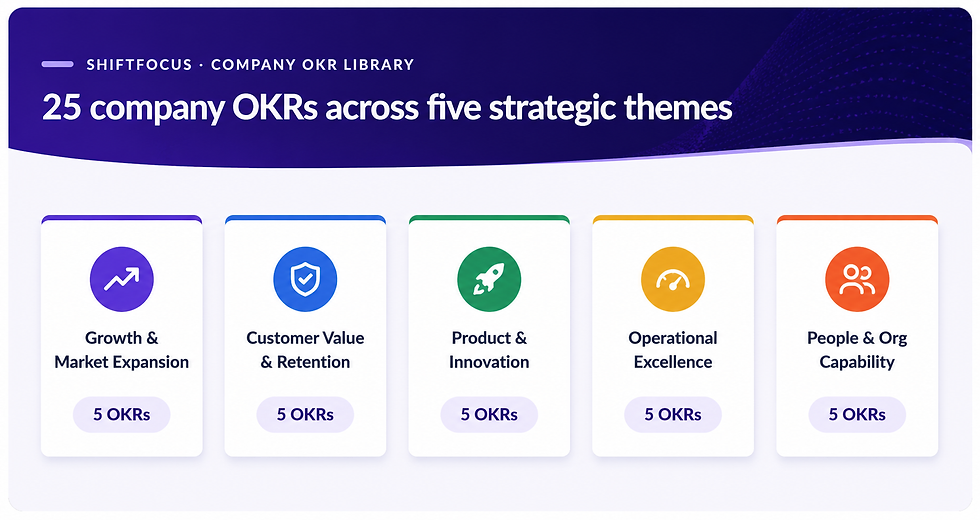
▍ 25 COMPANY OKR EXAMPLES AT A GLANCE
Theme | Company OKR examples | Typical owner |
Growth and market expansion | New market entry, enterprise growth, channel expansion, category leadership, international revenue | CEO, CRO |
Customer value and retention | Customer retention, time-to-value, product adoption, customer experience, strategic-account growth | CCO, VP Customer Success |
Product and innovation | New-product adoption, platform expansion, product quality, innovation pipeline, AI adoption | CPO, CTO |
Operational excellence | Margin, delivery reliability, execution speed, capacity, process simplification | COO, CFO |
People and capability | Leadership capability, critical hiring, internal mobility, manager effectiveness, employee retention | CHRO |
What Makes Good Company OKR Examples
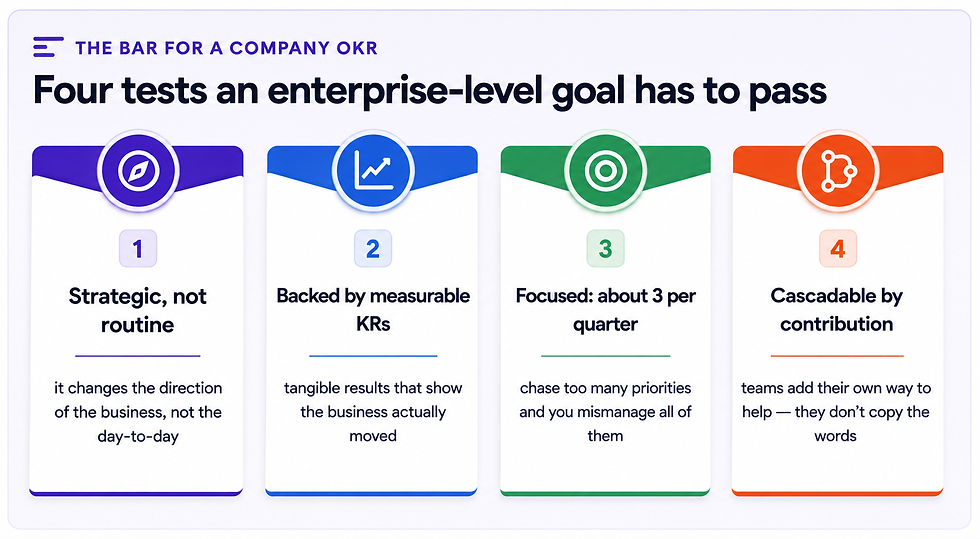
An essential business goal may not always mean that it qualifies as a company’s OKR. The best company OKR examples are centered around the major objectives that require collaboration from all of the departments and approval from the top-level managers.
Strategic, not departmental
An organizational Objective has to be perceived as a strategic achievement of the whole organization instead of a goal for one department. For instance, “Enter the enterprise market” is considered an objective of an entire organization since it means that all functions of marketing, sales, product development, finance, and customer service must work together. However, “Generate more marketing qualified leads” is targeted only at the marketing department.
Cross-functional
In strong company OKR examples, collaboration between departments is a must. As soon as each function knows how it contributes to a strategic objective, the business has less trouble in coordinating the execution of objectives.
Measurable at company level
Company Objectives need to be backed up by tangible Key Results that indicate the success of business operations. For instance, the level of customer growth, revenue uplift, product uptake, customer retention, or operational capacity.
Limited to the few biggest priorities
Businesses that tend to focus on too many goals usually mismanage all of them. Usually, companies must zero in on 3 goals each quarter, which provides greater concentration of resources and leadership involvement.
Supported by team commitments
For a company Objective to be attainable, teams need to come up with specific ways of contribution. Rather than rewriting the same Objective, departments prepare their own set of Key Results, which would highlight their roles in the achievement of the goals.
Company OKR Examples for Growth and Market Expansion
The success of growth strategies relies on coordinated activities in various business areas. The following company OKR examples can be useful to organizations that need assistance in changing their position in the market or expanding into new territories, and/or growing their strategic accounts:
New market entry
Objective: To successfully enter a new market.
Key Results:
Enter one new geographic market or industry during the quarter.
Acquire first 100 qualified customers in the new market.
Reach the revenue goals within 6 months.
Create local partnerships or distribution channels in the region.
Enterprise growth
Objective: To increase the number of enterprise customers acquired.
Key Results:
Increase enterprise pipeline (opportunities) by 30%.
Increase the enterprise win rate by 15%.
Shorten the enterprise sales cycle.
Increase the average value of contracts with enterprise clients.
Channel expansion
Objective: To generate scalable revenue from partners and channel routes to market.
Key Results:
Recruit new strategic partners in the channel.
Increase revenue generated by partners by 20%.
Enhance completion rates of partner onboarding.
Conduct joint marketing campaigns with target partner groups.
Category leadership
Objective: To solidify the market leadership position of the company in its primary market category.
Key Results:
Increase brand awareness in key sectors.
Boost win rate in comparison with competitors.
Increase share of voice in main communication channels.
Publish leadership content that is an industry benchmark.
International revenue
Objective: To develop revenue from foreign markets.
Key Results:
Increase revenue generated from foreign sources by 25%.
Launch localized marketing campaigns.
Improve efficiency of international customer acquisition.
Increase coverage of customer support in priority markets.

Example: How One Company OKR Cascades Across Teams
One common misunderstanding is that all business departments must duplicate the corporate Objective. That’s not how good company OKR examples work. The management sets the company goal, which each department must achieve using its own methods.
Company Objective:
To increase the income from operations by advancing the organization in the healthcare market.
Team | Supporting Objective | Example Key Result |
Marketing | To raise awareness among those who make decisions in healthcare. | Provide 300 qualified enterprise healthcare leads. |
Sales | To convert potential healthcare opportunities into customers. | Increase the winning rate of the enterprise healthcare by 15%. |
Product | To provide necessary capabilities for the customers from the healthcare sector. | Implement 3 compliance features that have been recognized as high priority. |
Customer Success | To improve onboarding and retention of healthcare accounts. | Achieve 95% retention after 90 days. |

Company OKR Examples for Customer Value and Retention
This set of company OKR examples will pay special attention to enhancing long-term relationships between customers and the business by using a coordinated approach within product development, sales, customer success and support, and marketing teams:
Customer retention
Objective: To increase the long-term retention rate of customers.
Key Results:
Increase the company’s annual retention rate by 10%.
Reduce churn rates that could have been avoided by 20%.
Increase renewal rates for key accounts.
Identify and eliminate the five main causes of customer attrition.
Time-to-value
Objective: Help customers derive value from the business products more quickly.
Key Results:
Accomplish a 30% reduction in average time-to-value.
Achieve a higher completion rate of onboarding processes during the first 30 days.
Enhance customer satisfaction level during the onboarding process.
Reduce the number of delays during the implementation process for the new clients.
Product adoption
Objective: To encourage the adoption of the company's most beneficial capabilities.
Key Results:
Boost adoption of product features in the leading sectors by up to 25%.
Increase the number of people who use the available features.
Enhance the range of capabilities being utilized by the company’s enterprise customers.
Minimize the number of inactive users.
Customer experience
Objective: To guarantee remarkable customer satisfaction.
Key Results:
Increase customer satisfaction rates across all support channels.
Reduce the average effort required from customers throughout the processes.
Increase the percentage of issues being resolved at first contact.
Shorten the time required for addressing important requests.
Strategic-account growth
Objective: To stimulate the provision of maximum value to strategic customers.
Key Results:
Boost expansion revenues from strategic customers by 20%.
Improve management engagement with main customers.
Increase cross-selling with existing enterprise accounts.
Implement quarterly business reviews with each top customer.

Company OKR Examples for Product and Innovation
Innovation should be aligned with the objectives of the business strategy instead of merely adding features to the products. The following company OKR examples can prove to be beneficial for organizations because they could improve product quality, stimulate product adoption, and foster innovation, bringing the required impact to the customers:
New-product adoption
Objective: To increase the successful adoption of new products.
Key Results:
Reaching the desired adoption levels within 90 days after launching the new product.
Making onboarding for new product releases more customer-friendly.
Increasing the usage of the product by the existing customers.
Collecting the right feedback from customers after launching the product.
Platform expansion
Objective: To expand the capabilities of the strategic platform.
Key Results:
Completing platform expansion on time.
Increasing the level of platform acceptance by enterprise customers.
Increasing the reliability of the platform after expansion.
Increasing the usage of the platform by customers.
Product quality
Objective: To ensure better customer experiences.
Key Results:
Decreasing the defects reported by customers by 30%.
Improving quality of launches across the teams.
Reducing the number of critical incidents in production.
Increasing the coverage of automated tests performed on important features.
Innovation pipeline
Objective: To boost the innovation potential of the organization.
Key Results:
Validate at least 5 new conceptualizations of products quarterly.
Grow the number of experiments of products launched because of customer input.
Refine the process of converting product ideas into projects.
Prioritize the innovations based on concrete customer value.
AI or automation adoption
Objective: To increase the effect of artificial intelligence and automation on the business.
Key Results:
Use automation for the most prioritized operational processes.
Boost the productivity of workers with the help of artificial intelligence.
Reduce the use of manual processes in all areas.
Assess the impact of automation on the results of operations and customers.
Company OKR Examples for Operational Excellence
The concept of operational excellence plays a vital role in not only providing consistent results but also creating better efficiency, profitability, and quality. These company OKR examples concentrate on enhancing the systems that improve the general performance of the organization rather than individual departments:
Margin
Objective: To increase the profits of the organization through better collaborative practices.
Key Results:
Increase the gross profit margin by 5%.
Minimize waste in the operational process.
Improve cost efficiency without reducing product or service quality.
Discover 3 new vital methods for enhancement in terms of cost optimization.
Delivery reliability
Objective: To achieve more consistent delivery of the products and services.
Key Results:
Make 98% of the deliveries on time.
Decrease the number of missed delivery contracts by 30%.
Increase customer satisfaction with deliveries.
Eliminate the recurring problems causing delivery delays.
Execution speed
Objective: To improve the functional speed of the company without reducing the quality of its products.
Key Results:
Reduce the time of completion of projects by 20%.
Speed up decision-making across various functions and departments.
Eliminate unnecessary approval stages for crucial workflows.
Increase the number of strategic initiatives completed on time.
Capacity
Objective: To increase the company’s efficient capacity to stimulate future growth.
Key Results:
Increase the efficiency of the use of resources in key business functions.
Eliminate operational restraints which impact various growth initiatives.
Improve planning of workforce needs in the future.
Increase the availability of resources to carry out strategic projects.
Process simplification
Objective: Make the core business processes simpler.
Key Results:
Reduce process handoffs across major workflows.
Standardize the methods of operation in different divisions.
Avoid unnecessary approvals and duplication of work.
Increase the level of employee satisfaction with the processes they are engaged in.

Company OKR Examples for People and Organizational Capability
Success in the long term means having good people, training leaders for the future, and ensuring that employees work efficiently in the right atmosphere. These company OKR examples are one of the ways to enhance the company's efficiency in achieving goals through proper utilization of human resources.
Leadership capability
Objective: Strengthening the leadership capacity of the company.
Key Results:
Conduct leadership training programs for all managers.
Increase the number of internal promotions for employees.
Increase leadership efficiency rates according to the employees’ feedback.
Develop succession plans for every top position.
Critical hiring
Objective: To fill critical positions in order to achieve the strategic goals of the company.
Key Results:
Fill all priority strategic leadership and technical positions on time.
Increase the number of accepted offers.
Reduce the time-to-fill for critical positions.
Increase the quality of hiring.
Internal mobility
Objective: To increase the opportunities for career development for the employees.
Key Results:
Increase the number of internal transfer requests.
Increase the participation of employees in career development programs.
Expand career opportunities due to internal transfers.
Promote a higher number of high-performing employees.
Manager effectiveness
Objective: To enhance the efficiency of frontline managers.
Key Results:
More coaching conversations are completed.
The results of manager efficiency evaluation in employee surveys will increase.
The process of providing performance feedback from different departments will be standardized.
The number of employee complaints related to management will decrease.
Employee retention
Objective: To retain employees with high performance.
Key Results:
The regrettable voluntary turnover rate will decrease by 15%.
The level of employee engagement will improve.
More employees will join retention initiatives.
Track and handle the top causes of employee attrition identified through feedback.
How Company OKRs Should Cascade
With efficient cascading, alignment is achieved, and not duplication. A business goal expresses the intended achievement of the firm. Each department mentions goals it can influence, and provides its objectives and initiatives at the team level.
Company Outcome
The objective of the organization must define the strategic business goals that each employee aims to achieve. It is the end goal, and not the work process of each department.
Team Contribution
Every department contributes in a different manner to achieving the objective; marketing helps to create a need, sales create demand, and the customer service department works on the process of adoption and usage of the new product.
Supporting Key Result
Each department measures the results that it can control. For instance, the marketing department measures the qualified leads, the products department measures the adoption of the products, and the customer service department monitors the number of renewals.
Initiative
The initiatives consist of the different actions performed by the teams, with the help of which they achieve their Key Results. They define the process of achieving the desired outcome, but do not feature the Key Results in themselves.
Dependency
Almost all company OKRs attributed to an entire organization require the collaboration of various departments. Therefore, recognizing what depends on each group beforehand allows the teams to plan their priorities properly and eliminate the factors limiting their efficiency throughout the quarter.
Why teams should not copy the parent Objective word-for-word
By copying the company’s Objective, the departments miss the whole point and lessen accountability. Rather, every department should have measurable performance indicators that it is responsible for, which will help it in pursuing the overarching aims of the relevant organizational strategy. As a result, accountability increases and everyone is on the same page with regard to the direction of the company.
Company OKR Example: Complete Cascade Diagram
COMPANY OBJECTIVE: To increase enterprise revenue by 20%.
Marketing Team
Supporting Outcome:
Increase qualified enterprise demand.
Key Result:
Build 500 qualified enterprise leads.
Initiatives:
ABM campaigns.
Executive webinars.
Industry content.
Dependency:
Sales feedback about the quality of leads.
Sales Team
Supporting Outcome:
Convert enterprise opportunities.
Key Result:
Increase enterprise win rate from 24% to 30%.
Initiatives:
MEDDICC qualification.
Executive selling.
Pipeline coaching.
Dependency:
Marketing pipeline + Product roadmap
Product Team
Supporting Outcome:
Increase readiness for enterprise products.
Key Result:
Create 4 enterprise-focused capabilities.
Initiatives:
SSO.
Audit logs.
Advanced reporting.
Dependency:
Customer Success feedback
Customer Success
Supporting Outcome:
Improve enterprise retention.
Key Result:
Boost the renewal rate of enterprise accounts to 96%.
Initiatives:
Executive Business Reviews.
Adoption plans.
Success playbooks.
Dependency:
Product releases + Sales handoff

How Many Company OKRs Should Be Set
Organizations are likely to do better with their execution efforts if they focus only on a few strategic priorities. Studies made by John Doerr and Christina Wodtke give continuous recommendations to focus on those goals where the biggest profits may be achieved.
Three to five company Objectives
Most organizations have to set no less than 3 and no more than 5 Objectives at the company level at the beginning of the quarter. This decision provides focus while the organization will possess enough resources to implement them successfully.
Limiting Key Results
More than 3-5 Key Results have to be set with each Objective. A larger number of Key Results makes the focus weaker and the implementation harder.
Capacity and resource checks
Before company OKRs are approved, it’s essential to check that the company has enough people, money, technology, and support from the executives to achieve them.
What to exclude
Day-to-day operational duties, repetitious departmental KPIs, maintenance activities, and personal performance objectives should normally not be incorporated into company OKRs unless they explicitly contribute to the accomplishment of a strategic business goal.

Common Company OKR Mistakes
Even the most experienced organizations can undermine the effectiveness of their company OKRs due to a lack of understanding of the mechanism of strategy alignment.
Every department goal treated as strategic
Not every departmental goal can be considered significant enough to attract management’s attention. Executive OKRs must be focused on the priorities that warrant cross-functional involvement.
Copy-and-paste cascading
Departments need to focus on different contributions to the same corporate outcome instead of just replicating the same objectives throughout the organization.
No dependency ownership
Cross-functional projects fail when there is no ownership of dependencies between teams. Therefore, leadership must identify and manage these dependencies throughout the implementation process.
No resource allocation
Strategic priorities need resources, staffing, leadership attention, and operational support. Without resources, even excellent OKRs remain merely aspirational.
Too many company priorities
Companies attempting to implement 10 strategies generally see fewer results than companies with a clear focus on about 4 or 5 realistic Objectives.

Company OKR Examples: Frequently Asked Questions
What are company OKRs?
Company OKRs are Objectives and Key Results assigned throughout an organization concerning the most essential strategic priorities a business has.
How many OKRs should a company have?
Most organizations perform best with around 3-5 company Objectives each quarter and 3-5 Key Results for each of them. This minimization favors organizational effectiveness without putting much pressure on the units.
How do company OKRs cascade?
Company Objectives indicate the outcome to be achieved strategically. Departments create their own Objectives associated with the company Objective. Teams do their work to secure and accomplish these company Objectives, making sure they are fulfilling their own targets as well.
Should every department align to every company Objective?
Departments need to be aligned only with the corporate objectives that they can have a meaningful impact on. Forcing all departments to take part in all objectives can create extra complications.
Who owns company-level OKRs?
The executive leadership team usually bears the responsibility for the company OKRs. Individual executives may be responsible for certain objectives. However, all executives together are responsible for making sure that the priorities have everything they need for success.
Where can I set, track and manage company OKRs?
In OKR software. A spreadsheet works for a few company OKRs, but it breaks once each one cascades to four or five teams. ShiftFocus links every team key result to its company OKR, runs weekly check-ins and flags cross-team dependencies before they slip.


Comments