%20(3).png)
20 PR OKRs for Media Authority, Message Pull-Through, and Reputation

Your PR OKRs determine whether you're a press-release factory or a strategic brand builder. They are what separates the PR teams that get noticed from those that don't.
Too many communications professionals still run on spreadsheets with columns listing the number of times their content was picked up by various media outlets, how many impressions their campaigns drove, and similar metrics that have completely lost their power to impress leaders at senior levels.
Leadership teams want to see proof of impact, but instead they're handed data points that have no real value to them. Boards stopped believing these metrics a long time ago, while CFOs have always been unconvinced of their relevance.
It's not a question of whether you are working hard enough. It's about which metrics you're choosing to track. In this guide, we’ll share 20 specific PR OKR examples that allow you to measure influence, message pull-through, and reputation not just the volume of press releases issued.
PR OKRs Should Measure Influence Not Press-Release Volume
Coverage quantity versus coverage quality is the first battle you must win. 100 mentions in irrelevant blogs are nothing. A single feature in a Tier One publication can make or break a business. It's not only about the numbers, but the quality of each placement as well.
Message pull-through is what separates strategic PR from noise. Was your core message included in the journalist's article? Did they accurately position your company?
Authority is the currency of modern PR. Is the reporter calling you first? Are analysts quoting you? Does your category show your name in the AI engine search? These are the results that count.
Sentiment and reputation outcomes are the ultimate proof of PR value. Are people talking about your brand more in a positive way? Do you have a plan in place for a crisis? These are the numbers that will get you to the executive table.
Business relevance is non-negotiable. If your PR OKRs don't align with revenue, talent acquisition, or market positioning, then you're just spending money.
Four PR OKRs for Media Authority
Tier-one media coverage
Objective: Build category authority by getting coverage in most influential industry publications.
Key Results:
Land coverage in 8 named tier-1 category publications by end of quarter. No tier-2 outlets points.
Secure a weighted media outlet quality score of 85 or better in all placements.
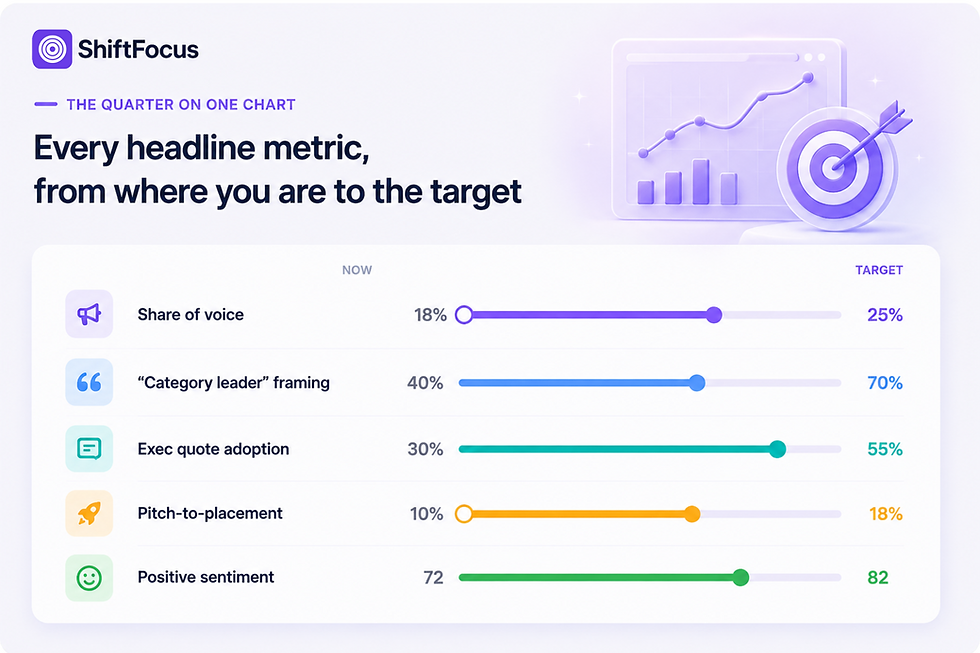
Increase the pitch-to-placement ratio from 10% to 18% for top-tier targets.
Secure at least 2 cover stories or exclusive interviews in major business or trade outlets.
Share of voice
Objective: Dominate the media conversation in our category and outperform key competitors.
Key Results:
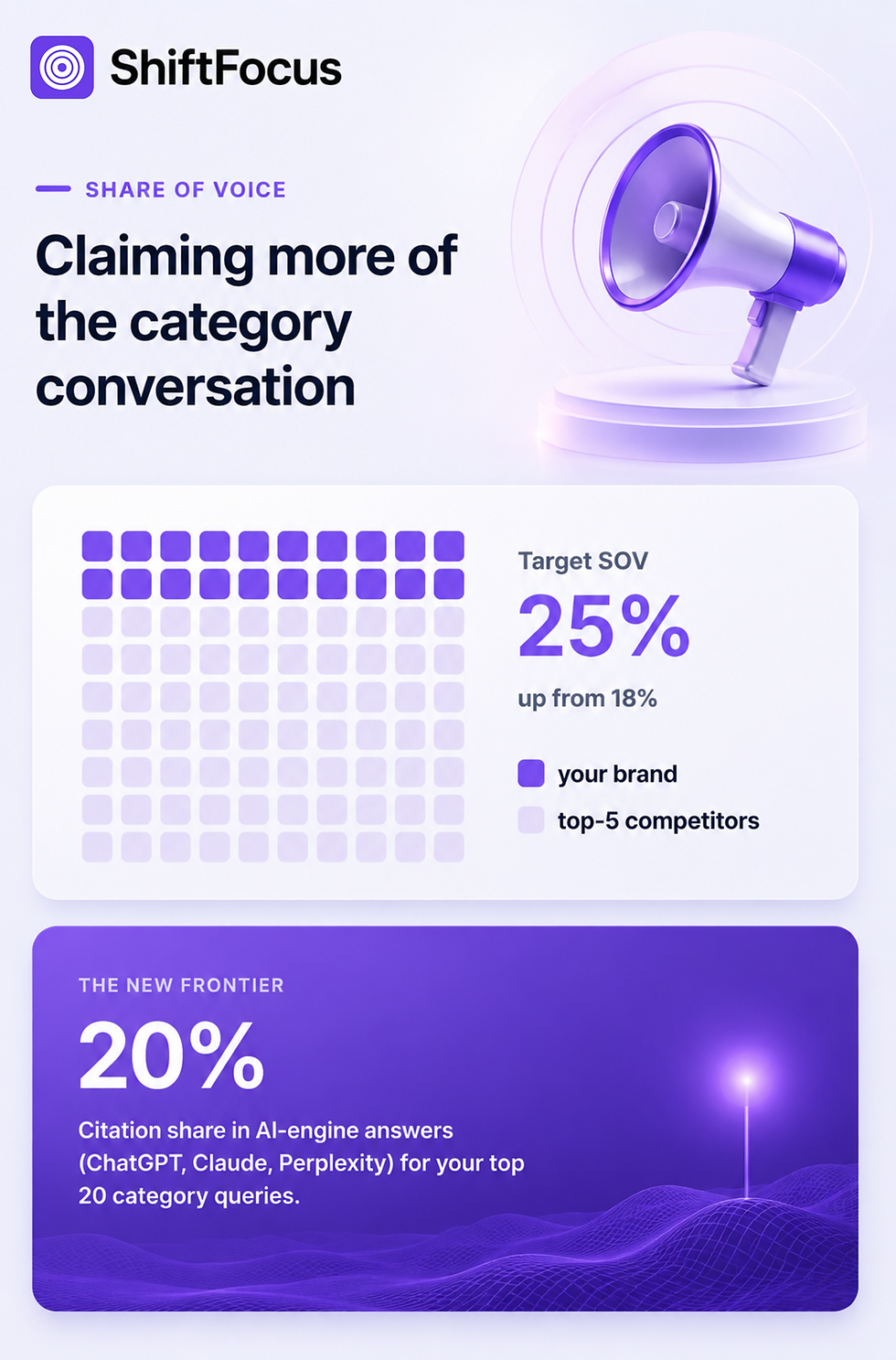
Increase weighted Share of Voice (SOV) from 18% to 25% against our top 5 competitors.
Achieve 20% Citation Share in AI-engine responses (ChatGPT, Claude, Perplexity) for the top 20 category queries.
Increase the number of industry analyst mentions from 5 to 12 per quarter.
Ensure our brand appears as a top 3 result in "best [category]" lists across 5 major industry publications.
Journalist relationships
Objective: Build a network of media contacts who trust us and see our team as a go-to source.
Key Results:
Establish some new relationships with 10 high-tier journalists in our target industry.
Increase how many journalists covered our brand 3+ times from 8 to 18.
Get a 40% response rate from pitches aimed at media.
Secure 5 briefings or off-the-record meetings with important reporters each quarter.
Category association
Objective: Become synonymous with our category in the media's and public's mind.
Key Results:
Increase the number of "unlinked brand mentions" from 50 to 120 per quarter.
Grow branded search volume by 35% as a proxy for demand generation.
Achieve 15% of new inbound demo requests citing earned media as their discovery source.
Ensure the company is included in 8 "roundup" or "best of" articles where we were not the primary subject.

Four PR OKRs for Message Pull-Through
Priority-message inclusion
Objective: Make sure that our core strategic messages are prominently and correctly displayed in all earned media coverage.
Key Results:
Maintain an 85% pull-through rate for our 3 priority messages on all coverage.
Score each article for message consistency, achieving an average score of 4.2 out of 5.
Make sure priority messages are covered in 95% of all proactive media pitches.
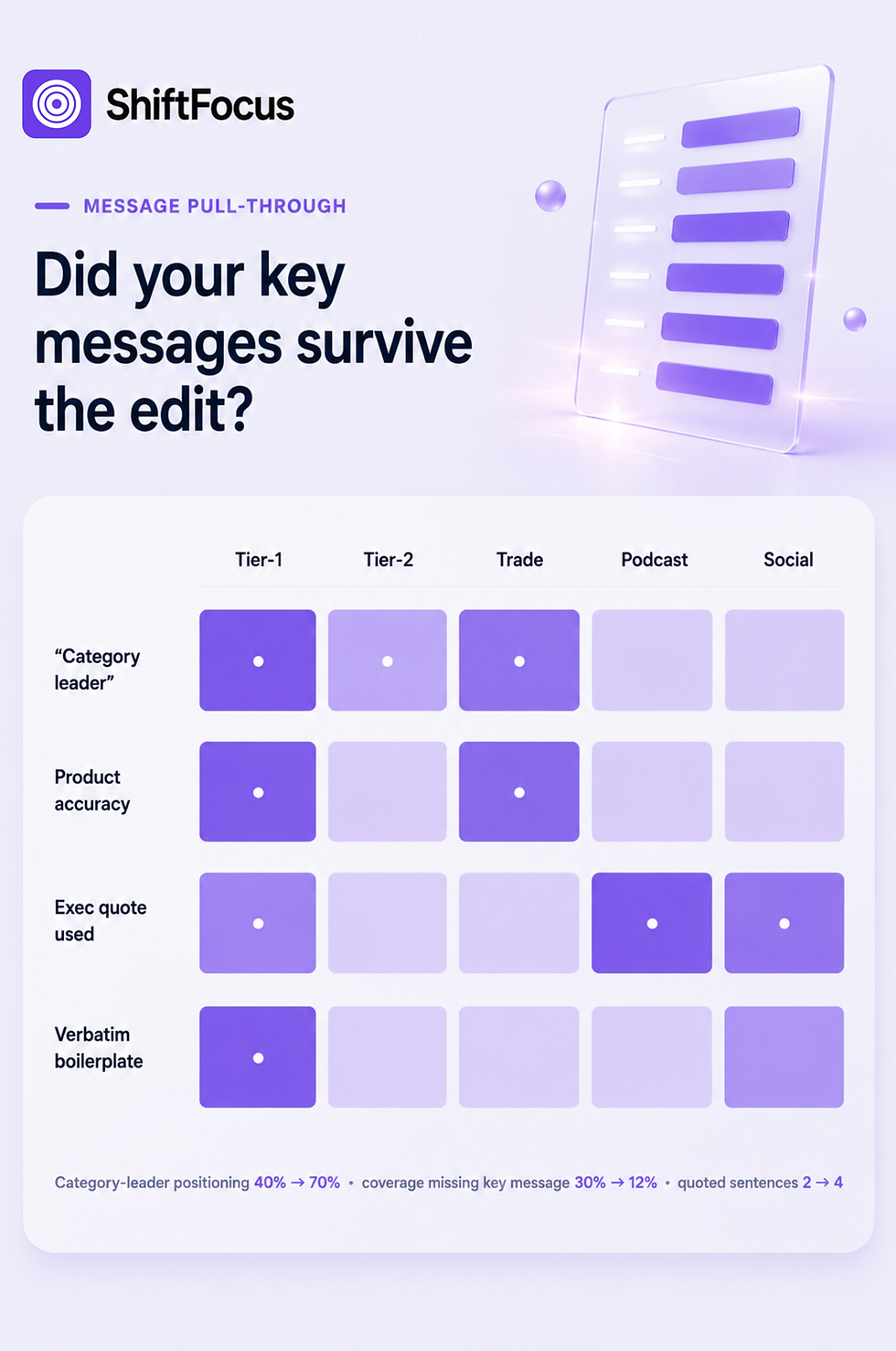
Decrease the percentage of coverage that does not include any of our priority messages from 30% to 12%.
Accurate company positioning
Objective: Correct any misperceptions about the company and ensure journalists describe us using the language we have defined.
Key Results:
Increase the percentage of articles that describe us using our defined "category leader" positioning from 40% to 70%.
Reduce the number of articles that incorrectly position us as a competitor in an adjacent category from 15 to 5.
Achieve 90% accuracy in "company description" fields in published articles (e.g., "what the company does").
Ensure that our company description is quoted verbatim in 50% of all tier-one coverage.
Executive quote adoption
Objective: lift the visibility and credibility of our executives by making sure that their quotes are shown in a lot of media stories more prominently.
Key Results:
Increase the rate of executive quote adoption in tier-one stories from 30% to 55% over time.
Secure at least one executive quote in 3 high-impact industry narratives each month.
Increase the average number of quoted sentences per article from 2 to 4.
Ensure that at least 80% of the quoted statements show our core product differentiators.
Reduction in incorrect narratives
Objective: To uncover and rectify any incorrect, misleading or negative stories about the company before they take root.
Key Results:
Reduce the number of articles containing at least one inaccurate statement about our product from 25 to 10.
Correct 90% of inaccuracies found in media coverage.
Proactively engage and cut down on the dissemination of misinformation on social media by 40%.
Achieve a 0% rate of negative search results for the CEO or company name.

Four PR OKRs for Executive Thought Leadership
Executive media visibility
Objective: Position the CEO and other key executives as the go-to voices in their respective fields.
Key Results:
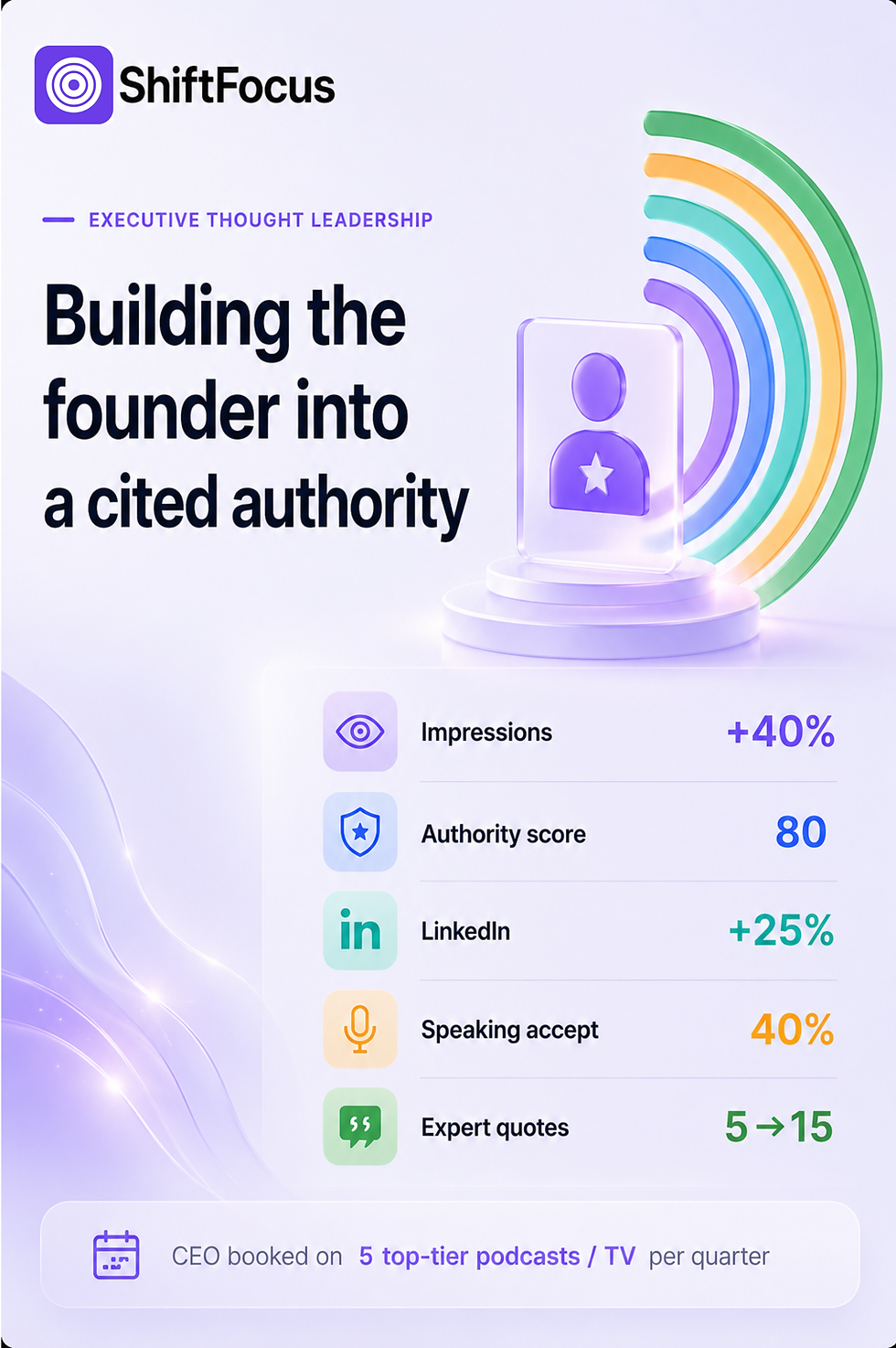
Book CEO on 5 top-tier podcasts or TV interviews per quarter.
Secure 12 total media appearances featuring executive talent.
Increase the executive's LinkedIn followers by 25% via content sharing.
Reach an average "authority score" (mentions, shares, citations) of 80 on all executive profiles.
Speaking opportunities
Objective: To obtain high-profile speaking opportunities at events where our target audience, partners, and investors are attending.
Key Results:
Attend 6 speaking engagements at industry events (500+ attendees).
Achieve a 40% conversion rate on speaking applications to acceptances.
Make sure that at least 3 speaking engagements are held at events where our top 5 competitors are also speaking.
Raise the number of speaking proposals submitted from 15 to 25.
Expert commentary
Objective: Become the media's go-to source for expert commentary on our area of expertise.
Key Results:
Increase the number of times our executives are quoted as "expert sources" in tier-one media from 5 to 15.
Secure 3 opportunities to comment on industry trends without pitching.
Grow the "expert source" database of journalists who have requested comment from us from 20 to 40.
Increase the percentage of expert commentary requests that we accept from 30% to 60%.
Thought-leadership amplification
Objective: Make sure that the content created by our executives that demonstrates thought leadership is viewed, shared, and acted upon by targeted audience.
Key Results:
Boost total number of impressions on executive thought-leadership content by 40%.
Grow the share rate for executive-authored content from 3% to 6%.
Get 5 "re-shares" or "mentions" of executive content from Tier 1 journalists.
Increase referral traffic to the company website from executive LinkedIn posts by 35%.
Four PR OKRs for Reputation and Issues Management
Sentiment improvement
Objective: Move the general public discussion around our brand into a more positive and neutral space.
Key Results:
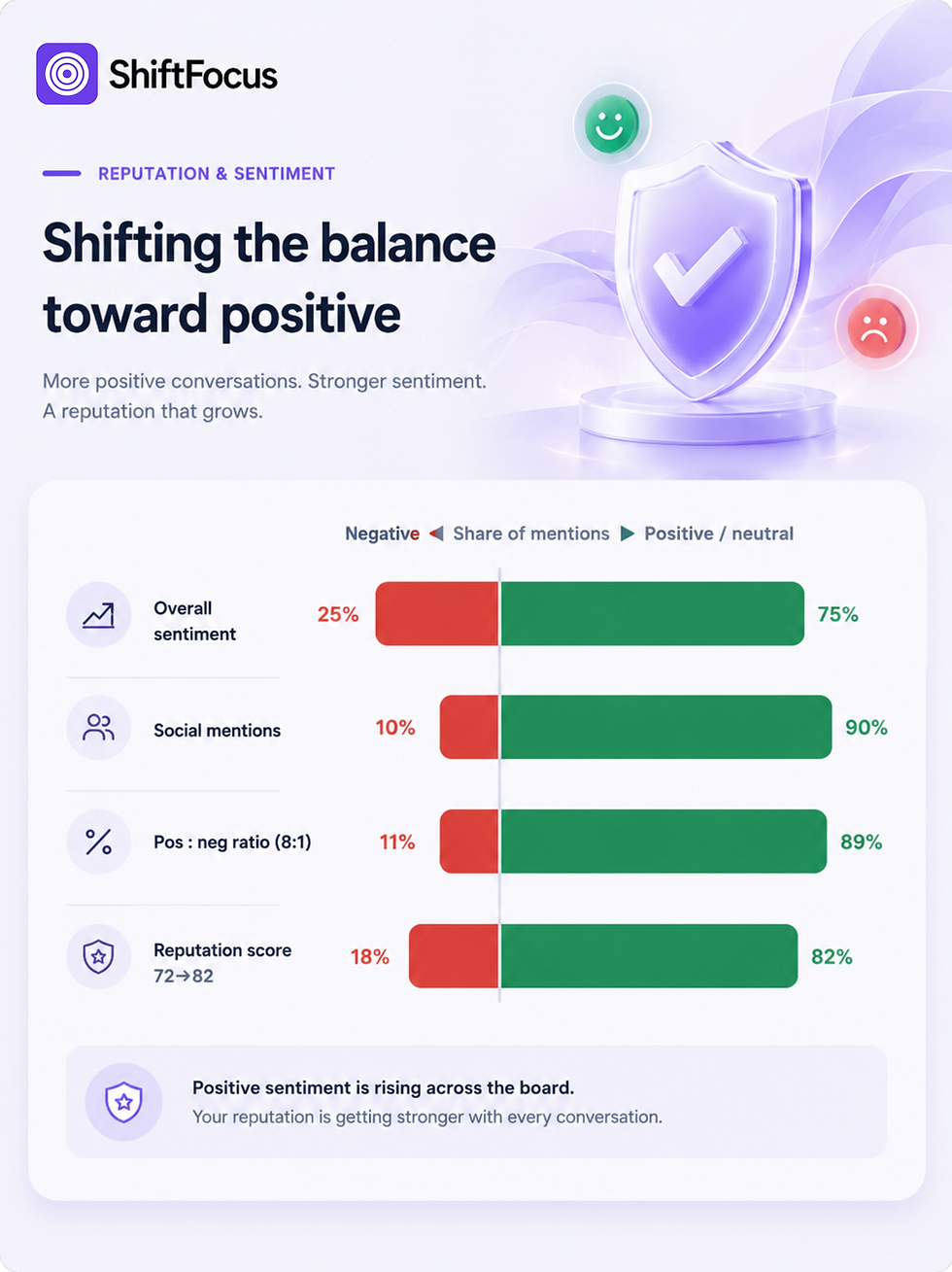
Raise the ratio of positive to negative coverage from 5:1 to 8:1.
Maintain a sentiment score of 75% positive/neutral for all earned and social mentions.
Reduce the percentage of negative sentiment on social media from 20% to 10%.
Increase the reputation score (combined perception from media, social, and public opinion) from 72 to 82.
Crisis readiness
Objective: Make sure that the company is able to react to any reputational crisis promptly, efficiently, and without harming the brand.
Key Results:
Cut down on the time-to-first-statement in crisis simulations to 45 minutes.
Complete quarterly dark-site refresh for the top 12 crisis scenarios.
Complete a crisis simulation with a 90% accuracy rating, both in speed and message.
Increase the number of crisis response protocols and holding statements that are pre-approved by legal from 5 to 15.
Response speed
Objective: Respond to media requests and reputation issues within a timeframe that is in line with stakeholder expectations.
Key Results:
Decrease the average time to respond to a crisis to 3 hours.
Ensure 95% of all media requests are responded to within 2 hours.
Reduce the time to publish a holding statement during a developing issue to under 1 hour.
Ensure that at least 80% of the crisis responses are issued before the story's publication.
Stakeholder trust
Objective: Establish and maintain strong relationships with key stakeholder groups by communicating consistently and transparently.
Key Results:
Maintain an 80% trust rating with employees, customers, and investors in surveys.
Improve employee advocacy (positive social media mentions) by 30%.
Achieve a 90% recommendation rate among employees as measured by internal surveys.
Increase investor confidence by 25% (based on positive analyst mentions).

Four PR OKRs for Communications Operations
Media-response speed
Objective: Answer the media questions quickly enough to please and impress the journalists and create more opportunities for the team.
Key Results:
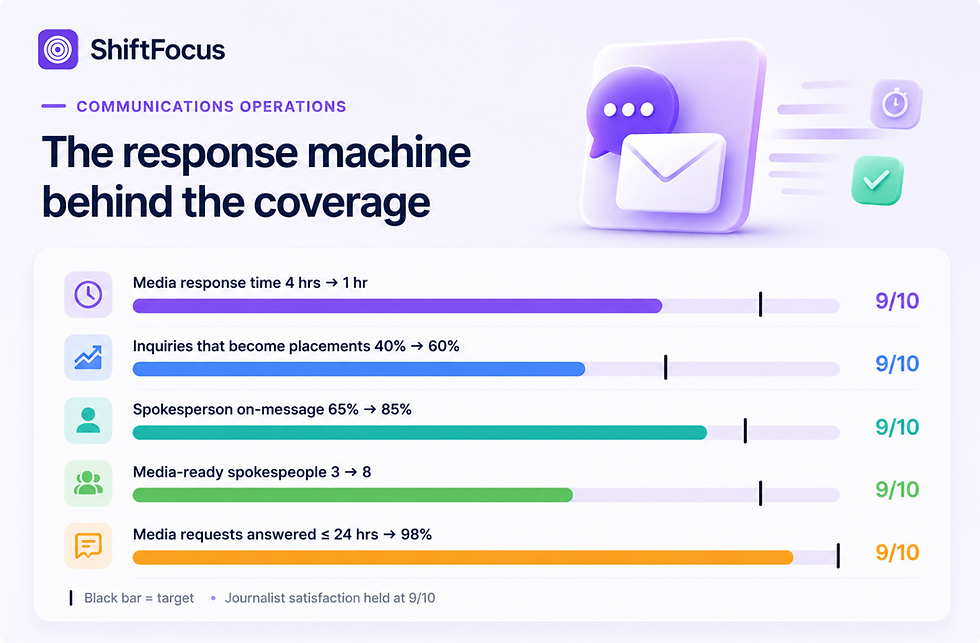
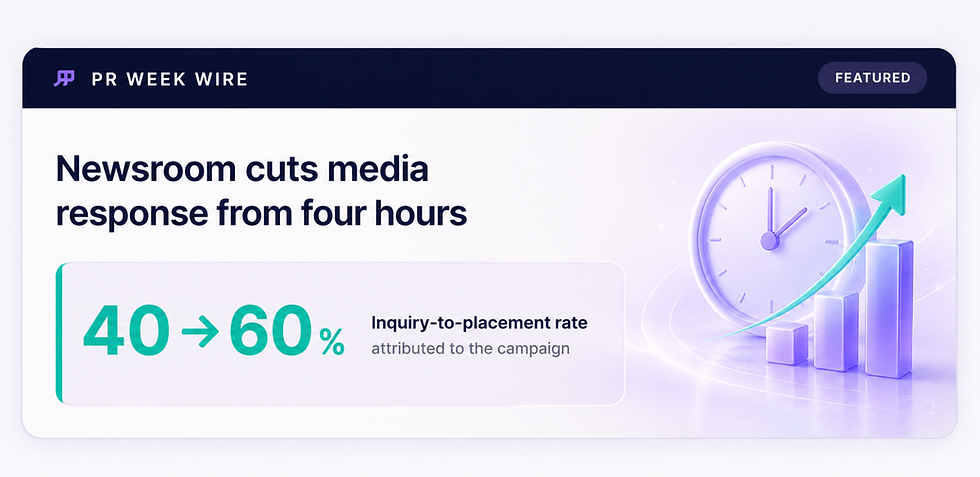
Reduce the average media response time from 4 hours to 1 hour.
Ensure 98% of all media requests are responded to within 24 hours.
Increase the percentage of inquiries that result in placement from 40% to 60%.
Maintain a 9/10 average score for journalist satisfaction with response speed.
Spokesperson readiness
Objective: Make sure all spokespeople are ready, trained and confident to engage with the media.
Key Results:
Ensure 100% of spokespersons complete media training and refreshers each quarter.
Raise the percentage of spokesperson interviews that are "on-message" from 65% to 85%.
Perform 2 "crisis simulation" exercises with spokespersons every quarter.
Expand the number of "media ready" spokespeople from 3 to 8.
Content reuse
Objective: Maximize the ROI of every piece of content and executive appearance by repackaging and redistributing it.
Key Results:
Repurpose 80% of all executive appearances into blog posts, social clips, or newsletters.
Increase the average number of content assets created per media placement from 2 to 5.
Achieve a 25% increase in overall impressions from repurposed content.
Ensure that 90% of all earned media is amplified on corporate social channels within 24 hours.
Measurement and reporting quality
Objective: Create an analytics program that gives credible insights that are actionable and rich in context for leadership.
Key Results:
Reach a 100% on-time delivery rate for all public relations reports.
Raise the number of insights-driven recommendations in each report from 3 to 8.
Make sure that 80% of reports show a link to business outcomes such as pipeline, trust, and recruitment.
Obtain an 85% satisfaction score from leadership regarding the quality of reporting.
How to Measure PR outcomes
Quality-weighted coverage means assigning a higher value to a mention in a top-tier outlet than a tier-3 blog.
Message pull-through is measured by analyzing coverage for the presence of your key messages.
Share of Voice shows your brand's presence in the market compared to competitors.
Sentiment analysis helps you understand the emotional tone of the coverage.
Search demand measures the correlation between PR activity and spikes in branded searches.
Referral traffic tracks how much valuable website traffic comes from your media placements.
Influenced pipeline connects PR to deals that mention earned media as a touchpoint.
Reputation surveys are the ultimate check on stakeholder trust and perception.
Common PR OKR Mistakes
Number of press releases as a KR rewards production, not impact. A great press release that generates no coverage is a waste.
Counting every mention equally is an error. A mention in Forbes is not the same as a mention in a local blog.
No target-audience distinction means you are not focusing on the outlets your customers actually read.
Vanity reach numbers like "millions of impressions" sound impressive but often mean nothing if your core audience wasn't reached.
Reputation goals without baselines are unmeasurable. You need a "before" score to measure improvement.
FAQs

What are PR OKRs?
PR OKRs (Objectives and Key Results) are a goal-setting framework that aligns a communications team's work with business strategy. The "Objective" is a qualitative, ambitious goal (e.g., "Establish category authority"), while the "Key Results" are 3-5 quantitative metrics used to measure progress (e.g., "Land coverage in 8 tier-1 publications").
Is media coverage a KPI or Key Result?
Media coverage is a Key Performance Indicator (KPI) that serves as a Key Result for an OKR. If the Objective is "Build media authority," then "Secure coverage in 10 top-tier outlets" is a valid Key Result.
How should PR measure authority?
PR should measure authority through Share of Voice, tier-one media placements, AI citation share, backlinks, and the frequency of executive expert commentary.
Can share of voice be a Key Result?
Yes. Share of voice is an excellent Key Result when you have a clear competitive set and a way to track it. It measures your brand's market presence compared to competitors.
How do you measure message pull-through?
Message pull-through gets measured by looking at media coverage for your key messages that you have pre-defined. Each article gets a score based on a simple 0-1-2 scale: 0 if no message appears, 1 if a message is there, and 2 if a message is featured prominently.
What are crisis-communications OKRs?
Crisis-communications OKRs focus on how fast and effective your response can be to a threat. They measure metrics like the time it takes to make the first statement, sentiment recovery - which is how people feel about your response, and readiness drills - which are practice situations for being prepared.


Comments