%20(3).png)
I Spent $60,000 on an EOS Consultant and $500/Hour on OKR Setup.Both Failed. Here's Why.

Updated: Feb 17
I've Been in the Room. Multiple Times.
I've worked with more than 50 people trying to set up OKRs across companies. We paid $60,000 for an EOS consultant to handle and create our own EOS setup.
At another company, we spent $500 per hour for a consultant to build a 100% OKR setup from scratch.
The setup was always great. The problem was everything that came after.
$60,000 for Five Days of Excitement and a Folder of Templates
For $60,000, we got the EOS consultant for five full days. The whole day, every day, he talked about the EOS system, the vision, the traction, the scorecard, how everything connects. He gave us Excel sheets, trackers, templates, and reporting frameworks.
The deliverables were mind-blowing. Genuinely. When we received that folder, we thought this was going to change how we run the company.
It didn't.
Every spreadsheet, every tracker, every template they were all beautifully designed and completely worthless. Not because they were bad. Because the team was never going to use them consistently. We didn't know that in the beginning. We were too excited.
We thought the consultant's ideas, the trackers, the frameworks, that all of this was the answer. But frameworks don't execute themselves. People do. And people weren't doing it.
Then We Tried the $500/Hour OKR Setup
Same story, different methodology. A different company. A pure OKR setup this time. $500 per hour for a consultant to design the entire system,and objectives, key results, cadence, and review cycles. Professional. Thorough. Expensive.
Same result.
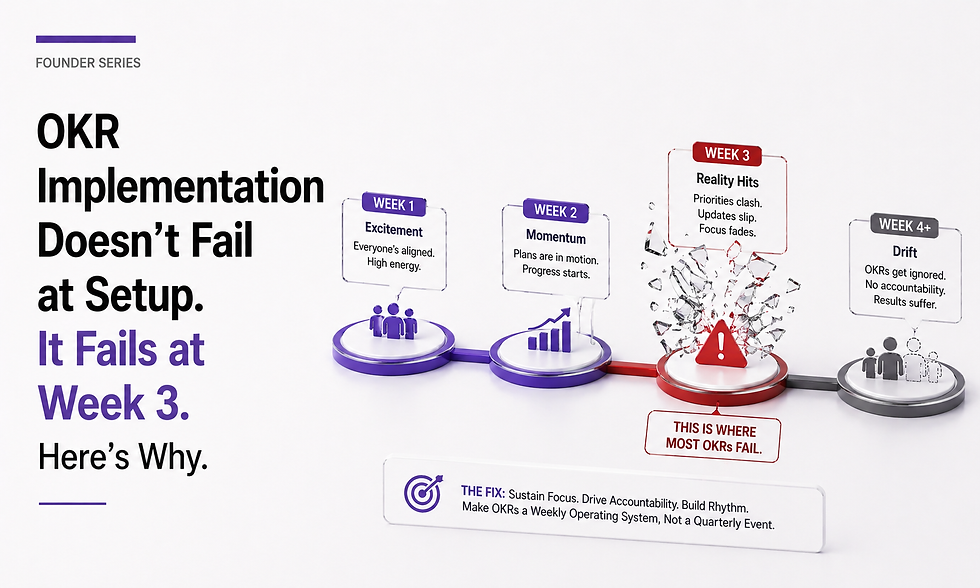
The system worked beautifully for exactly one week. Then it became something people engaged with for 30 minutes before a meeting and ignored for the other 167 hours in the week.
Everyone Uses the Software for 30 Minutes a Week
Here's the pattern and I've seen it at every single company.
The weekly check-in meeting is scheduled. 15 minutes before the meeting, everyone scrambles to log into the software and update their numbers.
During the meeting?
It's electric.
People share progress.
They discuss blockers.
They talk about why they couldn't hit their key results.
Real conversations happen.
Then the meeting ends.
Everyone closes the software.
Nobody logs back in until the next week.
Not the team leads.
Not the managers.
Not even me.
I'm guilty of it too.
The Failure Compounds Silently
Because nobody checks in mid-week, small problems become big problems. A key result that's slightly off track on Tuesday becomes completely derailed by Friday, but nobody sees it until the next Monday meeting.
By then, it's too late to course-correct. The failure compounds on itself, week after week, with no enforced rules or accountability to catch it in between.
And here's the worst part: if someone wants to, they can quietly change their key result to match whatever they actually did. No trail. No flag. No one notices.
People Can Update Tasks. They Won't Update Results.
This is something I noticed across every tool we tried. People will use ClickUp. They'll use Monday.com. They'll update their tasks. Moving cards, checking boxes, logging hours that part works.
But when it comes to reporting actual results?
Something changes.
There's an internal resistance. People feel stressed about sharing numbers that don't look good. They don't want to be the person who reports a missed target. So they either avoid the update entirely or they wait until the last possible moment and fill in something vague.
It's not laziness. It's human nature. Nobody wants to raise their hand and say, "I'm behind." And when the system doesn't enforce the update, when there's no consequence for silence, silence wins every time.
We Tried Everything Before Building Our Own
We have used pretty much every software related to goal setting, OKRs, KPIs, people management, you name it, we've tried it. Different tools, different methodologies, different consultants, different price points. The result was always the same.
Great setup. Exciting first week. Slow decay. Weekly meetings where everyone performs progress for 30 minutes. Then nothing until next week.
That's when we decided: we have to build this ourselves.
Top-Level Executives Are Flying Blind
The people who should have the clearest picture of execution the founders, the COOs, the VPs, have almost no visibility into what's happening at the team level. That's exactly where the domino effect starts.
One team falls behind, it cascades to the next, and by the time leadership sees it in a quarterly review, the damage is already done.
No Software Is Brave Enough to Show Who's Lagging
Here's what I've found across every tool I've used:
No OKR software on the market is brave enough to show who's lagging on the dashboard.
They all hide it behind averages and green status bars because nobody wants to be the tool that delivers uncomfortable news.
But that uncomfortable news is exactly what leadership needs. If someone is falling behind, the software should flag it. At a minimum, the leadership team needs to know not at the end of the quarter, but in the first few weeks when there's still time to fix it.
The Hard Truth Nobody Wants to Hear
No management team actually wants enforcement. They want a care-free job. We all do. We live in a competitive world. We want to achieve bigger things.
But we never want to be enforced to do the things that are actually easy to do. That contradiction is the core of the execution problem.
That's Why ShiftFocus OS Exists
I decided to create software that does everything a company needs to actually execute, rather than meeting every week while nothing happens in between.
Not another tracker. Not another dashboard. Not another folder of templates that collects dust after the consultant leaves.
A system that tells you the issues that are going to surface in the first month of setting a goal not at the end of the quarter when it's too late.
That's how we started building ShiftFocus OS.


Comments