%20(3).png)
Execution Forecasting Doesn't Work Because It Trusts Self-Reported Data

Updated: May 15
Most execution forecasts fall apart not because the numbers are wrong, but because the assumptions inside execution forecasting software stop being true before anyone notices.
At SaaS companies, leadership teams watch in shock as their quarterly plans dissolve in the final three weeks of the quarter, completely caught off guard by problems that had been quietly building up for months already.
The problem usually isn't bad planning.
The problem is that traditional forecasting software attempts to treat execution as a mathematical equation, but in reality, execution is a constantly evolving, live system that changes daily.
You've been in this situation before, I'm sure of it.
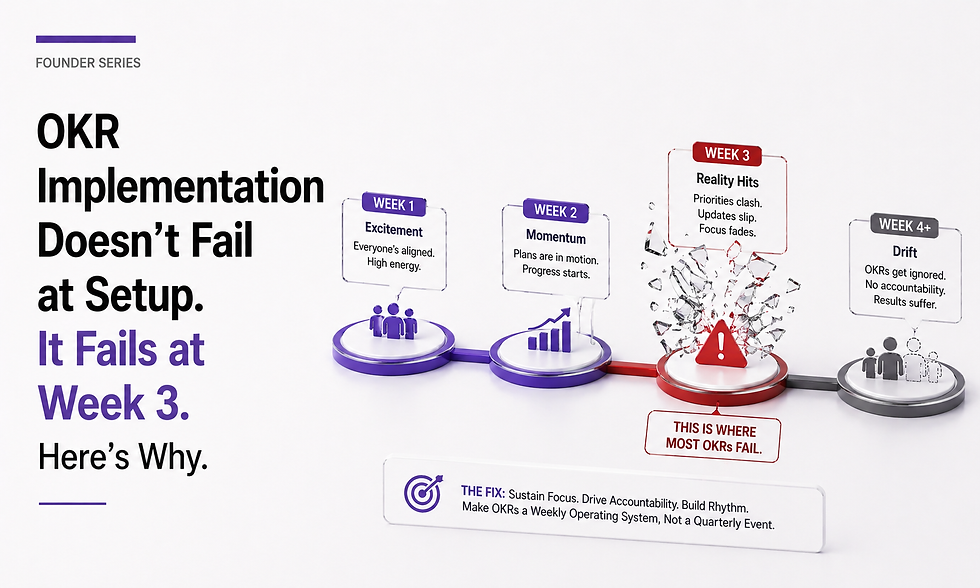
Your team is humming along, giving you regular green status updates right up until week 8 and then - just like that -everyone is suddenly stuck on yellow and red by week 10.
Those revenue projections that looked rock solid on Monday in the leadership team meeting have completely fallen apart by Friday.
And as the days tick by and you're stuck dealing with missed deadlines after missed deadlines, you find yourself getting more and more frustrated, asking the same maddening question over and over: "Why on earth didn't we see this coming?"
The real reason lies in how these execution forecasting software are actually built and maintained in the first place.
They're designed to make predictions, but on the flip side, they completely ignore what's really going on with the actual execution of these plans.
Forecast Confidence Builds Faster Than Forecast Accuracy
You are confident about your quarterly results three weeks in. Your teams have reported that everything is going well. Your dashboards display consistent improvement.
Your instincts tell you that everything is going as expected. This confidence can blind you because it comes from what you see on the surface instead of how things are in reality.
A study by the Project Management Institute revealed that only 58% of organizations regularly achieve their project goals. However, during the first half of each quarter, leaders are usually more than 80% confident in those projects.
The strong feelings you have do not match how well things are actually being done behind the scenes.
Execution Reality Changes Faster Than Forecast Models
Your business operates at one pace, while your forecasting process operates at a different pace. When you update a forecast with new information, three other things have likely changed that you haven't noticed yet.
Your best sales representative has just announced their resignation. Your biggest customer asked for a special feature that will use up engineering resources.
Your Chief Financial Officer has just announced that there will be a hiring freeze.
Every change affects how well things can be done, but your prediction still shows the same timeline as before.
Many leadership teams revise their forecasts every month or every three months, but this can lead to a risky delay.
In SaaS companies, important changes occur every week or even every day. A competitor introduces a new feature that makes you change your plans. A major partner changes the way their API works.
A new regulation means that we have to do some work to follow the rules that we didn't plan for. Your predictions become old as soon as you finish them, but you are still making important decisions about resources based on that outdated information.
Early Execution Weakness Never Enters the Forecast
The most dangerous moment in a project is the time when everything appears to be fine. Your team is achieving 90% of its objectives.
The reports are fine.
The leaders are pleased.
But in reality, work is decelerating, and you will not observe the problem in the data until it is too late to take corrective action.
This is the reason why so many leaders are taken by surprise.
For instance, if technical issues cause your team to operate at only 85% of its capacity instead of 100%, it can conceal this for several weeks by increasing work hours and delaying minor tasks.
The deceleration will not be reflected in the upcoming progress report.
And by the time it does, you’ve already lost a month that you could have used to address the issue.
Workload Pressure Quietly Invalidates Forecast Assumptions
In your forecast, you assumed that every team would be able to handle the amount of work you planned for them.
In reality, your product team is handling 40% more customer requests than in the last quarter.
Your engineering lead is dedicating fifteen hours per week to interviewing new hires.
And to top it all, your operations team is managing a significant infrastructure migration alongside their regular tasks.
When teams have less capacity than you assumed, the forecast can’t possibly be correct even though it still shows targets that look achievable.
Dependencies Compound Risk Without Triggering Alerts in Execution Forecasting Software
When it comes to traditional execution forecasting software, there is one belief that is no longer valid in today's complex (SaaS) environments.
That belief is: If every team completes its assigned tasks on time, the primary objective will be attained.
This was effective when work was straightforward and independent. It is not effective when tasks are interrelated and dependent on one another.
Most tracking tools are good at measuring three things: whether tasks are on track, the percentage of work completed, and whether deadlines are being met. They prioritize these areas since they are easy to quantify and report.
However, issues and delays are not reflected in the task progress. Delays are always in the cracks between the tasks, in the unarticulated assumptions that teams bring to the table, and in the small dependencies that can escalate into significant problems.
A study conducted by the Harvard Business Review revealed that 95% of employees are not aware of the overall strategy of their company.
If your teams don’t understand how their work connects to the larger objectives, your execution tracking system is merely monitoring activity rather than actual progress.
Mid-Quarter Priority Changes Break Forecast Stability
You scheduled this quarter in December.
Now that February has arrived, your biggest client is threatening to do business with someone else if you don't create the desired integration.
Because of a breach at a rival company, your board wants better security compliance.
There is now a new market opportunity that calls for quick changes to the product. Your decision to shift priorities is an indication of strong leadership.
However, the initial plan is still reflected in your forecast. As a result, there is a difference between what you actually do and what your predicted output indicates you will achieve.
Forecast Reliability Drops as Execution Complexity Grows
When your company had 50 people working on three major initiatives, forecasting was manageable. You could track everything, dependencies were obvious, and making adjustments was easy.
Now you have 300 people working on 15 interconnected initiatives across multiple teams, time zones, and functions. Your execution forecasting software may look the same, but the level of complexity it needs to handle has increased dramatically.
This scaling issue interferes with traditional forecasting software in a number of predictable ways. More people mean more dependencies.
More initiatives mean more trade-offs. More complexity means more points of failure. Still, most leadership teams continue to use the same spreadsheet-based forecasting processes they employed when they were just a fraction of their current size.
The forecast appears to be confident, but the confidence is derived from the lack of visibility of the complex execution.
Leadership Reviews Reinforce Optimism Over Reality
Although the purpose of the quarterly business review process is to identify problems, it actually accomplishes the opposite.
Instead of running the risk of revealing execution risk, teams are prepared to defend their forecasts.
They highlight successes, justify failures, and exude confidence in their recuperation tactics. Nobody wants to be the one who appears to be making an excuse or lowering morale.
This organizational dynamic produces an unintentional bias, favoring optimism in forecasts.
Teams continue to make confident forecasts even though approximately 84% of projects fall short of their initial projections.
The problem isn't that they can't; rather, the review procedure you've been using penalizes honesty when it comes to uncertainty and rewards confident projection.
As a result, teams begin to present you with what you want to see, which eventually causes the forecast to diverge from the actual execution.
Lagging Indicators Delay Forecast Correction
Everything you use to measure and justify your forecast is a lagging indicator. Revenue is a lagging indicator of how the sales execution is going.
Feature releases are a trailing measure of engineering health. Customer retention is a trailing metric for product-market fit.
By the time these metrics start moving, the execution issues have been in place for weeks or months.
This measurement lag ensures that you are perpetually navigating blindly into the near future.
Your forecast means that you’ll achieve $10M in revenue this quarter because you’re on track to achieve it based on the pipeline. But pipeline is a lagging indicator of sales activity, which is a lagging indicator of market conditions and team effectiveness.
The real execution health of your sales organization today will reflect in revenue numbers 60 days from now.
Your forecast won’t be able to take into consideration any problems that you’re not able to see at this point.
Execution Risk Surfaces Only Near the Deadline
A common saying when predictions go wrong is, "We believed we had more time." Teams tend to believe things will go well until the deadline makes them face the truth.
Two weeks before the launch, everyone suddenly notices that the integration isn't working, the performance isn't good enough, or there isn't a plan for how to get customers on board.
The danger was always present, but it didn't seem important until it was too late.
This focus on deadlines is why many leaders often feel caught off guard. Your team truly thought they were making progress because they focused on how much they had finished instead of how well they were doing the work.
They reached their goals, but those goals didn't prove that the work was truly right or finished. The prediction showed a positive result because it looked at actions rather than final results.
Forecast Trust Erodes After Repeated Late Surprises
The first time a forecast is way off, you take it that it was a one-time thing. The second time, you begin to doubt the assumptions.
By the third or fourth time, you’ve ceased to trust forecasts altogether and begun managing by instinct and constant intervention.
This lack of trust turns into a vicious cycle where leaders lack trust in their teams, teams lack trust in their ability to forecast, and everyone begins to work in reactive crisis mode.
When forecast trust is lost, your ability to make strategic decisions is lost too. You cannot pledge to the board targets if you do not have confidence in your internal projections.
You won’t be able to make hiring decisions if you are uncertain about revenue. You can’t plan product roadmaps if you have no idea what engineering can actually deliver.
However, the impact of the loss of forecast reliability extends beyond a single quarter. It affects your ability to manage the business strategically.
Execution Health Signals Restore Forecast Credibility
The answer is not improved math for execution forecasting software. It is the ongoing insight into the status of execution health. You have to see the pressure of the workload before it destroys productivity.
You are required to identify dependency risks before they develop into a crisis. You should be able to sense when teams are silently hurting rather than waiting for the metrics to eventually show their pain.
Execution forecasting software such as ShiftFocus offers this visibility by monitoring the leading indicators that forecast outcomes instead of merely gauging the lagging indicators that document results.
Trust Returns When Forecasts Reflect Execution Reality
When your forecasts adjust as quickly as your execution environment, they become reliable. Before they miss deadlines, you can see that Team A's timeline is unrealistic due to their increased workload.
When you can recognize that a chain of dependencies generates compounding risk before a crisis. When your forecast takes into account the messy reality of how work is actually done, rather than acting as though it follows a set script.
Your execution intelligence provides you with early warning, allowing you to modify your strategy before issues turn into failures, so you no longer have to deal with surprises.
Leadership teams that use execution forecasting software health monitoring report 38% higher on-time delivery rates and 43% fewer unforeseen project delays—not because their teams perform better, but rather because their projections now accurately reflect reality.


Comments