%20(3).png)
On Track' Is the Most Dangerous Status in Your Dashboard
- Author

- Jan 27
- 9 min read
Updated: May 13
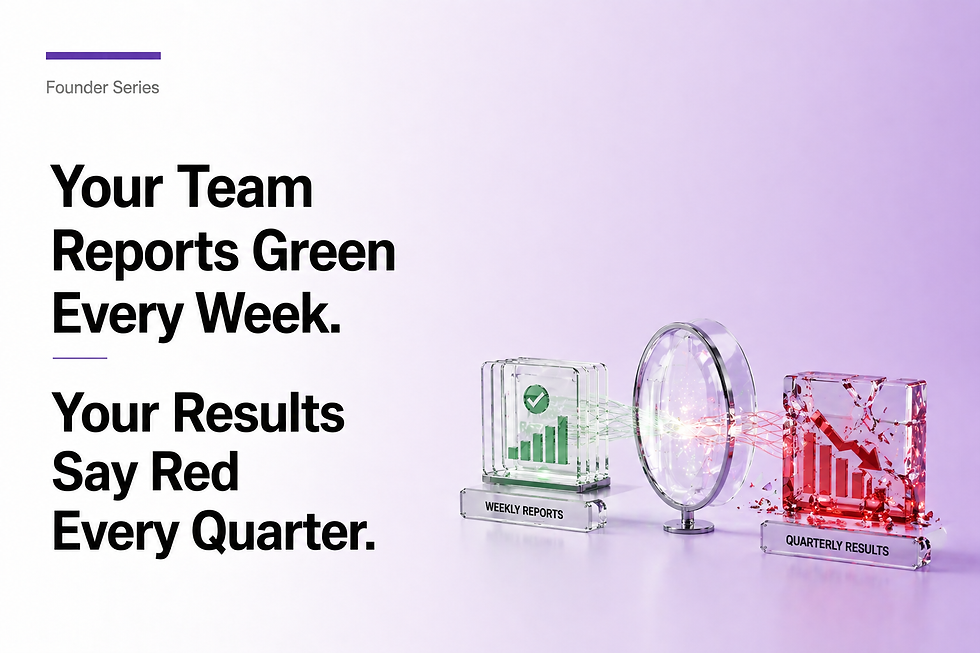
Just about every SaaS leadership team believes that execution tracking software is good since all the dashboards are green. The weekly reports state that the projects are “on track” and the project leaders are confident.
Then something snaps. A major project fails just a few weeks before the deadline.
A product launch is delayed by several months. The set revenue targets have not been achieved.
In that moment, the feeling of control is lost. You have already witnessed this.
On Friday, everything seemed okay. The team leaders reported that the progress was smooth. The project tools showed no warnings. Then comes Monday morning.
A key deliverable will not meet the deadline. Several teams are being blocked due to the presence of hidden dependencies. The plans for the quarter need to be reconstructed.
What are the reasons for failure?
The answer is not a comfortable one, but it is a definite answer. “On track” doesn't mean what you think it means.
“On Track” Creates Illusion, Not Control in Execution Tracking Software
When your teams say that tasks are "on track," they are telling you how much of the work is completed, not how well it is being done. There is a significant difference.
A project can be 60% finished and still be successful, or it can be 60% finished and close to failing.
Old tracking systems can't tell apart different factors because they look only at the results instead of the deeper reasons that influence whether those results will be achieved on time and in good shape.
A study by Harvard Business Review revealed that 70% of strategic plans fail to achieve their objectives.
Many of these issues go unnoticed until it’s too late to solve them. The problem isn't that people aren't putting in enough effort or that they lack the necessary skills. The problem is that leadership teams are making choices without having enough information.
They only have tools that show them what has already occurred, not what could happen in the future.
You are keeping an eye on the progress, but the quality of the work is quietly getting worse without you noticing.
Think about your latest significant project that either didn’t work out or took much longer than you thought it would. When did you first realize that something was wrong? It was likely too late.
The warning signs appeared weeks earlier, but your tracking systems did not notice them. Teams had different amounts of work to do. Some people didn’t mention problems they were facing, and little changes to the project seemed like no big deal on their own.
However, when these small changes piled up, they created serious issues. All of these problems were easy to spot, but the leaders didn't see them until it was too late to repair the harm.
Execution is weaker between teams and not within tasks.
The task management tools you use show when each task is finished. The progress bars on your project dashboards display how much progress has been made.
However, execution does not fail when it comes to specific tasks.
It falls apart in the gaps between them, during the transfers between teams, in the connections that go across departments, and in the resource conflicts that nobody can settle quickly.
A McKinsey study shows that companies that encourage teamwork across different departments are more successful.
They are five times more likely to say that their revenue growth is higher than the average rate.
Most execution tracking software concentrates on individual teams and projects instead of the connections that tie them together.
Your engineering team has completed its tasks, but the design team is three weeks late in meeting the requirements. This reliance won’t show up as a warning sign on either team's dashboard.
Both teams recognise that they are making progress, but overall, the project is not succeeding.
This is the moment when predicting the outcome of actions becomes important.
You need to see how work moves between teams, where problems might slow things down next week, and which tasks might fail before they actually do. Completion percentages cannot give you this information.
Only health metrics that look at how teams work together, share the workload, and anticipate future risks can reveal the real problems.
Mid-Quarter Changes Quietly Destroy Momentum
This is what kills execution in growth SaaS companies: mid-quarter changes that make sense in isolation but make no sense when taken as a whole and ultimately are catastrophic to execution.
A customer requires a custom feature. Sales requires technical assistance for an important opportunity. The board expects to see progress on a new strategic initiative.
Each request is logical on its own. Combined, they break down your team’s attention, breaking the execution momentum built in the first month.
Studies indicate that context switching results in a 40% loss in productivity, yet most leadership teams have no systems in place to track how many shifts in priority their teams absorb in a given month.
You add new priorities, but hardly ever remove old ones with the same conviction. The outcome is genuinely busy teams that work hard but display slow progress on everything that matters.
So while your dashboards still show ‘on track’, the execution health has collapsed due to many competing priorities.
The companies that actually manage to win out aren't usually any smarter or more talented than anyone else.
What they are better at is walling off their execution from the chaos of wildly shifting priorities.
They've got a clear eye on exactly how many separate projects each team is actually trying to keep track of.
They can see what's going to happen before all these last-minute changes blow the momentum out from under them.
And instead of just piling on more work to already-overwhelmed teams, they make genuine choices about what to prioritise - and what to leave behind.
Tracking Completion Misses Execution Health
Completion tracking answers a straightforward question: Was this task finished? "That's helpful, but it doesn't meet all the needs of a leader."
You need to answer different questions.
Will this project actually be finished on time?
Where will the delays occur next week?
Which teams are overloaded with tasks, and which teams have extra capacity?
What risks have your teams not reported yet?
Regular project management tools were not created to address these questions since they were not intended for forecasting how tasks will be completed.
The difference between tracking progress and checking how well things are going can slow down leaders when they need to make decisions.
When the completion metrics indicate a problem, it is usually too late to take meaningful steps to fix it. The most you can aim for is to minimize the damage.
If you had been aware of how things were going two weeks earlier, you could have adjusted your resources, changed the project’s focus, or modified what depended on other tasks while it was still easy to handle, before the problem became too big.
The Execution Signals "On Track" Never Shows
Actual execution risks show up in ways that your current dashboards do not show.
It happens when one team leader is always three days late in providing updates. It shows up when meetings with different teams are constantly pushed back.
Execution Signals become clear when engineering is working at full capacity while design is only at 60%.
It's clear when the same three people are involved in six different projects at the same time. These signals can accurately predict when something will go wrong, but you can't see them in systems that only check if tasks are finished.
A study by the Project Management Institute found that only 58% of organizations really understand how important project management is.
And an even smaller number keep an eye on the signs that show how well a project is doing, instead of just looking at whether it is finished.
This gap is why many good projects end up failing. Leadership teams are focusing on the wrong goals by measuring things that are simple to track instead of looking at the factors that really lead to success.
Green Dashboards Delay Intervention
Green dashboards can create a misleading feeling of safety and delay necessary action until recovery becomes expensive or even unachievable.
When everything seems to be going well, you naturally start to pay attention to other things. You believe that your teams can complete the task successfully.
This trust is understandable, but a blind trust without any checks can be risky when on scale. The aim is not to control every little detail.
The goal is to create warning systems that let you know when you can step in and make a difference, instead of informing you after a crisis has already happened.
Consider how this operates in real life.
In the second quarter, your goals are to introduce a new product feature, expand into a new market, and boost customer loyalty by 15%.
Every project has a team, a plan, and provides updates every week. Week six arrives, and everything remains green.
However, beneath the surface, the product team is struggling with a lot of old technical problems. The market expansion team cannot move forward because it is waiting for legal approval.
Meanwhile, the retention project is held up because the engineering team is busy handling a big issue for a major customer.
By the ninth week, when you start seeing these problems on your dashboards, you've already spent most of your quarter with little progress to show.
The last three weeks are not enough time to recover, so goals get moved to the third quarter, then to the fourth quarter, and eventually forgotten.
High-Performing SaaS Teams Track Execution Health
Companies that consistently achieve high performance share a common trait. They track not only the past but also the future.
They can see not just the overall status but also the execution health. Rather than seeing three weeks in the past, they can see three weeks into the future.
They can intervene early, reallocate resources appropriately, and maintain momentum even when circumstances change because of their long-term ability to see into the future.
It's not about putting in more effort or hiring more project managers. The right intelligence layer is more important than execution.
You will be making radically different decisions when you can see how the workload is distributed among teams, the dependencies between departments, or the capacity limitations before a bottleneck is locked in.
Initiatives that will disrupt execution are rejected. Instead of using resources reactively, you use them more proactively.
You minimise your teams from the constant context switching that destroys productivity.
When health is visible, being "on track" becomes meaningful.
The solution is not to stop tracking completion. Completion matters. But completion tracking needs to be there in conjunction with execution health tracking.
When you combine the two outlooks, "on track" actually means something. You know not only that 60% of tasks are complete, but that the remaining 40% is really achievable with current team capacity, dependencies, and risks.
You can be confident in your dashboards again because they're finally showing you what you really need to see.
This is precisely what execution intelligence delivers. It may be the difference between driving while looking at the rearview mirror and driving while looking through the windshield.
Both perspectives are important, but you can't drive effectively with one alone.
Platforms like ShiftFocus are designed just to provide this kind of in-the-future visibility to leadership teams that doesn't exist in traditional project management, but is the sort of thing modern SaaS companies actually need as part of the execution software.
Scale Makes This Problem Inevitable Without Better Execution Tracking Software
When your company has 20 people, there is no need to force execution into your business. You're in every conversation.
You know who's working on what.
Informal communication makes up for the gaps left by the formal communication systems. But somewhere between 50 and 200 employees, there is a breakdown of informal systems.
You can't be in every conversation anymore; Teams begin to work on initiatives that are interdependent in parallel without any natural coordination.
The problems of execution, which used to announce themselves loudly, now conceal themselves in the complexity of scale.
This isn't the failure of culture or process. It's part of the inevitable results of growth.
To really fix it, you need to have systematic visibility that is proportional to your organisation.
You need execution intelligence that works whether you have 100 employees or 1,000, whether you are running five initiatives or fifty.
In the absence of such a systematic approach, you will continue to suffer the wildly painful cycle of feeling fully designed, moving along according to plan, and returning disappointing results.
Control Comes From Visibility, Not Optimism
You can't solve problems with execution just by making more plans or having more enthusiastic teams.
Your plans are really good already. Your teams are already putting in a lot of effort.
There is a lack of clarity about what is truly happening behind the scenes of "on track" status reports.
When you can see how things are going right away, spot problems before they happen, and get alerts that give you time to act, managing tasks stops feeling like a constant struggle.
Instead, it becomes something you can handle effectively. You can’t gain control just by hoping for it.
It comes from having the ability to make smart choices before hope is your only option.


Comments