%20(3).png)
Your Company Doesn't Have a Strategy Problem. It Has a Silence Problem.

Updated: May 13
You hire people from top colleges and universities worldwide. Smart, capable, ambitious people.
And when something goes wrong, when a goal is off track, when a deadline is going to be missed, when a key result is clearly not going to land, they choose silence.
Not because they’re lazy. Not because they don’t care. But because in most companies, staying silent is safer than speaking up.
Your Team Knows Before You Do. They Just Won’t Tell You.
Here’s the pattern I’ve seen at every company I’ve worked with.
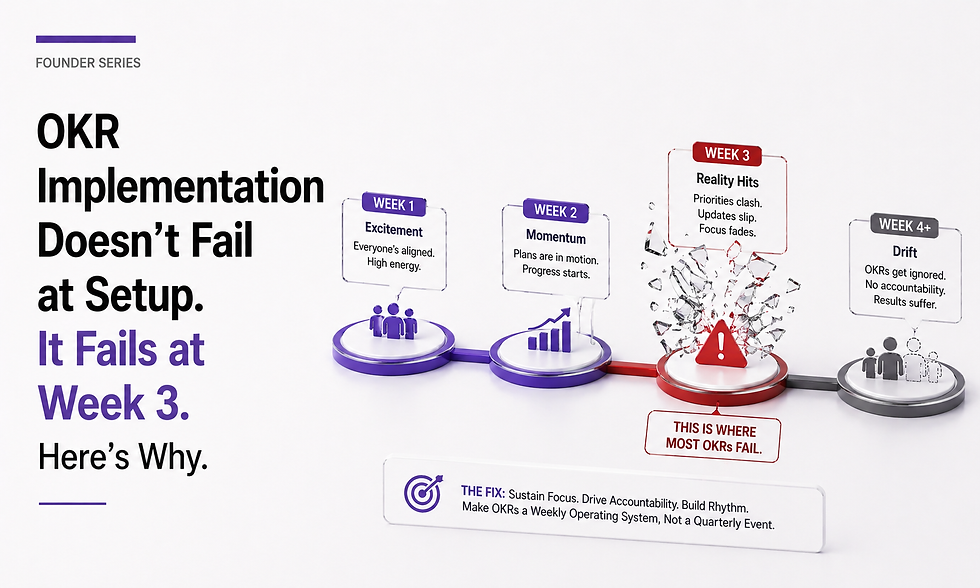
The team already knows five, six weeks before the quarter ends, that they’re not going to hit their goals.
They can feel it.
The numbers aren’t moving fast enough. The dependencies are stuck. The workload doesn’t match the target.
But leadership?
Leadership finds out one week before the quarter ends. Sometimes at the quarterly review itself. By then, six weeks of potential course correction will have been wasted.
The information was there. The data was there. The people who could see the problem were there. The only thing missing was a system that forced the truth to travel upward before it was too late.
The Amazon India Example
Let me give you a specific example to show how this plays out.
Imagine Amazon India wants to dominate Google for industrial machinery keywords. The objective is clear: own the search results for that sector. The SEO team and content team are tasked with ranking for those keywords.
Within two to three months, the content team knows it’s not going to happen. They haven’t created enough product pages. The keyword targets are too aggressive for the timeline. The volume of content needed is way beyond their current capacity.
They know this. They can see it in their own numbers. But they won’t say it transparently because they’re afraid. Afraid of being questioned by their managers.
Afraid of being seen as the person who couldn’t deliver. Afraid that raising the flag means inviting scrutiny on themselves rather than getting help. So they stay quiet. They update their OKR tool with whatever makes it look like progress is happening.
And the silence continues week after week until the quarter ends and everyone acts surprised.
The Dependency Chain Nobody Sees
But it gets worse. Even if the content team somehow produces enough pages, what about the creative team?
If the creative team doesn’t produce enough images, the content team can’t publish those product pages. The content writer is ready.
The copy is done.
But the page can’t go live without product images, banners, and visual assets. So the content team’s key result stays stuck, not because of anything they did wrong, but because another team is behind.
Does your OKR software show this?
Does it show that the creative team is falling behind and that it’s blocking the content team’s delivery?
Does it show the velocity of output compared to last week?
Does it show whether the current pace is enough to hit the target by quarter-end?
I don’t think so.
No OKR software in the world tracks cross-team dependencies with sufficient visibility to surface them before they become a crisis.
So when Amazon India’s marketing head finally discovers that they failed to dominate industrial machinery keywords on Google, he starts an audit.
Who was responsible?
What happened?
hich team dropped the ball?
This audit happens at the end of the quarter when the damage is already done and the opportunity is already lost.
Numbers Can Be Manipulated. Silence Can’t Be Detected.
Low-level team members speak through their numbers. That’s all leadership sees on the metrics on the dashboard. And those numbers can be easily manipulated, adjusted, rounded up and Reframed.
Everything looks green. The dashboard is clean. But
Does the software actually audit whether those numbers are real?
Does it check if the key results are actually correlated to the objective?
Does it verify that the work being reported is enough to achieve the goal?
No software does this. So the silence continues. The green dashboard is not evidence of progress. It’s evidence that nobody has been questioned yet.
What Enforcement Actually Looks Like
Every team member will remain silent unless questioned. If they’re not enforced. That’s not a character flaw it’s human nature. So the software has to do what humans won’t.
Here’s what I mean by enforcement:
If a content piece isn’t published by the deadline, the software escalates to the content manager.
If the content manager doesn’t check in or resolve the issue within 48 hours, it escalates to the head of the content marketing department. If the department head doesn’t act, it moves to the marketing head.
Every step is automated. No manual follow-ups. No “hey, can you check on this?”
Slack messages that get ignored.
The software surfaces the silence and forces a response not by being annoying, but by making the problem visible to the person who can actually fix it.
This escalation keeps climbing until the problem is solved. Not until someone acknowledges it. Until it’s actually solved.
ShiftFocus Doesn’t Break Your Team. It Breaks the Silence.
I’m not saying ShiftFocus is going to magically help you achieve all your goals. No software can promise that.
What I am saying is that ShiftFocus is built to track your goals in a way that’s so transparent, your team can’t hide behind silence anymore. Not in a way that feels like surveillance in a way that gives everyone clarity.
The team member knows exactly what’s expected. The manager knows exactly where things stand. The executive knows exactly where the risks are.
When the silence breaks, the problems surface early. When problems surface early, they get fixed before the quarter is lost. That’s not a feature. That’s the entire point of execution enforcement.
Your company doesn’t have a strategy problem. Your strategy is probably fine. You have an OKR problem. And the only way to fix it is to build a system that makes silence impossible.


Comments