%20(3).png)
EOS for Capital-Raising Firms: EOS Rocks, L10 Meetings, and Scorecards That Actually Raise Money

We have worked with multiple capital-raising firms and we have implemented EOS™ (Entrepreneurial Operating System™) for those companies. From our experience, we are sharing what type of Rocks™ work, what template we use for our Level 10™ meetings, and how we track our Rocks™, how we handle our issues and ideas in this article.
Why EOS™ Works (When Set Up Right) for Capital-Raising Firms
The primary goal of capital-raising firms is to raise money from their target audience. As a marketing agency and EOS™ Implementer, we carefully craft our Rocks so that we actually achieve them not because the year just started and we want to start with a bang and mention we are going to help you raise a hundred million dollars. We are not going to be excited and share something totally irrelevant for the capital-raising firm.
We Start With the Founder's Real Numbers, Not Marketing Hype
We get the numbers from the founder or CEO or principal fund manager, and we study the nature of the fund. We come to a conclusion and we set our goal, and we set our EOS Rocks™ for the capital-raising firm or fintech company.
Setting EOS Rocks™ for Capital-Raising Firms: A Real Example
How the Quarterly Raise Target Becomes a Weekly Rock
Here is an example we implemented. For one of our capital-raising clients a Texas-based fund whose target audience is surgeons and other accredited professionals we set an EOS Rock™ as 20 appointments a month with accredited investors. To raise the exact amount of money the fund needs, we work backward to investor meetings.

If a firm wants to raise $5 million this quarter and the average ticket size is $200K, then you need 25 investors minimum. Some investors will come in with $500K or $1 million, but for the Rock™ we consider the minimum investor ticket size. With that math, we need 7 to 8 investors per month to achieve our goal.
Why the First Month Is Allowed to Be Slow
Maybe the first month is a little bit slow. If we hit 4 or 5 investors in the first month, that's fine. We will have a compounding engine on the second month and in the third month. The discipline is what compounds, not the raw number.
The Capital-Raising Funnel That Sets Up Every Rock

EOS Rock™ 1: New Accredited Investor Appointments Per Month
Our first EOS Rock™ is the number of new appointments with accredited investors. For the Texas-based fund, we set this Rock™ at 20 appointments a month the target audience being surgeons. We have a team of people who work toward that on LinkedIn organically: writing content, leaving comments, connecting with our target audience to get that number achieved. 20 accredited investors, new, trying to book an appointment with the capital-raising firm. This is one Rock™.
EOS Rock™ 2: Second and Third Follow-Up Appointments
We have another Rock™: the number of second and third appointments booked with accredited investors. People don't invest with someone after meeting once. So we create another Rock™ specifically for booking the second and third meeting. On a monthly basis, we try to meet at least 10 more new people from the previous month for their second and third meeting. This is another Rock™.
EOS Rock™ 3: PPM and Agreement Documents Sent
The most important EOS Rock™ the one at the end of the funnel is the number of agreements sent: the number of PandaDocs sent, the number of PPM (Private Placement Memorandum) documents sent to investors. Based on that, we will know how many on average will sign the document and wire the money. We have a modest goal of six or seven per month for this Rock™. If three sign at $200,000 each, then almost half a million dollars is being raised in that month.
The 3 Core EOS Rocks™ for Capital-Raising Firms
# | Rock | Monthly Target | Why this Rock matters |
1 | New accredited investor appointments | 20 / month | Top of funnel if this misses, nothing downstream works |
2 | 2nd and 3rd follow-up appointments | 10 / month | People don't invest after one meeting the middle of the funnel |
3 | PPM / agreement documents sent | 6–7 / month | End of funnel 3 sign-ups at $200K each = ~$500K raised |
Our Level 10 Meeting™ Template for Capital-Raising Firms
Why Missing One L10 Is More Costly Here Than Anywhere Else
Since these capital-raising firm people are so busy, our Level 10 meetings™ need to be conducted in a much stricter way than in any other companies. If a single week is missed and we are meeting in the next week, then the whole track becomes diluted. The money involved in running a capital-raising firm also comes with a cost all of it is investors' money, and it should not be wasted.
The weekly L10 is non-negotiable
Investors' money has a real cost. A missed L10 means a missed correction and a missed correction means a wasted week of capital.
How We Open the L10: Money Raised This Week
First, we start the call with how much money we needed to raise and whether we raised it this week. Then we fill all the EOS Rocks™:
how many appointments this week from LinkedIn?
How many from Facebook ads?
How many from Instagram?
How many fake appointments or non-accredited investors came into our funnel?
How many DocuSign documents, PPMs, and investor agreements went out?

Our Capital-Raising L10 Agenda at a Glance
# | Segment | What we cover |
1 | Money raised this week | Did we raise what we said we would? Sets the tone for everything below. |
2 | Scorecard channel by channel | LinkedIn / Facebook / Instagram appointments. Accredited vs non-accredited. |
3 | Funnel PPM and agreements | DocuSign documents, PPMs, investor agreements sent this week. |
4 | Rock review | Are weekly + monthly + quarterly Rocks on track? Honest grading only. |
5 | IDS™ Issues and Ideas | If a channel missed: why? what's the fix? who owns it by next week? |
The Quarterly Math We Review Every L10
When we discuss all these numbers, for example, if a firm wants to raise $5 million this quarter and the average ticket size is $200K, then you need 25 investors minimum. Some investors will come in with $500K or $1 million, but for the Rock we consider the minimum. Monthly, we need 7 to 8 investors. If we hit 4 or 5 in the first month, that's fine the compounding engine kicks in by month two and three.
How We Run IDS™ When a Channel Misses Its Rock
LinkedIn Shortfall: Account Blocks and Scaling Profiles
In the first month, let's say our LinkedIn appointments are not hitting the EOS Rocks™. We need to hit 10 appointments this week from LinkedIn, and if it is only 7 appointments, we consider that an issue and we discuss it in the Ideas and Issues section. For a three-appointment shortage, we find the reason. Maybe the LinkedIn account is blocked, or the LinkedIn invitation feature is blocked for a week. If the profile is blocked, we need to find new profiles to keep sending more connection requests, more comments, and increase the volume.
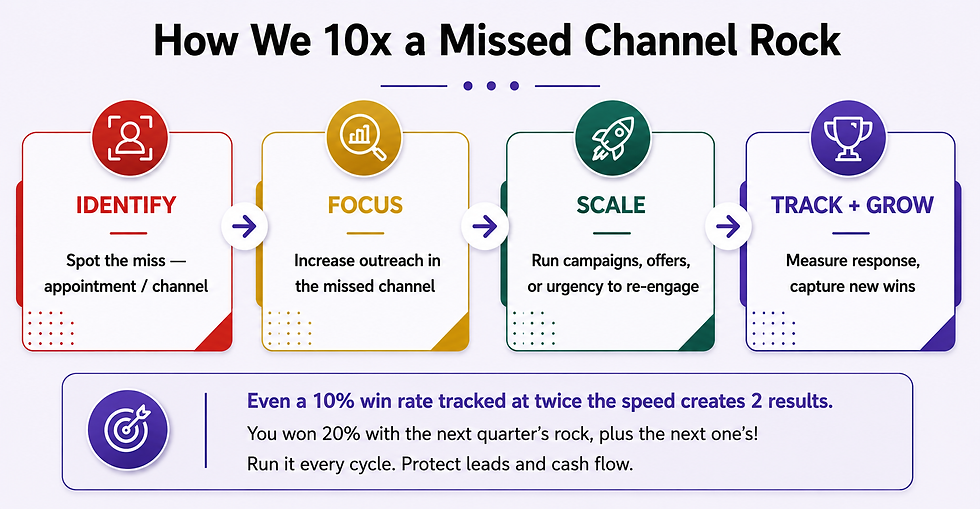
Facebook Ads Shortfall: Spend, Creatives, or Video Testimonials
If LinkedIn is hitting the EOS Rock™ say we are hitting all 10 appointments that's fine. But what if Facebook ads don't hit the 20-appointments-per-week EOS Rock™? Then the solution becomes the question: Do we need to increase the ad spend? Do we need to increase the number of creatives? Do we need to add more video testimonials? All of these are discussed, created as a task, and we come back next week to discuss the same.
Our Channel Troubleshooting Table
Channel | Most common shortfall cause | The fix we IDS™ in the L10 |
Account blocked or invitation-sending feature throttled | Spin up new profiles, increase connection requests, lift comment volume | |
Facebook ads (cold) | Volume miss less than 20 appointments / week | Increase ad spend, refresh creatives, add video testimonials |
Facebook ads (CPA) | Volume hit but cost above $300 / appointment | Audience refinement, hook testing, landing page tightening |
Funnel quality | Fake or non-accredited appointments leaking through | Tighten qualification questions and pre-screening on booking page |
Our Capital-Raising Funnel Scorecard: Who Owns What
Why Not Everything Belongs to the Marketing Agency
We have our own capital-raising funnel Scorecard™ where we have all of these metrics, and we have EOS™ owners for specific Rocks™. Fund managers and the investor relations team own certain metrics. Not everything is owned by the marketing agency or the EOS Implementer™.

Marketing-Owned Metrics vs Fund-Owned Metrics
Marketing agency owns | Fund team owns |
LinkedIn appointments | 2nd and 3rd appointments booked |
Facebook ads appointments | PPM / PandaDocs documents sent |
Instagram + retargeting appointments | Signed agreements |
Cost per appointment | Wires received |
Lead quality (accredited vs not) | Amount raised |
The "Good Problem" Issues That Come From Hitting Your EOS Rocks™
When the Real Issues Are Volume Issues, Not Pipeline Issues
The real ideas and issues from a capital-raising firm come when there is a good number of appointments a good number of phone calls with accredited investors above the anticipated number. Then the IDS™ conversation flips from "how do we generate more?" to "how do we handle this many qualified calls without dropping the ones already in motion?" That is the kind of issue every capital-raising firm wants on the agenda.
The Bottom Line
We craft Rocks we can actually hit backed into from the founder's real raise target. The L10 catches misses early. The IDS™ turns misses into next week's tasks. That is how EOS for capital-raising firms actually works.


Comments