%20(3).png)
EOS Implementation: A Step-by-Step Guide to Rolling Out EOS Without Losing Momentum
- Daniel Madhan
- May 28
- 8 min read

Here's a hard truth most businesses that try EOS™ never actually make it work. They start strong, get excited, then, slowly fade out. Gino Wickman's own numbers back this up: less than 30% of companies that begin EOS implementation hit full traction within 18 months.
The traction problem
Gino Wickman's own numbers back this up: less than 30% of companies that begin EOS implementation hit full traction within 18 months.
The Real Gap: From Reading Traction to Running By It
The problem isn't the system itself. The real problem is the giant gap between finishing the book, Traction™, and actually running your business by it. That gap is where leadership teams lose steam, skip steps, and quietly abandon the whole thing usually without admitting it.
It happens more than you'd think. But here's the good news it doesn't have to happen to you. With the right approach and honest commitment, your team can be part of the rare 30% that actually crosses the finish line.
The First 90 Days of EOS Implementation: Focus Day, Vision Building Day, and What Comes After
The first 90 days aren't about being perfect they're about getting everyone on the same page.

Focus Day: Score Your Six Components Honestly
Focus Day™ is where your leadership team sits down and gets completely honest with themselves. You'll look at 6 key areas of your business: Vision, People, Data, Issues, Process, and Traction. Each area gets a score from 1 to 10, and if your team is truly honest, most scores land somewhere between 3 and 5. That's not failure that gap is actually your game plan.
Vision Building Days: Build the V/TO Without Rushing
Vision Building Days™ 1 and 2 are held 30 days apart for a reason. Together, you'll build your V/TO™ basically a one-page blueprint that captures your Core Values™, your purpose, your big 10-year goal, and what your business looks like three years from now. Here's a trap many teams fall into: rushing Day 2 to fix everything from Day 1. When that happens, your V/TO looks neat on paper, but nobody actually uses it to make real decisions.
Weeks 30 to 90: Where the Real Work Kicks In
From weeks 30 to 90, the real work kicks in. You'll run your first Level 10™ Meetings, build a Scorecard™ to track progress, and set your first Rocks™ the 3 to 5 priorities that matter most this quarter. Most teams play it too safe with their first Rocks because the routine still feels new and unfamiliar. Set bold ones anyway. Showing up consistently, week after week, is exactly what builds the confidence your team needs to trust the whole process.
Self-Implementing vs Hiring an EOS Implementer: Honest Pros and Cons
What Self-Implementing Actually Saves You
Doing EOS on your own can save you money. Hiring a certified EOS implementer can cost between $10,000 and $20,000 a year. If your budget is tight, that can really hurt. However, saving money is the only benefit you get from handling it by yourself.
Why a CEO-as-Facilitator Setup Gets Messy
The real issue is that the person leading the sessions still has a company to manage. When your CEO also acts as the facilitator, things can quickly become messy. Difficult conversations might be avoided, and the Visionary™ may start leading meetings that the Integrator™ should be in charge of. No one wants to challenge the boss in the room, and the boss may not want to be challenged either. While it might seem doable in theory, it often falls apart in reality.
Why an Outside EOS Implementer Changes the Game
It is a game-changer when a third party EOS implementer comes in. They are not concerned with office politics. They have no loyalty to the head of sales or the longtime manager who hates being held accountable. They can push back without it being personal and that's what makes the process work.
The Hybrid Middle Ground for Tight Budgets
But if you're a smaller group on a budget, there's a clever middle ground to consider. Get used to EOS's free tools, workbooks and self-guided resources in the first 60 days. Then, introduce a professional implementer for the Focus Day and both Vision Building Days. You receive professional advice when it's needed the most, but not for every session. It's a viable compromise that actually works.
Self-Implement, Hire, or the Hybrid Middle Ground
Self-Implement | Hire an EOS Implementer | Hybrid Middle Ground |
Saves money - but that's the only benefit | $10,000 to $20,000 a year | Free tools for the first 60 days |
CEO-as-facilitator gets messy; hard conversations avoided | Not concerned with office politics; can push back without it being personal | Bring in a pro for Focus Day + both Vision Building Days |
Rolling Out EOS to Department Teams After Leadership Adopts It
The Mistake: Keeping EOS Stuck at the Top
Here's a mistake almost every company makes in its first year with EOS. Leadership learns the system, gets excited about it, and then just... stops there. They keep it all at the top.
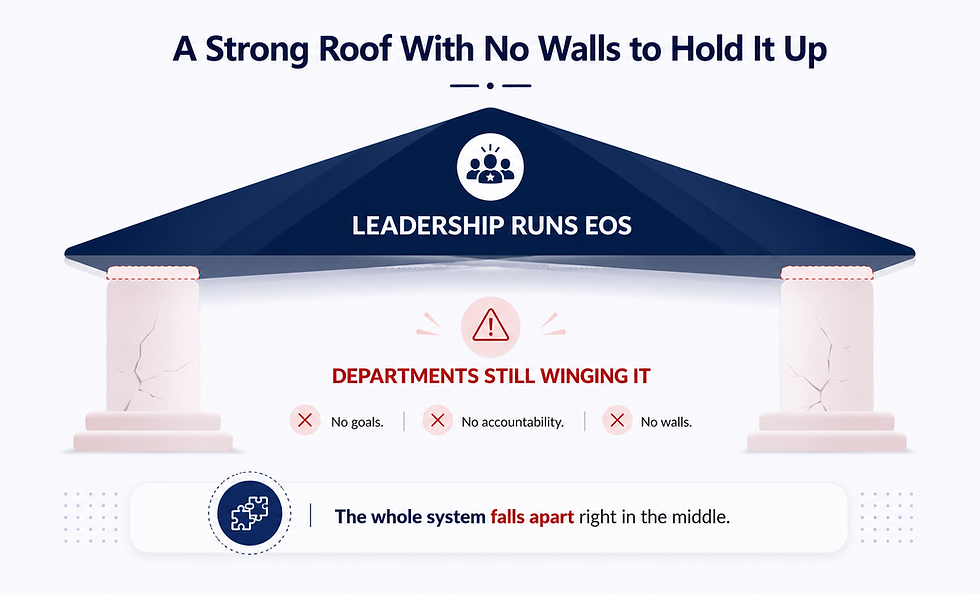
Think about it this way. If your leadership team is tracking Rocks, reviewing a Scorecard, and running tight Level 10 Meetings every week but your sales team is still winging it every Monday morning with no clear goals and no accountability the whole system falls apart right in the middle. You've built a strong roof with no walls to hold it up.
Run It at the Top for One Full Quarter First
So, here's how you do it right. Let your leadership team run EOS for at least one full quarter before you bring it down to department heads. The reason is that there's a real difference between using a tool and being able to teach it. You want your leaders to know it well enough to walk someone else through it with confidence.
Then Cascade the Same Tools to Each Department
After that quarter, each department head gets their own version of the same tools their own Scorecard to track weekly numbers, their own Rocks to focus on each quarter, and their own Level 10 Meeting to keep the team aligned and moving.
Here's the most important rule to remember: every department Rock should directly support at least one company Rock. If a department goal doesn't connect back up to a bigger company priority, it has no business being on the list.
You've built a strong roof with no walls to hold it up.
The Common EOS Implementation Mistakes in Year One (From 12 Real Companies)
After watching 12 companies stumble through their first year of EOS, the same five mistakes kept showing up.
Mistake 1: Rocks That Aren't Real Rocks
Rocks that aren't real Rocks. A Rock is a 90-day goal with a crystal-clear finish line. "Improve customer service" is just wishful thinking. "Launch an NPS survey and hit a score of 50+ by the end of Q3" now that's a Rock. If you can't tell when it's done, it's not a Rock.
Mistake 2: Scorecards With No Owners
Scorecards with no owners. Every number on your Scorecard needs one real human being behind it not a team, or a department. Shared responsibility is just a polite way of saying no responsibility.
Mistake 3: Issue Lists That Never Resolve
Issue lists that never resolve. If the same problem keeps popping up in your IDS™ meetings, you're not solving anything you're just talking in circles. Real solving means the issue disappears for good.
Mistake 4: Treating the V/TO as a Document, Not a Filter
V/TO treated as a document, not a filter. Your Vision/Traction Organizer™ should be your decision-making compass.
Mistake 5: Leadership Team Changes Mid-Implementation
Leadership team changes mid-implementation. Introduce a new leader at month three without re-running Vision Building Day, and you have a problem. That person wasn't involved in the vision building; they just got it handed down to them. That gap silently shatters everything.
The 5 Year-One EOS Implementation Mistakes at a Glance
# | Mistake | The fix |
1 | Rocks that aren't real Rocks | A 90-day goal with a crystal-clear finish line. If you can't tell when it's done, it's not a Rock. |
2 | Scorecards with no owners | One real human being behind every number. Shared responsibility is a polite way of saying no responsibility. |
3 | Issue lists that never resolve | If the same problem keeps popping up, you're talking in circles. Real solving means it disappears for good. |
4 | V/TO treated as a document, not a filter | Your Vision/Traction Organizer should be your decision-making compass. |
5 | Leadership team changes mid-implementation | A new leader at month three without re-running Vision Building Day silently shatters everything. |
Why EOS Implementation Stalls at Month 4-6 and How to Push Through
The Honeymoon Period Always Ends
The first couple of months of operating EOS in your business are thrilling. Everyone is learning new tools, meetings feel fresh, and the whole team is engaged. But at some point between months 4 and 6, that energy slowly subsides. This is not a coincidence it happens to almost every team.

Why Teams Quietly Start Taking Shortcuts
Here is why. People use tools carefully and deliberately when they are brand new. However, once they get comfortable, they begin to take shortcuts without realizing it. Level 10 Meetings are rushed. Rocks, or the big priorities that your team agrees on every quarter, begin to be stretched or simply forgotten. The skills that power the tools start to fall away.
The Awkward Conversation Everyone Avoids
EOS calls this "getting stuck in the weeds," but the real problem runs a little deeper than that phrase suggests. Your team encounters its first truly awkward moment in the EOS structure at some point during this time. Maybe someone is not being held accountable for their role. Perhaps there is a people problem that no one wants to talk about. Perhaps a scorecard number is repeatedly appearing in red, and everyone simply hopes it will correct itself. These are difficult conversations. When they emerge, the simplest solution is to simply stop using the tool that brings them up.
The Fix: Track Your IDS Time Across Three Meetings
The solution is straightforward and requires honesty. Review your team's last three scorecards for the Level 10 Meeting and ask yourself one question: How much time did your team actually spend on IDS? If that time is getting shorter, it's a definite sign that your team is not solving problems, but they are avoiding them. The key to breaking through the wall is to catch that pattern early.
The Enforcement Layer Most EOS Implementations Miss Entirely
Accountability Is the Piece EOS Won't Build For You
EOS hands you a powerful tool. But it won't automatically build a team that actually uses it. That missing piece is accountability and it shows up most clearly in how your leadership team handles the Issues List™. When someone misses a Rock, the natural reaction is to let it slide. Maybe it feels uncomfortable. Maybe you don't want to point fingers. But true EOS discipline means putting that missed Rock straight onto the Issues List, digging into why it happened using the Identify, Discuss, Solve (IDS) method, and fully resolving it.
What the Five-Year EOS Survivors Have in Common
The companies that are still running EOS three, four, five years down the road all share one thing in common: the tools aren't optional. Rocks are visible to everyone. Scorecard numbers get reviewed in every single meeting. Nobody takes accountability personally because it's baked into the structure itself it's just how things work.
That cultural shift is the real difference-maker. It's what separates teams that are still thriving on EOS after five years from the ones that quietly drop it after two years.
The Bottom Line
The companies still running EOS three, four, five years down the road all share one thing: the tools aren't optional.


Comments